Cabinet Lock With Card: The Definitive Guide to RFID and Smart Card Cabinet Security
Complete guide to cabinet lock with card technology covering RFID types, smart card integration, installation, security analysis, and industry-specific applications for electronic card-based cabinet access control.
The Evolution and Fundamentals of Cabinet Lock With Card Technology
A cabinet lock with card represents a paradigm shift in how organizations control access to secured storage. Unlike mechanical locks that require physical keys or code-based electronic locks that depend on memorized numeric sequences, a cabinet lock with card uses radio frequency identification or smart card technology to authenticate users through a contactless credential. The user simply presents their card or fob near the reader surface of the cabinet lock with card, and if the credential is authorized, the lock releases within a fraction of a second.
The underlying technology in a cabinet lock with card has its roots in access control systems developed for commercial building entry in the 1970s and 1980s. As RFID technology miniaturized and decreased in cost, it became practical to embed card readers into locks small enough to fit on cabinet doors and drawers. Today's cabinet lock with card products range from compact units no larger than a traditional mechanical cam lock to sophisticated networked devices that integrate seamlessly with enterprise access control platforms spanning thousands of doors and cabinets across multiple facilities.
The fundamental advantage of a cabinet lock with card over key-based alternatives is credential management flexibility. When a mechanical key is lost, stolen, or not returned by a departing employee, the security of every cabinet that key could open is compromised. Rekeying mechanical locks is expensive and time-consuming. With a cabinet lock with card, administrators can instantly revoke a lost card's access privileges through the management software, and the physical lock hardware requires no modification whatsoever. This capability transforms cabinet security from a static, hardware-bound system to a dynamic, software-managed service.
The user experience of a cabinet lock with card is another significant advantage. Presenting a card takes less than a second and requires no memorization of codes. For users who already carry an ID badge or access card for building entry, that same card can often be programmed to work with compatible cabinet lock with card units, creating a single-credential experience across the entire facility. This convenience factor drives user compliance—when cabinet security is effortless, users are far less likely to circumvent it by leaving cabinets unlocked or sharing credentials.
This comprehensive guide explores every dimension of cabinet lock with card technology, from the radio frequency principles that enable contactless operation to the enterprise integration architectures that make large-scale deployments manageable. Whether you are evaluating a cabinet lock with card for a small office, a hospital pharmacy, a university laboratory, or a multi-site corporate deployment, the detailed technical and practical information in this guide will support informed decision-making throughout the procurement and deployment process.
RFID Technology Behind a Cabinet Lock With Card
The radio frequency identification technology that powers a cabinet lock with card operates across several frequency bands, each with distinct characteristics that affect read range, data transfer speed, and suitability for different applications. Understanding these frequency bands is essential when selecting a cabinet lock with card, as the choice determines compatibility with existing credential populations, performance in the intended installation environment, and the overall security level of the system.
Low frequency RFID, operating at 125 kHz, is the oldest and most widely deployed technology in the cabinet lock with card market. Low frequency credentials, often based on EM4100 or compatible chip protocols, transmit a fixed, unique identifier when energized by the reader field. The read range for a low frequency cabinet lock with card is typically short—one to three centimeters—which is actually advantageous for cabinet applications where the user intentionally holds their card close to the reader. Low frequency signals penetrate non-metallic materials well, so a low frequency cabinet lock with card can often read a card through a wallet or badge holder. However, low frequency credentials are typically read-only and lack the cryptographic capabilities of higher frequency alternatives.
High frequency RFID at 13.56 MHz represents the current mainstream technology for a cabinet lock with card. The most common high frequency standards are MIFARE, developed by NXP Semiconductors, and ISO 14443 and ISO 15693 compliant credentials. A high frequency cabinet lock with card offers several advantages over low frequency: faster data exchange, support for mutual authentication between the card and reader, encrypted communication channels, and the ability to read and write data to the credential. The read range for a high frequency cabinet lock with card is similar to low frequency at one to four centimeters, providing the intentional proximity that cabinet applications require.
Ultra-high frequency or UHF RFID, operating between 860 and 960 MHz, offers dramatically extended read range of up to several meters. While UHF technology powers inventory tracking and supply chain applications, it is generally not well suited for a cabinet lock with card due to the security implications of extended read range. A UHF cabinet lock with card could potentially be triggered by a card that is several meters away, creating a risk of unintended unlocking. Some specialized cabinet lock with card applications do use UHF for hands-free access in environments such as healthcare procedure rooms where staff cannot touch readers due to sterility requirements, but these deployments require careful system design to prevent unauthorized access.
Near Field Communication or NFC, which operates at 13.56 MHz and is compatible with many high frequency RFID standards, extends the cabinet lock with card concept to include smartphones as credentials. An NFC-enabled cabinet lock with card can read credential data from a smartphone running a compatible application, allowing users to access cabinets using a device they already carry. This capability is particularly valuable in environments where issuing and managing physical cards is logistically challenging, such as temporary contractor access or short-term equipment rental scenarios.
The security architecture of a cabinet lock with card varies significantly by technology generation. Basic low frequency systems store access control decisions entirely in the lock itself, with each cabinet lock with card maintaining a local list of authorized card identifiers. When a card is presented, the cabinet lock with card checks the identifier against its internal list and unlocks if a match is found. This standalone mode is simple to deploy but becomes administratively burdensome as the number of locks and users grows. More advanced cabinet lock with card systems use online or semi-online architectures where the lock queries a centralized controller or server for each access decision, enabling real-time credential validation and immediate revocation of lost or stolen cards.
Key Specifications and Features of a Cabinet Lock With Card
The card compatibility of a cabinet lock with card is the most fundamental specification to evaluate. A single-technology cabinet lock with card may support only one card type, such as 125 kHz proximity cards or MIFARE Classic 13.56 MHz cards. Multi-technology readers are increasingly common and can read two or more card types simultaneously, which is valuable when migrating from an older card technology to a newer one, or when the cabinet lock with card must accommodate visitors or contractors who carry different credential types than regular employees. Some multi-technology cabinet lock with card models can read low frequency proximity, high frequency smart cards, and NFC from smartphones through a single reader interface.
The user capacity of a cabinet lock with card determines how many unique cards the lock can recognize. Entry-level standalone models might store a few dozen card identifiers, while advanced networked cabinet lock with card systems can support thousands or tens of thousands of users. The capacity requirement depends on the deployment scenario. A cabinet lock with card on a single file cabinet in a small office might only need to recognize five to ten users. A cabinet lock with card on a shared equipment locker in a large hospital could need to recognize hundreds of staff members. When evaluating capacity, consider not just current needs but anticipated growth over the expected service life of the lock, which is typically five to ten years.
Audit trail functionality in a cabinet lock with card records each access event with a timestamp and card identifier. Standalone cabinet lock with card models store audit records in onboard memory, with capacities typically ranging from several hundred to several thousand events. The audit data must be retrieved periodically, usually through a dedicated programming device, a USB connection, or a Bluetooth interface to a management application. Networked cabinet lock with card models transmit audit events in real time to a central database, providing immediate visibility into access activity and eliminating the risk of losing audit data if a lock is damaged or its memory becomes corrupted.
Power management is a critical consideration for any cabinet lock with card. Battery-powered models, the most common type, typically operate on standard AA or AAA alkaline batteries with service lives ranging from one to two years under typical usage. Power consumption is driven primarily by the RFID reader, which must generate a radio frequency field strong enough to energize a passive card and read its data. Some cabinet lock with card models incorporate power-saving features such as motion sensors that activate the reader only when a user approaches, extending battery life significantly. Hardwired cabinet lock with card models, which receive power through low-voltage wiring from an external power supply or access control panel, eliminate battery replacement requirements but require more complex installation.
The physical construction quality of a cabinet lock with card directly affects both security and longevity. The housing should be constructed from durable materials such as zinc alloy, stainless steel, or impact-resistant engineering polymers. The card reader surface, which endures repeated contact with cards and badges, should resist scratching and wear that could eventually impair reading performance. The internal locking mechanism should operate smoothly and positively, with a bolt or latch that extends fully into the locked position and retracts completely when triggered. A cabinet lock with card that binds, sticks, or produces inconsistent operation will frustrate users and undermine confidence in the security system.
Installing and Configuring a Cabinet Lock With Card
Pre-installation planning for a cabinet lock with card begins with a thorough assessment of the mounting surface. Cabinet doors and drawer fronts vary widely in thickness, material, and construction quality. A cabinet lock with card must be mounted to a surface that can support the lock body and withstand the forces applied during normal operation and any attempted forced entry. Thin or hollow-core cabinet doors may require reinforcement plates or backing panels to provide adequate mounting support. The installation location should also provide clearance for the lock body and any protruding components on the interior side of the door or drawer.
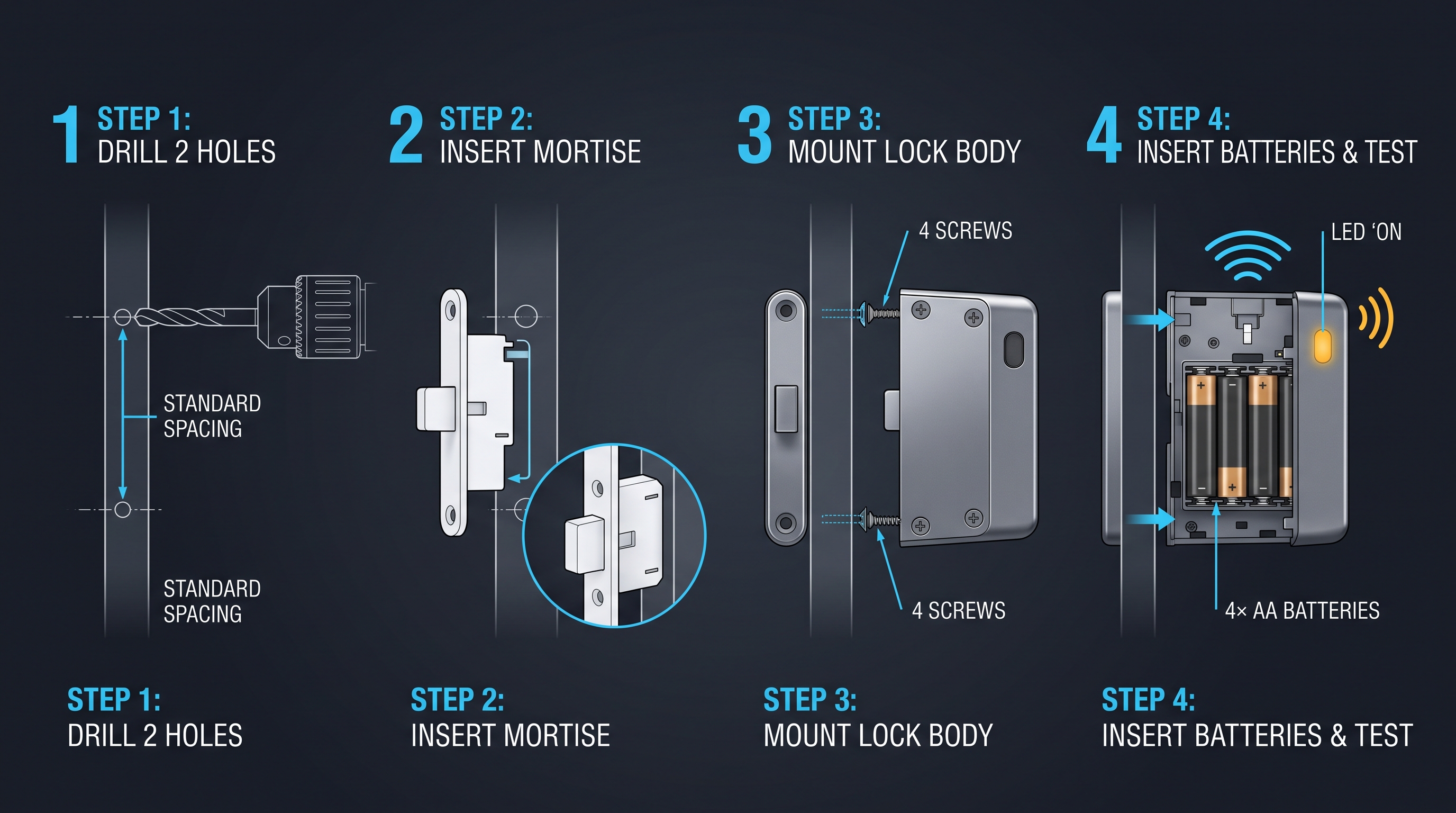
The mounting hole pattern for a cabinet lock with card typically follows one of several industry-standard configurations. Many models use the same hole pattern as traditional mechanical cam locks, allowing a cabinet lock with card to retrofit into existing cabinets without modifying the mounting hole. This compatibility is a significant advantage when upgrading from mechanical to electronic security, as it minimizes installation time and preserves the appearance of the cabinet. Before drilling any new holes, verify that the cabinet lock with card specifications match the existing mounting hole dimensions or the planned new hole layout.
Card enrollment is the process of registering authorized cards with a cabinet lock with card. In standalone mode, enrollment typically involves entering a programming mode through a master card or administrator code, then presenting each user card to the reader for registration. The cabinet lock with card reads and stores the card's unique identifier, associating it with an access privilege. Some standalone models support tiered privileges, where certain cards can function as master cards with the ability to enroll or delete other cards, while regular user cards can only trigger unlocking. Networked cabinet lock with card models typically handle enrollment through the management software, where card numbers are entered manually or captured from a desktop reader connected to the management computer.
Access scheduling is a feature available on more advanced cabinet lock with card models. An access schedule defines when a particular card or group of cards is authorized to unlock the cabinet. A cabinet lock with card in a retail stock room might allow access for all staff during business hours but restrict access to managers only during closing shifts. In a healthcare setting, a cabinet lock with card on a medication storage cabinet might allow nursing staff access during their scheduled shifts only. Access schedules are configured through the management software for networked models or through programming cards and administrative interfaces for standalone models.
Testing a newly installed cabinet lock with card should be comprehensive and systematic. Test each enrolled card to confirm it reliably triggers unlocking. Test that unenrolled cards are rejected. Test the mechanical override if one is provided. Test battery replacement procedures to confirm that card enrollment data is preserved during power interruptions. For networked cabinet lock with card models, test communication with the management server and verify that access events appear in the audit log. Perform all testing with the cabinet door or drawer open to avoid the risk of being locked out if a malfunction is discovered.
Security Analysis of Cabinet Lock With Card Systems
The security posture of a cabinet lock with card depends on both the inherent security properties of the RFID technology and the system-level design choices made by the manufacturer and the deploying organization. A thorough security analysis examines the credential technology, the communication between card and reader, the lock's internal decision-making logic, the physical robustness of the hardware, and the administrative processes governing card issuance and revocation.
Credential cloning is a primary threat vector for any cabinet lock with card. If an attacker can read the data from an authorized card and write it to a blank card or emulation device, they can create a functional duplicate that the cabinet lock with card will accept as legitimate. The difficulty of cloning varies dramatically by technology. Low frequency 125 kHz credentials with fixed identifiers can be cloned using inexpensive hardware widely available online. A cabinet lock with card that relies on these credentials for access decisions provides minimal protection against a technically capable attacker. High frequency smart cards with cryptographic authentication, such as MIFARE DESFire, resist cloning because the card proves its authenticity through a cryptographic challenge-response exchange rather than simply broadcasting a static identifier.
Relay attacks represent a more sophisticated threat where an attacker extends the communication between a legitimate card and a cabinet lock with card over a greater distance. In a relay attack, one device near the legitimate card captures the card's response to reader challenges and relays it to a second device near the cabinet lock with card, which presents it to the reader. The cabinet lock with card believes the legitimate card is present and unlocks. Defending against relay attacks requires distance-bounding protocols that measure the round-trip time of the communication exchange and reject responses that exceed the time expected for a card in close physical proximity. This capability is available in some high-security smart card platforms but is not yet common in cabinet lock with card products.
The physical security of a cabinet lock with card against forced entry follows the same principles as any locking device. The bolt or latch must be sufficiently strong and extend far enough into the frame to resist prying. The lock body must be securely mounted to resist being torn away from the cabinet surface. The reader surface should resist drilling attacks that attempt to access internal wiring and bypass the electronic authentication. A well-designed cabinet lock with card will have all the decision-making electronics on the secure side of the lock, so that even if an attacker destroys the external reader, they cannot simply apply voltage to an actuator wire and trigger unlocking.
Administrative security is often the weakest link in a cabinet lock with card deployment. Cards that are not promptly deactivated when an employee leaves the organization represent standing security vulnerabilities. Master cards or programming cards, if lost or stolen, can allow an attacker to enroll their own cards into the system. Card sharing, where one employee lends their card to another, undermines individual accountability and the integrity of audit trails. A cabinet lock with card system is only as secure as the policies and procedures governing credential lifecycle management. Organizations should establish clear processes for card issuance, periodic revalidation of access privileges, prompt deactivation of lost or separated-employee cards, and regular audits of access records.
Enterprise Integration of Cabinet Lock With Card Systems
Integrating a cabinet lock with card into an enterprise access control system transforms it from an isolated security device into a managed component of the organizational security infrastructure. The integration model depends on the capabilities of both the cabinet lock with card and the access control platform. The most basic integration simply uses the same card technology for both door access and cabinet access, so users carry a single credential. However, the door access system and the cabinet lock with card systems may operate independently, with separate databases and administration interfaces.
Wiegand interface support in a cabinet lock with card enables connection to standard access control panels. The Wiegand protocol, despite its age and limitations—it is unidirectional and unencrypted—remains the most widely supported interface in the access control industry. A cabinet lock with card with a Wiegand output can be wired to an access control panel just like a door reader, with the panel making access decisions and sending a signal back to the cabinet lock with card to unlock. This architecture centralizes access control logic in the panel, which maintains the database of authorized cards and access schedules.
The Open Supervised Device Protocol, or OSDP, addresses the security limitations of Wiegand by providing bidirectional encrypted communication between the reader and the controller. A cabinet lock with card that supports OSDP can communicate securely over longer distances and can report its status, receive configuration updates, and handle more sophisticated interactions than the simple card-read-and-unlock sequence that Wiegand supports. As organizations upgrade their access control infrastructure, specifying OSDP-capable cabinet lock with card hardware ensures compatibility with current and future security standards.
Wireless integration technologies including Bluetooth Low Energy, Wi-Fi, and Z-Wave or Zigbee enable a cabinet lock with card to connect to management systems without dedicated wiring. A wireless cabinet lock with card can be installed in locations where running access control wiring is impractical or prohibitively expensive, such as in historic buildings, across large campuses, or in temporary facilities. Wireless models do require battery power and periodic battery changes, and the wireless connection must be secured against eavesdropping and tampering. The convenience and flexibility of wireless cabinet lock with card deployment often outweighs the battery maintenance requirement for many applications.
Management software integration is the layer where administrators interact with the cabinet lock with card system. The software provides the interface for enrolling cards, managing access privileges, configuring schedules, viewing audit trails, and generating reports. A well-designed management platform for a cabinet lock with card system should integrate with existing identity management systems such as Active Directory or LDAP, HR systems that trigger access changes when employees are hired or terminated, and security information and event management platforms that aggregate security data from across the organization.
Industry Applications for Cabinet Lock With Card Technology
Healthcare environments present some of the most demanding requirements for cabinet lock with card deployment. Hospitals must secure medication cabinets, controlled substance storage, patient records, and expensive medical equipment while ensuring that authorized clinical staff can access these resources instantly when needed for patient care. A cabinet lock with card in a healthcare setting must support the staff ID badges already carried by clinical personnel, eliminating the need for separate credentials. The audit trail capability is critical for regulatory compliance with controlled substance tracking requirements. In emergency situations, the cabinet lock with card must not impede access to life-saving medications and equipment—considerations that typically lead to deployments where locks can be overridden in code-blue or other emergency scenarios.
Higher education institutions deploy a cabinet lock with card across a wide range of applications including laboratory chemical and equipment storage, IT asset cabinets, musical instrument lockers, athletic equipment storage, and faculty research cabinets. Many universities have already invested in campus-wide smart card programs that combine building access, meal plans, library privileges, and payment functions on a single student or staff ID card. A cabinet lock with card that is compatible with this existing campus card infrastructure extends the value of that investment while providing granular security for high-value or hazardous contents. Laboratory safety regulations often require documented access control for hazardous materials storage, making the audit trail of a cabinet lock with card an important compliance tool.
Corporate office environments benefit from cabinet lock with card deployment for securing file cabinets containing personnel records, financial documents, intellectual property, and other confidential materials. The integration of a cabinet lock with card with the corporate badging system means that when an employee's building access is terminated upon separation, their cabinet access is automatically revoked as well. This integration closes a common security gap where separated employees might retain physical keys to file cabinets long after their building access credentials have been deactivated.
Hospitality applications for a cabinet lock with card include guest room safes, minibar cabinets, and staff access to housekeeping supply storage and maintenance equipment lockers. A cabinet lock with card in a hotel guest room safe can be programmed to accept the guest's room key card, providing a seamless experience where the same card that opens the room door also opens the in-room safe. This eliminates the need for guests to remember safe combinations and reduces front desk calls from guests who have forgotten their safe code. The cabinet lock with card can be automatically reprogrammed for each new guest as part of the property management system integration.
Government and defense applications for a cabinet lock with card involve classified document storage, weapons and sensitive equipment armories, and evidence storage for law enforcement agencies. These applications typically require a cabinet lock with card that supports government-issued credentials such as Common Access Cards or Personal Identity Verification cards, which incorporate multiple authentication factors including the card itself, a PIN known only to the cardholder, and biometric data stored on the card. A cabinet lock with card in these environments must meet stringent security standards including FIPS 201 compliance and may require additional certifications for TEMPEST, forced-entry resistance, and environmental durability.
Cabinet Lock With Card Versus Alternative Technologies
Comparing a cabinet lock with card against keypad-based electronic locks illuminates the strengths and trade-offs of each approach. A cabinet lock with card eliminates the need to memorize codes, eliminate the risk of code observation through shoulder surfing, and enables rapid access with a simple tap. However, cabinet lock with card deployment requires that every authorized user possess a compatible card, which adds cost and logistical complexity. A keypad-based lock has zero per-user credential cost—each new user simply learns the code. The choice between cabinet lock with card and keypad often comes down to the existing credential infrastructure: if users already carry access cards, cabinet lock with card leverages that investment. If not, keypad may be more practical.
Biometric cabinet locks using fingerprint, facial recognition, or iris scanning represent another alternative to cabinet lock with card technology. Biometric locks eliminate the credential entirely—the user is the credential. This eliminates the risk of lost or stolen cards and provides very high assurance of user identity. However, biometric cabinet locks are generally more expensive than cabinet lock with card models, may have higher false rejection rates particularly in environments where users wear gloves or have dirty hands, and raise privacy concerns that require careful consideration. Biometric and card technologies are increasingly combined in multi-factor cabinet lock with card units that require both a card and a fingerprint for access.
Mechanical key locks remain the baseline against which electronic alternatives are measured. A mechanical lock is inexpensive, requires no power, and can last for decades with minimal maintenance. Against these advantages, a cabinet lock with card offers credential management flexibility, audit trail capability, integration potential, and the elimination of physical key management. For many organizations, the deciding factor is the hidden cost of key management: the time spent tracking keys, rekeying locks when keys are lost, and managing the logistics of key distribution and collection. A cabinet lock with card eliminates these costs, often delivering a positive return on investment within the first year of deployment despite higher upfront hardware costs.
The mobile credential approach, where smartphones replace physical cards using NFC or Bluetooth communication, represents an emerging alternative to traditional cabinet lock with card technology. Mobile credentials eliminate the cost and environmental impact of plastic cards, enable remote issuance and revocation, and leverage the security features of modern smartphones including device-level encryption and biometric unlock. A cabinet lock with card that supports both physical cards and mobile credentials provides maximum flexibility, allowing a phased transition from cards to phones as the user population adopts mobile credential technology.
Sustainability and Lifecycle Management of Cabinet Lock With Card Deployments
The environmental impact of a cabinet lock with card deployment encompasses manufacturing, operation, and end-of-life disposal. The manufacturing phase includes the extraction and processing of raw materials, the production of electronic components, and the assembly of finished products. A cabinet lock with card contains metals, plastics, and electronic components, each with their own environmental footprint. Manufacturers increasingly publish environmental product declarations or lifecycle assessments that quantify these impacts and demonstrate progress toward sustainability goals.
Operational energy consumption of a cabinet lock with card is dominated by battery usage for battery-powered models and electricity consumption for hardwired models. Battery-powered cabinet lock with card units consume batteries throughout their service life, with the total battery count depending on the lock's power efficiency and the replacement interval. Selecting a cabinet lock with card that maximizes battery life reduces both operational cost and environmental impact. Some manufacturers offer rechargeable battery options or energy harvesting accessories that can reduce or eliminate disposable battery consumption.
End-of-life management for a cabinet lock with card involves the proper disposal or recycling of electronic components, batteries, and materials. Many jurisdictions have regulations governing electronic waste or e-waste disposal that apply to cabinet lock with card units at end of life. Manufacturers with take-back programs simplify compliance by accepting returned units for responsible recycling. When selecting a cabinet lock with card, consider the manufacturer's environmental policies, the availability of recycling information, and whether the product design facilitates disassembly for material recovery.
Lifecycle management of the cards themselves is an important consideration for large cabinet lock with card deployments. Plastic PVC cards have an environmental cost, and large organizations may issue thousands or tens of thousands of cards annually. Card durability affects replacement frequency—cards that delaminate or wear out quickly generate more waste and higher replacement costs. Some organizations are transitioning to mobile credentials specifically to reduce plastic card consumption, while others specify cards made from recycled or bio-based materials. The card lifecycle should be factored into the total cost of ownership and environmental impact assessment for a cabinet lock with card deployment.
Selecting and Procuring a Cabinet Lock With Card: A Structured Approach
The procurement process for a cabinet lock with card should begin with a detailed requirements document that captures all stakeholder needs. Security requirements specify the threat model and minimum acceptable security level. Operational requirements define the number of users, access patterns, and administrative workflows. Technical requirements address compatibility with existing systems, network infrastructure, and IT security policies. Environmental requirements describe the installation conditions that the cabinet lock with card must withstand. Budget requirements establish the total cost parameters including hardware, installation, and ongoing operational costs.
A structured evaluation process for cabinet lock with card vendors should include hands-on testing of candidate products. Request evaluation units and install them in representative locations. Test with the actual cards used by your organization. Verify battery life claims by monitoring evaluation units over time. Evaluate the management software usability with the actual administrators who will use it daily. Test integration with existing access control systems if applicable. The evaluation period should be long enough to identify any reliability issues, usability problems, or feature gaps before committing to a large-scale purchase.
Installation planning for a cabinet lock with card deployment should address the physical installation requirements for each cabinet, the card enrollment and programming process, user training, and the transition from existing locking mechanisms. For retrofits, document the existing lock configuration for each cabinet and verify compatibility with the new cabinet lock with card. For new construction, coordinate with cabinet suppliers to ensure that cabinet specifications accommodate the selected cabinet lock with card model. Develop an installation schedule that minimizes disruption to operations, and plan for contingencies such as unexpected mounting challenges or compatibility issues.
User training is a critical success factor for cabinet lock with card adoption. Users who understand how to operate the lock, who know what to do if their card is not recognized, and who appreciate the security and convenience benefits of the system are more likely to use it correctly and consistently. Training should cover proper card presentation technique, what the various LED indicators and audible signals mean, how to report a lost or stolen card, and the importance of not sharing cards or holding doors open for unauthorized individuals. Refresher training should be provided periodically and as part of new employee onboarding.
Post-deployment support and maintenance planning ensures the long-term success of a cabinet lock with card deployment. Establish a support process for handling user issues such as lost cards, lock malfunctions, and access problems. Maintain a spare inventory of locks, batteries, and programming devices to enable rapid replacement when failures occur. Schedule periodic preventive maintenance including battery replacement, firmware updates, and physical inspection of locks and mounting hardware. Review audit logs regularly to verify that the cabinet lock with card system is being used as intended and that access patterns are consistent with security policies.
This definitive guide to cabinet lock with card technology was last updated on August 3, 2026. Technology specifications, product features, and pricing are subject to change. Always verify current information with manufacturers and conduct site-specific assessments before procurement. For personalized recommendations on cabinet lock with card solutions for your specific application, contact the CabinetLock Security Team or consult with a qualified physical security professional.
Resources and Further Reading
- ISO/IEC 14443: Identification Cards — Contactless Integrated Circuit Cards — Proximity Cards
- ISO/IEC 15693: Identification Cards — Contactless Integrated Circuit Cards — Vicinity Cards
- NIST SP 800-73: Interfaces for Personal Identity Verification
- SIA OSDP Standard v2.2: Open Supervised Device Protocol
- GS1 EPCglobal UHF RFID Standards
Not sure which sensor fits your project?
Talk to our mmWave application engineers for a free consultation.
Find the right presence sensor for your hotel project
Compare the 3 protocols, check hotel-specific case studies, and download the installation guide
Related products
3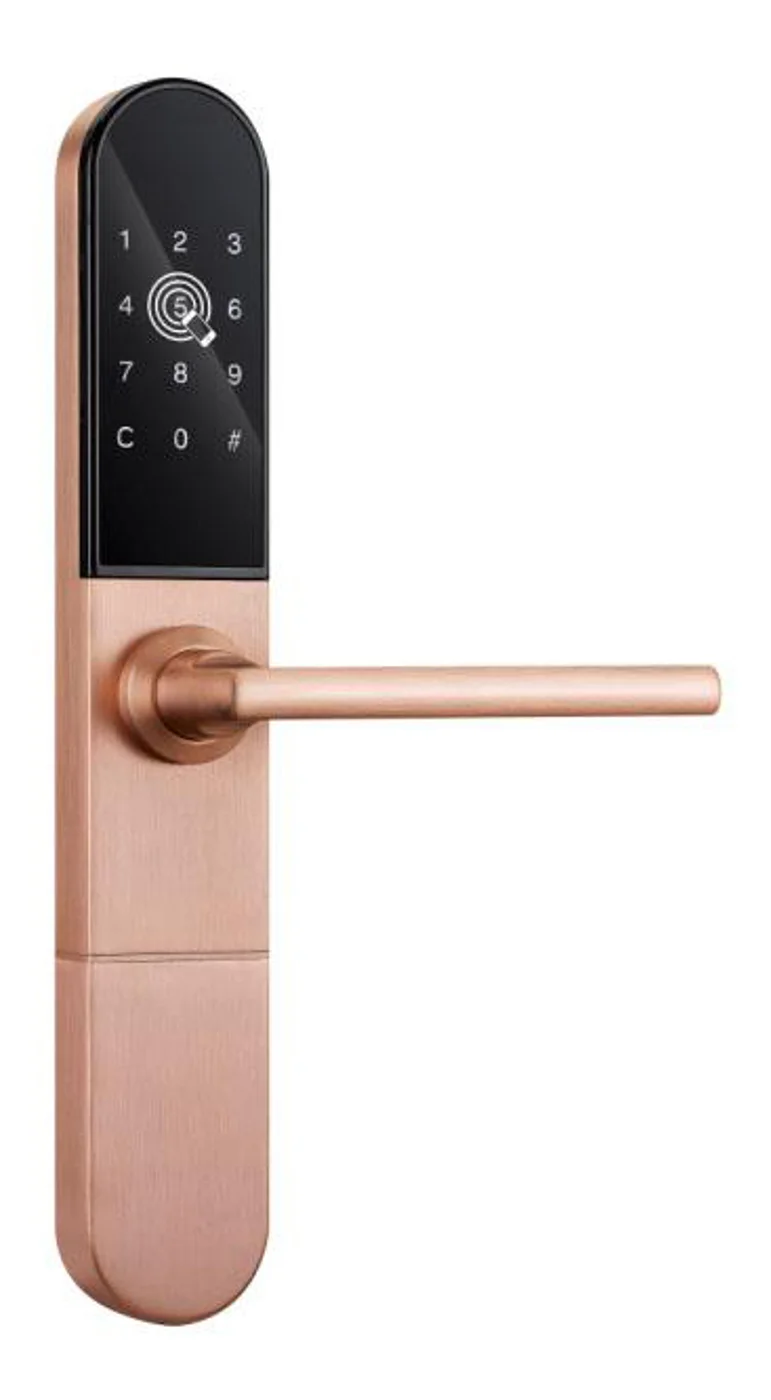
Smart Cabinet Lock — App-Managed, Multi-Site Dashboard
App-managed smart cabinet lock for office, parcel, and multi-site fleets. BLE app dashboard, audit trail, remote unlock, no per-lock server. Higher-tier chassis.
This page already points to it as the next recommended reference.
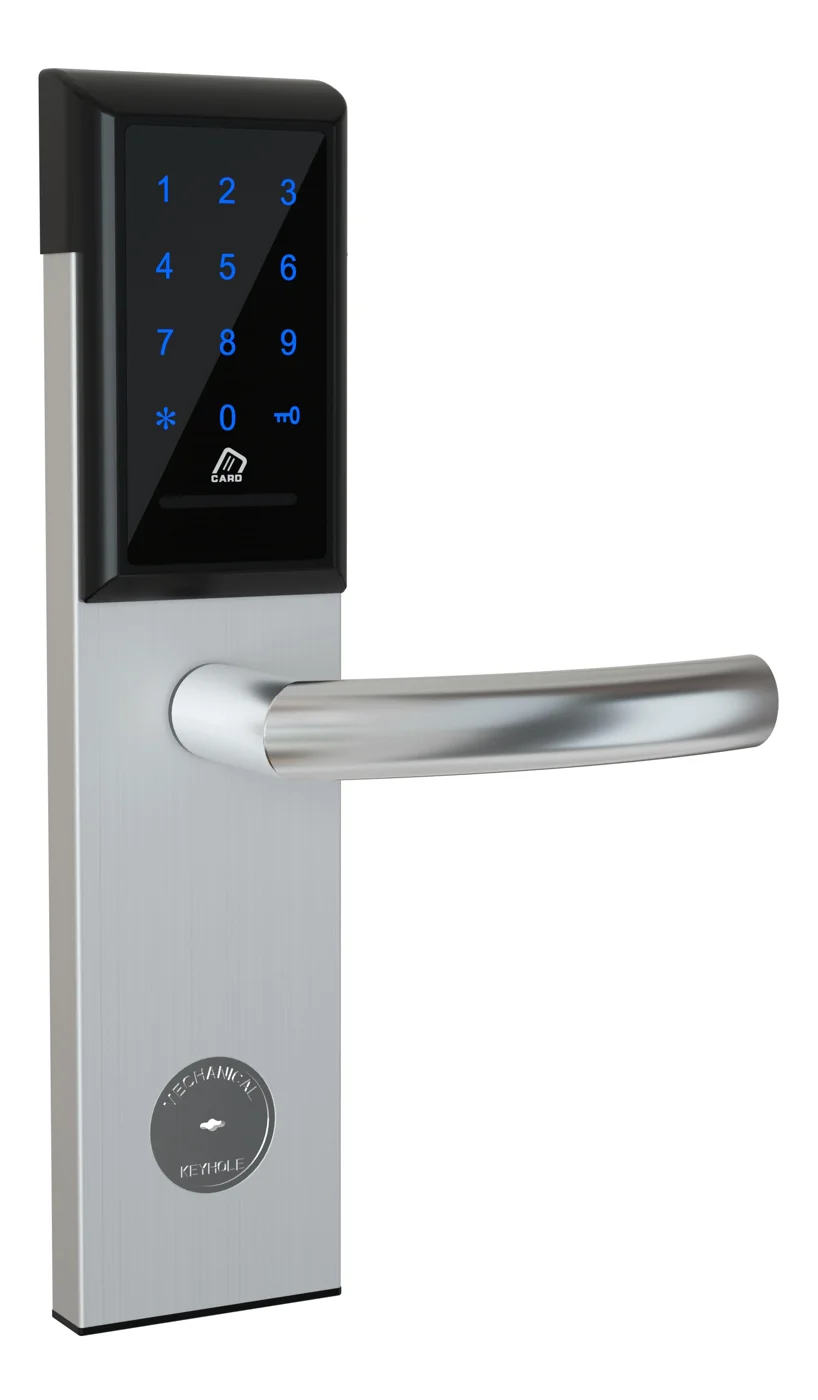
Office Cabinet Lock — PIN + Card for Filing & Pedestals
Offline PIN + card office cabinet lock for filing cabinets, pedestals, and drawers. Battery-powered 5-minute retrofit, no WiFi, no key management. CE/FCC/RoHS.
This page already points to it as the next recommended reference.
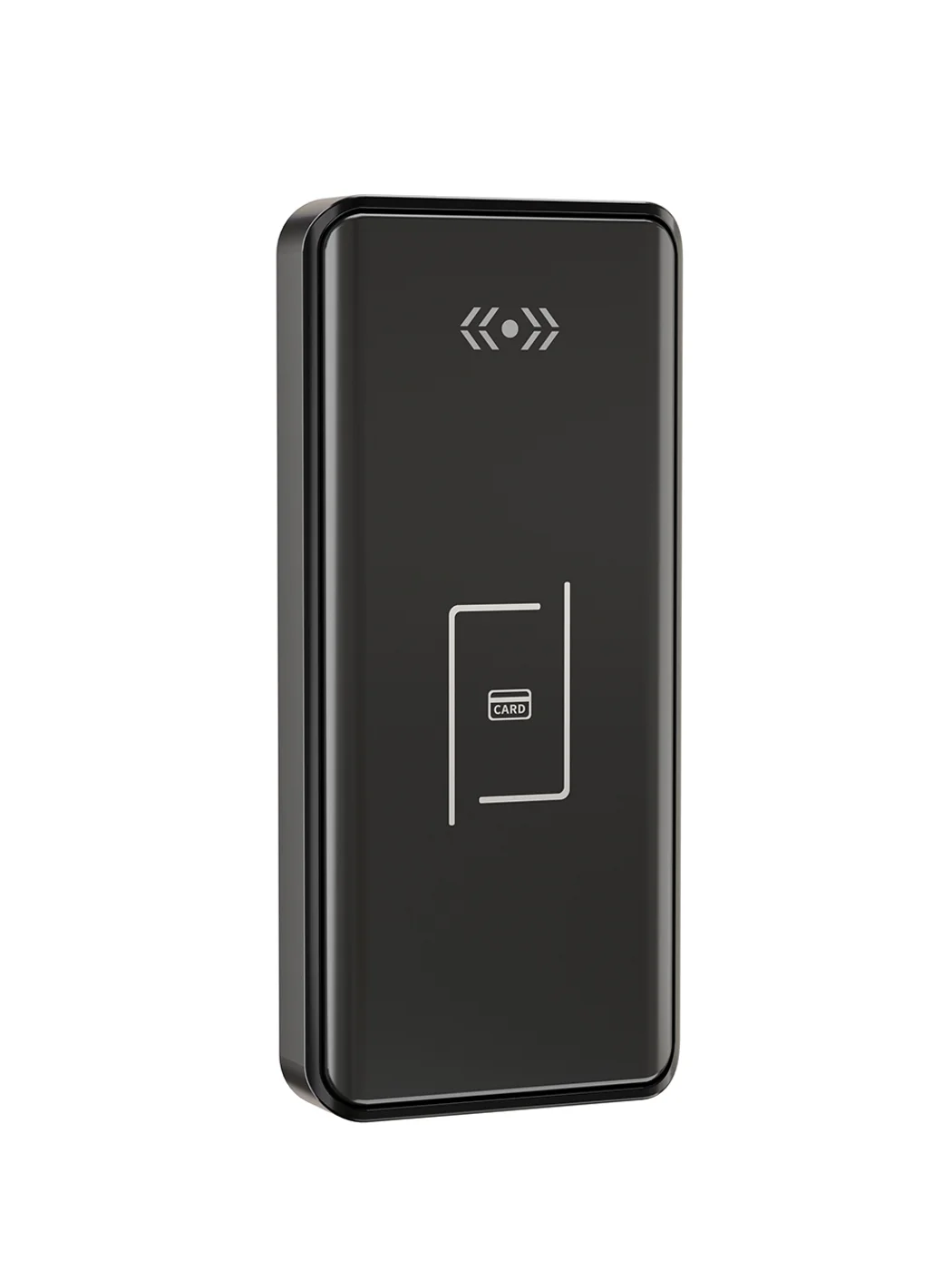
Gym Locker Lock — Offline Card, No WiFi Required
Offline card gym locker lock for fitness and pool lockers. MIFARE card, battery-powered 5-minute retrofit, no WiFi or server. Zinc alloy body, CE/FCC/RoHS.
This page already points to it as the next recommended reference.
Related blog posts
3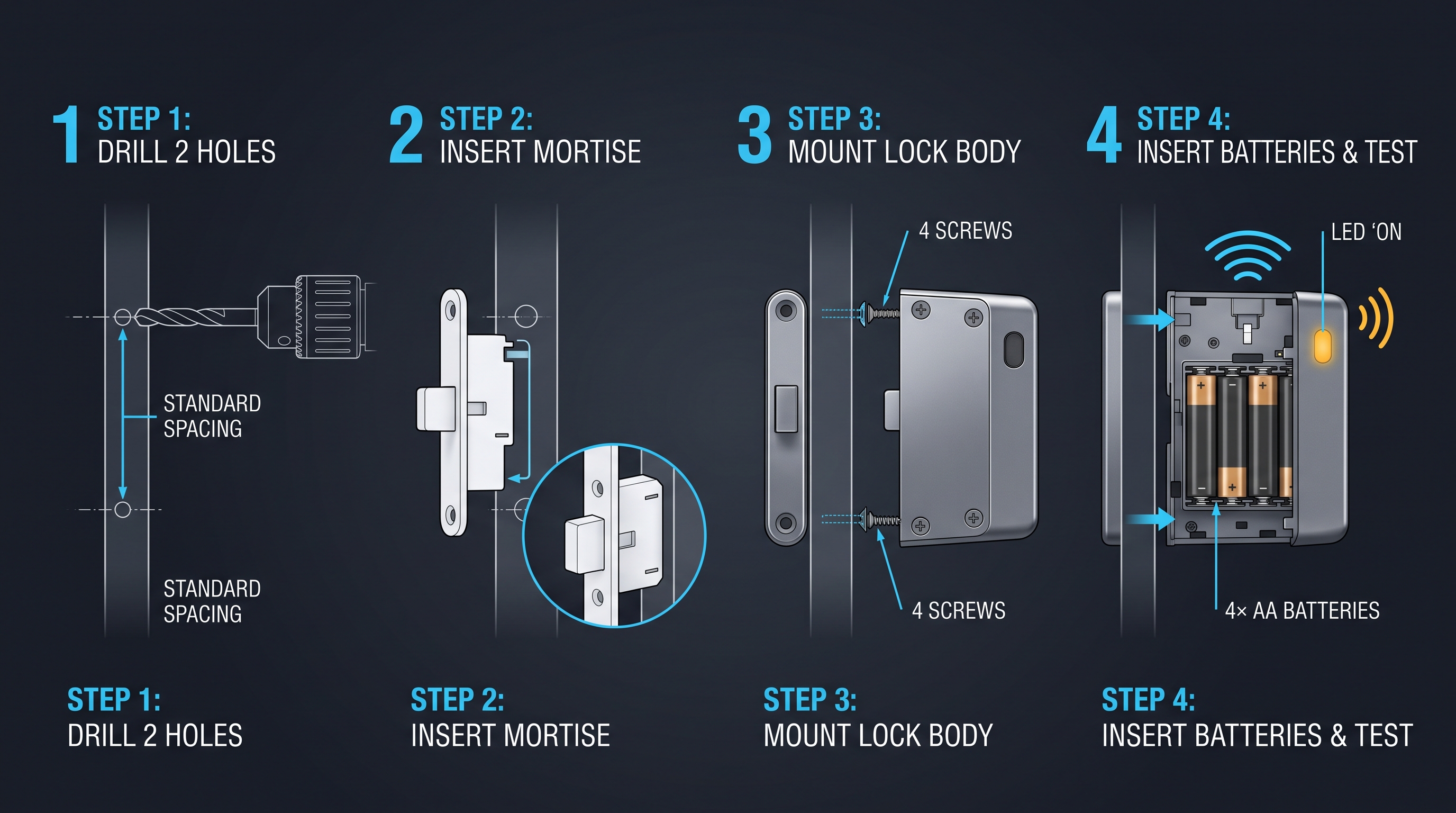
Electronic Cabinet Access: The Complete Guide to Digital Cabinet Entry
Electronic cabinet access replaces keyed locks with digital credentials, generating an access record and letting admins add or revoke users without touching hardware; this guide covers keypad, RFID, biometric, and connected electronic cabinet access methods.
It supports the same product context: Smart Cabinet Lock — App-Managed, Multi-Site Dashboard, Office Cabinet Lock — PIN + Card for Filing & Pedestals, Gym Locker Lock — Offline Card, No WiFi Required.
Display Cabinet Lock: The Complete Guide to Securing Glass Showcases and Retail Display Cabinets
Learn how a display cabinet lock secures glass showcases and retail displays. Compare electromagnetic, RFID, and keyed display cabinet lock types for any application.
It supports the same product context: Smart Cabinet Lock — App-Managed, Multi-Site Dashboard, Office Cabinet Lock — PIN + Card for Filing & Pedestals, Gym Locker Lock — Offline Card, No WiFi Required.
Electronic Access Cabinet: The Complete Guide to Smart Locking Enclosures
Explore electronic access cabinet systems with RFID, Bluetooth, PIN, and biometric control. Learn about powered enclosures for IT, healthcare, and evidence management.
It supports the same product context: Smart Cabinet Lock — App-Managed, Multi-Site Dashboard, Office Cabinet Lock — PIN + Card for Filing & Pedestals, Gym Locker Lock — Offline Card, No WiFi Required.
Specify your hotel project with our engineers
Send your room count, ceiling type, and protocol preference. We will return a sample plan and quote within 24 business hours.
- Move from general guidance into a product or application discussion.
- Use RFQ when pricing, drawings, MOQ, or launch timing needs structure.
- Keep a direct contact path visible for fast clarifications and handoff.