Cam Lock Elektronik: Memodernisasi Kunci Kabinet Andalan
Cam lock elektronik memadukan bentuk klasik cam lock dengan kredensial RFID, keypad, dan BLE. Kompatibel retrofit lubang silinder standar. Panduan lengkap.
Cam lock elektronik adalah versi yang dikendalikan secara elektronik dari cam lock klasik, menggantikan silinder berkunci dengan pembaca, mikrokontroler, dan rakitan cam bermotor yang pas dengan lubang 16 hingga 25 milimeter yang sama seperti yang digunakan cam lock mekanis pada kabinet, loker, kotak pos, dan etalase pajangan. Cam lock elektronik menerima kredensial seperti lencana RFID 13.56 MHz (MIFARE, DESFire, iCLASS), kartu prox 125 kHz, kode PIN pada keypad, atau sinyal Bluetooth Low Energy 5.0 dari smartphone, dan memutar cam 90 hingga 180 derajat dengan motor DC kecil atau solenoid untuk mengunci dan membuka pintu kabinet. Daya tahan baterai pada dua hingga empat sel AA berkisar 12 hingga 24 bulan, dan kapasitas kredensial umumnya 100 hingga 1.000 pengguna dengan 1.000 hingga 10.000 peristiwa audit tersimpan di flash. Cam lock elektronik tersedia dengan panjang ekor cam 12 hingga 80 milimeter untuk menyesuaikan setiap kedalaman rangka kabinet, dan membawa sertifikasi CE, FCC, UL 294, dan ANSI/BHMA A156.25 dengan enkripsi AES-128 atau AES-256 pada pertukaran kredensial.
Apa Itu Cam Lock Elektronik?
Cam lock elektronik adalah pengganti langsung dari cam lock mekanis yang mempertahankan bentuk dasar cam lock — badan silindris, ekor cam yang berputar untuk mencengkeram rangka kabinet, dan pelat muka — sambil menggantikan silinder berkunci dengan pembaca kredensial elektronik dan aktuator bermotor. Cam lock elektronik merupakan evolusi elektronik dari salah satu jenis kunci tertua dan paling banyak digunakan di industri furnitur dan kabinet. Cam lock mekanis telah mengamankan lemari arsip, loker, kotak kas, kotak pos, mesin penjual otomatis, dan etalase pajangan selama lebih dari satu abad karena sederhana, murah, dan ringkas. Cam lock elektronik mempertahankan keunggulan tersebut sekaligus menambahkan kemampuan keamanan dan manajemen modern yang dibutuhkan organisasi saat ini.
Pencapaian rekayasa yang membedakan dari cam lock elektronik adalah kemampuannya menghadirkan fungsi elektronik dalam amplop dimensi cam lock mekanis. Antena pembaca, mikrokontroler, motor, dan baterai harus semuanya muat di dalam badan yang tidak lebih besar dari silinder kunci mekanis, dan ekor cam tetap harus berputar pada 90 hingga 180 derajat yang sama untuk mencengkeram rangka kabinet. Kendala pengemasan yang ketat inilah yang menjadikan cam lock elektronik sebagai kunci furnitur elektronik yang paling kecil, paling ringan, dan termurah. Cam lock elektronik adalah jalur peningkatan alami bagi puluhan juta kabinet yang sudah dilengkapi lubang cam lock mekanis.
Cam lock elektronik melayani dua pasar yang berbeda. Pasar retrofit menggantikan cam lock mekanis yang ada pada furnitur terpasang, menggunakan lubang bor dan pola sekrup yang sama tanpa pengerjaan tambahan sama sekali. Pasar OEM memasok cam lock elektronik kepada produsen kabinet, loker, dan furnitur yang memasangnya di pabrik. Di kedua pasar, proposisi nilainya identik: tidak ada kunci untuk disalin, tidak ada silinder untuk di-rekey, jejak audit lengkap, dan manajemen melalui platform perangkat lunak. Cam lock elektronik adalah titik masuk berbiaya rendah ke dalam keamanan kabinet elektronik, dan menjadi kunci elektronik pertama yang diterapkan banyak organisasi.
Cam lock elektronik sering kali menjadi pilihan yang tepat ketika kesesuaian mekanis menjadi kendala utama. Lemari arsip dengan lubang 20 milimeter dan rangka dangkal tidak dapat menerima kunci pintu besar atau kunci furnitur berukuran penuh, tetapi dapat menerima cam lock elektronik. Etalase pajangan berpintu kaca membutuhkan pelat muka ringkas dan cengkeraman cam dari cam lock elektronik. Deretan loker dengan spesifikasi cam lock seragam dapat ditingkatkan satu loker demi satu loker. Untuk aplikasi-aplikasi ini, cam lock elektronik bukanlah kompromi; ia adalah solusi terbaik yang tersedia dalam bentuk faktor yang ditentukan oleh furnitur.
Anatomi Cam Lock Elektronik
| Komponen | Cam Lock Mekanis | Cam Lock Elektronik |
|---|---|---|
| Pelat muka | Lubang kunci dan silinder | Pembaca: zona RFID, keypad, atau BLE |
| Badan | Silinder kuningan atau seng | Seng atau alloy, elektronik tersegel |
| Aktuator | Pengguna memutar kunci | Motor atau solenoid memutar cam |
| Ekor cam | Baja, panjang tetap | Baja, panjang dapat disesuaikan |
| Daya | Tidak ada | Sel AA, Li-ion, atau PoE |
| Keamanan | Risiko duplikasi kunci | Enkripsi kredensial AES-128/256 |
| Audit | Tidak ada | 1.000 hingga 10.000 peristiwa tersimpan |
Cara Kerja Cam Lock Elektronik
Cam lock elektronik bekerja dengan gerakan fundamental yang sama seperti leluhur mekanisnya: ekor cam berputar yang mengayun ke pengait pada rangka kabinet untuk mengunci, dan keluar dari pengait itu untuk membuka. Perbedaannya terletak pada sumber tenaga. Pada cam lock mekanis, tangan pengguna memutar kunci, yang memutar cam langsung melalui silinder. Pada cam lock elektronik, pengguna menunjukkan kredensial, kontroler memvalidasinya, dan motor DC kecil atau solenoid memutar ekor cam melalui sudut yang diperlukan. Waktu pembukaan dari penyajian kredensial hingga rotasi cam umumnya 200 hingga 800 milidetik, lebih cepat daripada meraba-raba mencari kunci.
Ekor cam adalah antarmuka dengan rangka kabinet, dan geometrinya menentukan cara kunci mencengkeram. Ekor cam memiliki panjang, umumnya 12 hingga 80 milimeter, yang harus menjangkau pengait rangka saat cam diputar ke posisi terkunci. Ekor cam memiliki offset, sehingga cam berputar di sekitar poros silinder tetapi ujung ekor menyapu lingkaran yang beririsan dengan rangka. Beberapa model cam lock elektronik menggunakan cam dua sisi dengan ekor di kedua sisi badan, memungkinkan kunci yang sama mencengkeram rangka di kiri atau kanan kabinet. Ekor cam dapat disesuaikan pada sebagian besar model — dapat digeser sepanjang spline dan dijepit — sehingga satu cam lock elektronik cocok untuk beragam geometri kabinet.
Alur validasi dan audit pada cam lock elektronik mengikuti arsitektur yang sama seperti kunci kabinet elektronik lainnya. Pembaca menangkap kredensial, kontroler memvalidasinya terhadap basis data lokal dan kebijakan jadwal apa pun, dan jika berhasil motor bergerak serta peristiwa dicatat. Peristiwa disimpan di flash dan dikirimkan ke platform manajemen melalui BLE, Zigbee, atau WiFi. Basis data kredensial mendukung 100 hingga 1.000 pengguna dalam memori lokal kunci, dan platform manajemen dapat menyediakan, mencabut, dan menjadwalkan kredensial dari jarak jauh. Cam lock elektronik adalah perangkat akses elektronik penuh yang kebetulan memakai dimensi cam lock.
Pengelolaan daya menjadi kritis pada cam lock elektronik karena paketnya begitu kecil. Kompartemen baterai, umumnya dua atau empat sel AA, harus muat di dalam badan kunci sambil menyisakan ruang untuk motor dan elektronik. Arus motor untuk satu rotasi cam adalah 200 hingga 400 mA selama 100 hingga 300 milidetik, dan kontroler tidur pada level mikroampere di antara operasi. Dengan penggunaan tipikal 20 hingga 50 pembukaan per hari, cam lock elektronik bertahan 12 hingga 24 bulan dengan satu set sel alkalin. Beberapa model menggunakan paket Li-ion isi ulang dengan port pengisian USB-C, yang praktis untuk loker dan mesin penjual otomatis dengan penggunaan tinggi di mana baterai akan sering diganti.
Urutan Operasi Cam Lock Elektronik
- Kredensial disajikan ke pembaca: ketukan RFID, entri PIN, atau sinyal BLE.
- Kontroler memvalidasi kredensial terhadap basis data lokal dan jadwal.
- Jika terotorisasi, motor menyala dan memutar ekor cam ke posisi terbuka.
- Laci atau pintu terbuka; peristiwa pembukaan ditulis ke log audit flash.
- Saat pintu ditutup, motor memutar ekor cam kembali ke posisi terkunci.
- Peristiwa dikirim ke platform manajemen saat tautan radio memungkinkan.
- Jika kredensial tidak valid, peristiwa penolakan dicatat dan penghitung percobaan ulang bertambah.
Cam Lock Elektronik vs Cam Lock Mekanis
Perbandingan antara cam lock elektronik dan cam lock mekanis adalah ilustrasi paling jelas dari nilai akses elektronik. Cam lock mekanis berharga 3 hingga 15 USD, tidak membutuhkan daya, dan tidak memiliki mode kegagalan selain keausan mekanis. Namun keamanannya dibatasi oleh kunci fisik: kunci apa pun dapat disalin dalam hitungan menit di toko perangkat keras, kunci yang hilang memaksa rekey silinder dengan biaya 30 hingga 100 USD ditambah jasa, dan tidak ada catatan siapa yang membuka kabinet. Cam lock elektronik berharga 50 hingga 200 USD, membutuhkan baterai, dan menambahkan firmware sebagai item perawatan. Sebagai gantinya, ia memberikan ketahanan tak terbatas terhadap duplikasi kunci, pencabutan kredensial tanpa biaya, jejak audit lengkap, dan manajemen jarak jauh.
| Atribut | Cam Lock Mekanis | Cam Lock Elektronik |
|---|---|---|
| Biaya perangkat keras | 3 hingga 15 USD | 50 hingga 200 USD |
| Daya | Tidak ada | 12 hingga 24 bulan dengan sel AA |
| Biaya rekey | 30 hingga 100 USD + jasa | Nol, pencabutan perangkat lunak |
| Jejak audit | Tidak ada | 1.000 hingga 10.000 peristiwa |
| Manajemen kunci | Fisik, tanpa akhir | Digital, seketika |
| Kesesuaian retrofit | Alami | Lubang 16 hingga 25 mm yang sama |
| Postur keamanan | Risiko duplikasi kunci | Kredensial AES-128/256 |
| Manajemen jarak jauh | Tidak ada | Platform BLE, Zigbee, WiFi |
Perbandingan biaya menjadi menguntungkan cam lock elektronik dengan sangat cepat. Perusahaan dengan 100 loker, yang masing-masing diakses beberapa pengguna setiap hari, akan mengalami kehilangan kunci dan pergantian staf yang memicu peristiwa rekey. Dengan hanya dua peristiwa rekey per loker selama lima tahun, armada cam lock mekanis menghasilkan biaya rekey 6.000 hingga 20.000 USD. Armada cam lock elektronik menghasilkan biaya rekey nol. Premi perangkat keras awal sekitar 10.000 USD kembali pada tahun ketiga atau keempat, setelah itu armada elektronik lebih murah dioperasikan dan secara tambahan menyediakan kemampuan audit serta manajemen yang tidak dapat dihasilkan armada mekanis dengan harga berapa pun.
Perbedaan operasionalnya sama pentingnya. Dengan cam lock mekanis, karyawan baru membutuhkan kunci, dan satu-satunya cara mendapatkannya adalah menggandakan kunci cadangan atau melakukan rekey silinder, keduanya membutuhkan waktu dan uang. Dengan cam lock elektronik, kredensial karyawan disediakan di platform manajemen dalam hitungan detik, dan akses diberikan ke seluruh deretan loker atau armada kabinet secara seketika. Ketika karyawan keluar, kredensial dicabut secara global. Tim fasilitas tidak pernah menyentuh kunci lagi. Bagi organisasi mana pun dengan pergantian karyawan atau akses bersama, keunggulan operasional inilah faktor penentunya.
Kapan Mempertahankan Cam Lock Mekanis
Ada alasan yang sah untuk mempertahankan cam lock mekanis. Kabinet yang menyimpan barang bernilai rendah, dibuka oleh satu orang, dan tidak pernah berganti pengguna tidak membenarkan biaya elektronik. Proyek dengan anggaran terbatas dan tanpa persyaratan kepatuhan dapat mengalokasikan dananya untuk kontrol keamanan lain. Dalam kasus tersebut, cam lock mekanis berkualitas tinggi dengan keyspace terbatas dan penerbitan kunci terkontrol adalah pilihan yang wajar. Namun ambang untuk memilih mekanis lebih tinggi daripada kelihatannya, karena penghematan audit, manajemen, dan rekey dari cam lock elektronik terakumulasi sepanjang umur layanan kunci selama satu dekade.
Pilihan Kredensial Cam Lock Elektronik
Cam lock elektronik mendukung berbagai jenis kredensial, dan pilihannya bergantung pada pengguna, infrastruktur lencana yang ada, serta lingkungan penerapan. RFID 13.56 MHz adalah opsi paling umum karena memanfaatkan kembali lencana korporat dan berfungsi dengan tangan bersarung. Proximity 125 kHz adalah opsi untuk sistem lencana lawas tetapi lemah terhadap kloning dan sebaiknya dihindari untuk data teregulasi. Entri PIN pada keypad tidak membutuhkan perangkat keras pengguna dan berfungsi sebagai kredensial cadangan atau pengunjung yang sangat baik. Kredensial smartphone Bluetooth Low Energy populer untuk loker yang menghadap konsumen dan kantor modern tempat pengguna selalu membawa ponsel. Biometrik sidik jari tersedia pada model cam lock elektronik kelas atas untuk aplikasi dua faktor dan keamanan tinggi.
Dukungan multi-kredensial menjadi pembeda di antara model cam lock elektronik. Model yang hanya mendukung RFID memaksa setiap pengguna membawa lencana. Model yang mendukung RFID plus PIN plus BLE dapat melayani staf dengan lencana, pengunjung dengan kode PIN, dan manajer dengan pembukaan berbasis ponsel, semuanya melalui pembaca yang sama. Pelat muka pembaca menjadi satu-satunya titik interaksi, dan basis data kredensial menetapkan jenis kredensial yang diizinkan bagi setiap pengguna. Fleksibilitas ini bernilai di lingkungan pengguna campuran seperti ruang co-working, universitas, atau rumah sakit, tempat populasi berbeda secara sah menggunakan kredensial berbeda.
Pembaca kredensial pada cam lock elektronik adalah modul tersegel yang menghadap pengguna. Untuk pembaca RFID, koil antena berada di belakang pelat muka dan membaca lencana pada jarak 10 hingga 50 milimeter. Untuk keypad, grid sentuh kapasitif dicetak pada pelat muka. Untuk model BLE, antena radio dityetel untuk bentuk faktor kecil kunci, dan aplikasi ponsel menangani interaksi pengguna. Modul pembaca harus tersegel untuk mencegah masuknya debu dan kelembapan, dan pelat muka harus dapat dibersihkan dengan produk yang sama seperti yang digunakan pada kabinet. Pembaca cam lock elektronik adalah antarmuka utama pengguna, sehingga ergonomi dan keandalannya berdampak langsung pada kepuasan.
Jenis Kredensial dan Pertimbangan untuk Cam Lock Elektronik
| Kredensial | Pembaca | Keamanan | Perangkat Keras Pengguna | Penggunaan Terbaik |
|---|---|---|---|---|
| RFID 13.56 MHz | Koil, jangkauan 10-50 mm | AES-128, autentikasi timbal balik | Lencana korporat | Enterprise, akses staf |
| Prox 125 kHz | Koil, jangkauan 10-30 mm | Lemah, UID statis | Lencana lawas | Sensitif biaya, risiko rendah |
| PIN | Keypad kapasitif | Bergantung panjang | Tidak ada | Pengunjung, cadangan |
| BLE smartphone | Radio BLE 5.0 | AES-128, terikat perangkat | Ponsel perusahaan | Loker konsumen, kantor |
| Sidik jari | Sensor kapasitif | Biometrik | Jari terdaftar | Dua faktor, keamanan tinggi |
| NFC virtual | Antena NFC | AES-128, secure element | Dompet ponsel | Jalur kredensial modern |
Instalasi Cam Lock Elektronik
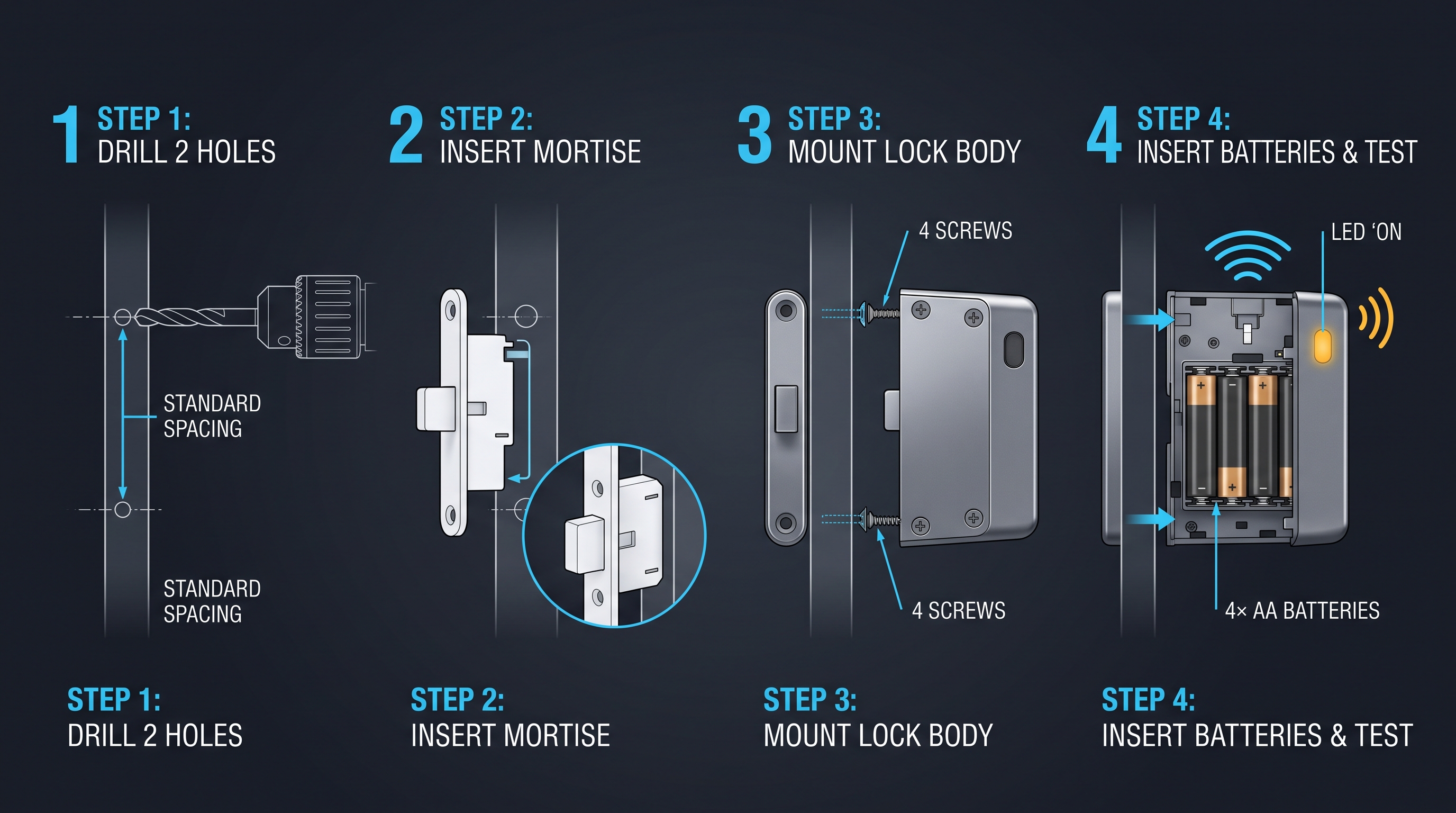
Memasang cam lock elektronik adalah pekerjaan retrofit kunci kabinet elektronik yang paling cepat karena bentuk faktornya sama persis dengan cam lock mekanis. Pemasang melepas cam lock mekanis yang ada dengan kunci pas atau puller, mengukur lubang dan panjang ekor cam, lalu memasukkan cam lock elektronik ke lubang yang sama. Badan kunci diamankan dengan pola mur dan sekrup yang sama, ekor cam disesuaikan dengan kedalaman rangka kabinet, dan baterai dipasang. Total waktu pemasangan mekanis adalah 10 hingga 20 menit per unit, menjadikan cam lock elektronik kunci elektronik termudah untuk diretrofit di seluruh armada besar kabinet, loker, atau kotak pos.
Penyesuaian ekor cam adalah langkah mekanis yang kritis. Panjang ekor cam harus cukup agar ujung yang berputar dapat menjangkau dan mencengkeram rangka kabinet saat cam berada di posisi terkunci. Ekor cam yang terlalu pendek berarti pintu dapat dibuka dengan dibobol. Ekor cam yang terlalu panjang berarti cam macet terhadap rangka atau bagian belakang kabinet, menyebabkan motor terjepit. Sebagian besar model cam lock elektronik menggunakan ekor cam berspline yang bergeser sepanjang poros aktuator dan terkunci dengan sekrup penahan atau klip. Pemasang memosisikan ekor sehingga pada posisi terkunci ujungnya tumpang-tindih dengan pengait rangka sebesar 4 hingga 8 milimeter, dan pada posisi terbuka ujungnya sepenuhnya bebas dari rangka.
Pengaturan elektronik menambahkan pendaftaran kredensial dan registrasi platform. Pemasang menyalakan kunci, memasuki mode pendaftaran dengan tombol tersembunyi atau kredensial administrator, dan mendaftarkan administrator pertama. Kunci kemudian dipasangkan dengan gateway atau dihubungkan ke WiFi, dan diregistrasikan di platform manajemen dengan nomor seri serta lokasinya. Kredensial uji disediakan dan siklus buka-kunci penuh dijalankan. Untuk pemasangan armada, proses berulang di setiap kabinet, tetapi langkah pendaftaran biasanya lebih cepat daripada langkah mekanis. Pemasang terampil dapat meretrofit 20 hingga 30 unit cam lock elektronik per hari, termasuk pendaftaran dan pengujian.
Langkah Instalasi Cam Lock Elektronik
- Lepas cam lock mekanis yang ada dengan kunci pas atau puller.
- Ukur diameter lubang dan panjang ekor cam yang dibutuhkan rangka.
- Pilih dan sesuaikan ekor cam pada cam lock elektronik agar cocok.
- Masukkan badan kunci ke lubang dan amankan dengan mur serta sekrup yang disediakan.
- Pasang baterai, amati urutan boot LED, dan verifikasi uji motor.
- Masuki mode pendaftaran dan daftarkan kredensial administrator pertama.
- Pasangkan dengan gateway atau hubungkan ke WiFi; registrasikan di platform manajemen.
- Sediakan kredensial uji dan verifikasi siklus buka-kunci penuh serta pencatatan audit.
- Sesuaikan cengkeraman ekor cam jika pintu tidak menutup rapat atau macet.
Aplikasi Cam Lock Elektronik per Sektor
Cam lock elektronik digunakan di mana pun cam lock mekanis dipasang secara historis, tetapi dengan lapisan elektronik yang menyediakan keamanan dan audit. Di kantor, cam lock elektronik mengamankan laci lemari arsip, pedestal meja, dan lemari perlengkapan, serta menjadi retrofit pilihan karena lubang 20 milimeter yang ada menerimanya secara langsung. Di deretan loker, cam lock elektronik mengamankan loker karyawan, loker gym, dan loker pos, dengan kredensial PIN atau BLE yang menghilangkan masalah penitipan kunci pada deretan loker bersama. Di layanan kesehatan, cam lock elektronik mengamankan kereta obat, laci perlengkapan, dan lemari instrumen dengan lencana RFID serta jejak audit yang memenuhi DEA.
Ritel dan vending menggunakan cam lock elektronik untuk etalase pajangan, laci kas, dan pintu servis mesin penjual otomatis. Pelat muka ringkasnya pas untuk etalase kaca tanpa menghalangi pandangan terhadap merchandise, dan jejak audit mengidentifikasi staf mana yang membuka etalase serta kapan. Pintu servis mesin penjual otomatis yang diamankan dengan cam lock elektronik menggantikan kunci silinder T-handle standar, dan lencana teknisi rute memberikan catatan bertanda waktu untuk setiap kunjungan servis. Di pendidikan, cam lock elektronik mengamankan lemari laboratorium, penyimpanan kertas ujian, dan loker siswa, dengan pembatasan jadwal yang menjaga akses tetap dalam jam yang disetujui.
Sektor publik dan pemerintah menggunakan cam lock elektronik di pengadilan, kantor polisi, dan kantor tempat loker bukti, lemari arsip, dan penyimpanan peralatan harus dikendalikan aksesnya. Cam lock elektronik menyediakan jejak audit yang dibutuhkan sistem manajemen bukti, dan opsi autentikasi ganda memenuhi aturan dua orang untuk penyimpanan bukti bernilai tinggi. Di sektor perhotelan, cam lock elektronik mengamankan kereta housekeeping, minibar, dan loker di dalam kamar, terintegrasi dengan sistem manajemen properti sehingga keycard tamu membuka minibar sementara housekeeping menggunakan kredensial staf terpisah. Di setiap sektor, cam lock elektronik menghadirkan formula yang sama: bentuk faktor ringkas, kredensial elektronik, audit lengkap, dan manajemen jarak jauh.
Ringkasan Aplikasi per Sektor
| Sektor | Aplikasi | Kredensial | Kepatuhan |
|---|---|---|---|
| Kantor | Laci arsip, pedestal, perlengkapan | Lencana atau BLE | Kebijakan korporat |
| Deretan loker | Loker karyawan, gym, pos | PIN atau BLE | Kebijakan privasi |
| Kesehatan | Obat, instrumen, perlengkapan | Lencana RFID | DEA, HIPAA, Joint Commission |
| Ritel | Etalase, laci kas | Lencana staf | Pencegahan kerugian |
| Vending | Pintu servis | Lencana rute | Audit kunjungan servis |
| Pendidikan | Lab, ujian, loker | Lencana dengan jadwal | FERPA, integritas ujian |
| Pemerintah | Bukti, arsip, peralatan | Autentikasi ganda | Rantai pemilikan, NIST |
Fitur Keamanan Cam Lock Elektronik
Postur keamanan cam lock elektronik bertumpu pada empat lapis: keamanan kredensial, keamanan aktuator, deteksi tamper, dan keamanan platform. Keamanan kredensial menggunakan enkripsi AES-128 atau AES-256 pada tautan radio, autentikasi timbal balik antara kunci dan kredensial, serta penyimpanan terenkripsi basis data kredensial di flash. Pertukaran kredensial dilindungi dari penyadapan dan serangan replay dengan kunci sesi berbasis nonce. Keamanan aktuator memastikan ekor cam tidak dapat digerakkan ke posisi terbuka tanpa kredensial valid — motor terkunci terhadap dorongan balik oleh gear worm atau detent, sehingga penyerang tidak dapat memutar cam dengan tangan atau alat.
Deteksi tamper adalah fitur pembeda pada model cam lock elektronik tingkat yang lebih tinggi. Akselerometer atau sensor kejut mendeteksi pembobolan, pukulan, atau rotasi paksa ekor cam, dan saklar penutup mendeteksi pelepasan pelat muka. Peristiwa-peristiwa ini memicu alarm lokal, notifikasi jarak jauh melalui platform, dan entri permanen di log audit. Kunci yang ter-tamper tidak dapat direset secara diam ke kondisi bersih oleh pengguna; diperlukan kredensial administrator atau perintah platform untuk menghapus tanda tamper. Ini memastikan serangan fisik selalu terlihat dalam jejak audit dan tidak dapat dihapus.
Keamanan platform menutup keseluruhan rantai. Platform manajemen mengautentikasi administrator dengan autentikasi multi-faktor, menerapkan akses berbasis peran, dan mencatat semua tindakan administratif. Tautan kunci-platform menggunakan TLS 1.2 atau lebih tinggi dengan sertifikat klien. Platform menyimpan data audit dengan perlindungan integritas tahan tamper dan mendukung kebijakan retensi yang tidak dapat diubah. Untuk lingkungan teregulasi, platform sebaiknya menawarkan laporan SOC 2 dan opsi residensi data. Penerapan cam lock elektronik hanya seaman jumlah dari lapisan-lapisan ini, dan platform adalah tempat sebagian besar insiden keamanan pada sistem yang diterapkan bermula.
Ringkasan Keamanan Berlapis
| Lapisan | Kontrol Cam Lock Elektronik |
|---|---|
| Tautan kredensial | Enkripsi sesi AES-128/256, autentikasi timbal balik |
| Penyimpanan kredensial | Flash terenkripsi, kunci di secure element |
| Aktuator | Gear worm back-drive lock, detent |
| Tamper | Akselerometer, saklar penutup, tanda tamper |
| Peringatan | Alarm lokal, notifikasi platform |
| Platform | MFA, RBAC, TLS 1.2+, audit permanen |
Daya dan Baterai Cam Lock Elektronik
Cam lock elektronik secara fundamental dibatasi oleh ruang kecil yang tersedia untuk baterai di dalam badan seukuran cam lock. Susunan standarnya adalah dua atau empat sel AA, bergantung pada kebutuhan tegangan motor dan daya tahan baterai yang diinginkan. Empat sel AA alkalin menyediakan kapasitas terpakai 2.500 hingga 3.000 mAh dan memberikan 12 hingga 24 bulan operasi pada 20 hingga 50 pembukaan per hari. Dua sel AA membagi dua volume dan kapasitas, menghasilkan 6 hingga 12 bulan, dan digunakan ketika kompartemen baterai harus berbagi ruang dengan motor yang lebih besar atau radio WiFi. Kompartemen baterai cam lock elektronik umumnya diakses dari depan dengan melepas pelat muka atau dari belakang saat pintu terbuka.
Beban motor mendominasi anggaran energi. Memutar ekor cam sebesar 90 hingga 180 derajat membutuhkan 200 hingga 400 mA selama 100 hingga 300 milidetik, dan arus motor adalah konsumsi tunggal terbesar dalam umur kunci. Firmware meminimalkan waktu aktif motor dengan menggerakkan motor hanya hingga cam mencapai endstop, yang terdeteksi oleh lonjakan arus atau sensor posisi, lalu memutus daya. Kontroler dan radio tidur pada level mikroampere di antara peristiwa. Hasilnya, cam lock elektronik mengonsumsi energi lebih sedikit dalam setahun daripada bel pintu nirkabel biasa, meskipun kompartemen baterainya ringkas.
Telemetri baterai adalah fitur standar pada model cam lock elektronik yang terhubung platform. Kunci melaporkan tegangan baterainya ke platform pada setiap sinkronisasi, dan platform memprediksi tanggal penggantian berdasarkan tren tegangan dan tingkat penggunaan. Peringatan baterai lemah diterbitkan 30 hingga 60 hari sebelum kegagalan yang diperkirakan, memberi tim fasilitas waktu untuk menjadwalkan penggantian selama operasi normal. Untuk loker dengan penggunaan tinggi, varian Li-ion isi ulang dengan pengisian USB-C menghindari biaya berulang sel AA, tetapi menambah kedisiplinan jadwal pengisian dan model keausan baterai.
Opsi Konfigurasi Daya
| Konfigurasi | Kapasitas | Umur Diharapkan | Perawatan |
|---|---|---|---|
| 4 x AA alkalin | 2.500 hingga 3.000 mAh | 12 hingga 24 bulan | Penggantian baterai tahunan |
| 2 x AA alkalin | 1.200 hingga 1.500 mAh | 6 hingga 12 bulan | Penggantian baterai dua kali setahun |
| 4 x AA lithium | 3.000 hingga 3.500 mAh | 18 hingga 36 bulan | Penggantian 18 bulan |
| Paket Li-ion, USB-C | 1.000 hingga 2.000 mAh | 3 hingga 6 bulan per pengisian | Rotasi pengisian |
| PoE / kabel | Tanpa batas | Tidak ada | Tanpa perawatan baterai |
Platform dan Manajemen Cam Lock Elektronik
Platform manajemen untuk cam lock elektronik membawa kemampuan kontrol terpusat, audit, dan integrasi yang sama seperti platform untuk kunci elektronik yang lebih besar, dan cam lock elektronik mewarisi manfaat enterprise dengan biaya per unit lebih rendah. Platform menyediakan kredensial, menugaskan kunci ke grup, menerapkan jadwal, mengumpulkan peristiwa audit, dan memantau kesehatan baterai di seluruh armada. Karena cam lock elektronik sering diterapkan dalam jumlah besar — deretan loker dengan 500 loker, sekolah dengan 200 kabinet — operasi massal dan dasbor armada platform menjadi penting. Platform harus mampu menangani armada ribuan unit cam lock elektronik tanpa degradasi.
Operasi massal adalah fitur penentu penerapan armada cam lock elektronik. Administrator menugaskan kohort karyawan baru ke seluruh deretan loker dengan satu penugasan grup. Perubahan jadwal untuk tim kebersihan diterapkan pada 300 lemari perlengkapan dengan satu perintah. Pembaruan firmware diluncurkan ke armada dalam semalam, dengan grup uji 10 persen diverifikasi terlebih dahulu. Tugas platform adalah membuat operasi skala armada semudah operasi satu kunci, dan bentuk faktor ringkas cam lock elektronik tidak mengurangi kekuatan platform.
Integrasi memperluas cam lock elektronik ke dalam ekosistem akses organisasi. REST API platform menyediakan dan mencabut kredensial dari sistem HR, sehingga akses loker dan kabinet karyawan mengikuti siklus kepegawaian mereka secara otomatis. Peristiwa dialirkan ke platform SIEM untuk pemantauan keamanan, dan ekspor audit mendukung pelaporan kepatuhan. Bagi organisasi yang sudah mengoperasikan sistem kontrol akses gedung, platform cam lock elektronik dapat berbagi sumber kredensial, sehingga lencana yang membuka pintu juga membuka loker. Cam lock elektronik adalah simpul berbiaya rendah yang terhubung ke jaringan identitas yang sama seperti kunci pintu yang mahal.
Fitur Platform untuk Armada Cam Lock Elektronik
| Fitur | Manfaat untuk Penerapan Cam Lock Elektronik |
|---|---|
| Akses berbasis grup | Menugaskan kohort ke seluruh deretan loker |
| Jadwal massal | Menerapkan jendela waktu pada ratusan kunci |
| Firmware OTA armada | Mem-patch seluruh armada dengan satu rencana rollback |
| Telemetri baterai | Memprediksi penggantian per kunci, batch per lantai |
| REST API | Provisi HR, streaming SIEM |
| Audit permanen | Bukti kepatuhan untuk setiap akses |
| Multi-tenant | Model penyedia layanan terkelola |
Memilih Cam Lock Elektronik yang Tepat
Memilih cam lock elektronik yang tepat membutuhkan evaluasi atas kesesuaian mekanis, strategi kredensial, lingkungan, dan platform manajemen. Kesesuaian mekanis dimulai dari diameter lubang — 16, 20, atau 25 milimeter — serta panjang dan offset ekor cam yang dibutuhkan. Cam lock elektronik harus secara fisik pas dengan kabinet, dan ekor cam harus mencengkeram rangka. Ukur dua kali dan bandingkan dengan datasheet sebelum membeli. Strategi kredensial sebaiknya memanfaatkan kembali infrastruktur lencana yang ada bila memungkinkan, dan kunci harus mendukung format lencana yang sudah diterbitkan organisasi.
Lingkungan menentukan spesifikasi housing dan pelat muka cam lock elektronik. Kunci kantor indoor tidak membutuhkan peringkat khusus di luar elektronik standar. Loker di gym dengan kelembapan tinggi dan klorin membutuhkan badan tahan korosi dan pelat muka tersegel. Kotak pos luar ruangan atau mesin penjual otomatis di lokasi tanpa pengaturan iklim membutuhkan peringkat IP54 atau lebih tinggi dan rentang suhu operasi yang mencakup iklim setempat. Cam lock elektronik sebaiknya dispesifikasikan sesuai lingkungan, bukan dibeli sebagai komponen serba bisa.
Platform manajemen sebaiknya dievaluasi untuk skala armada, API, dan kepatuhan. Jika penerapan kurang dari 20 unit, platform sederhana berbasis aplikasi mungkin cukup. Jika penerapan ratusan atau ribuan unit, platform harus mendukung operasi massal, dasbor armada, dan integrasi API dengan sistem HR serta kontrol akses. Jika datanya teregulasi, platform harus menyediakan audit permanen, laporan SOC 2, dan opsi residensi data. Cam lock elektronik adalah produk armada, dan platform adalah penguat yang mengubah kunci individual menjadi sistem akses terkelola.
Checklist Pemilihan Cam Lock Elektronik
- Diameter lubang: 16, 20, atau 25 mm; pastikan badan kunci cocok.
- Ekor cam: panjang, offset, satu atau dua sisi, dapat disesuaikan.
- Kredensial: format lencana, keypad, BLE, biometrik; sesuaikan sistem yang ada.
- Lingkungan: indoor, kelembapan tinggi, luar ruangan; peringkat IP dan rentang suhu.
- Daya: AA alkalin, lithium, Li-ion isi ulang, atau kabel.
- Platform: skala armada, operasi massal, API, SOC 2, residensi data.
- Kepatuhan: keabadian audit, level enkripsi, kebijakan retensi.
- Ukuran armada dan anggaran: sesuaikan perangkat keras dan lisensi dengan penerapan.
Pertanyaan yang Sering Diajukan tentang Cam Lock Elektronik
Cam lock elektronik adalah versi modern dari cam lock, pas dengan lubang dan pola pemasangan yang sama sambil menggantikan silinder berkunci dengan pembaca elektronik, cam bermotor, dan platform manajemen. Ia menyediakan akses kredensial tanpa kunci, pencatatan audit, dan manajemen jarak jauh dalam bentuk faktor kunci elektronik paling ringkas yang tersedia. Pertanyaan-pertanyaan di bawah menjawab kekhawatiran paling umum dari pembeli, pemasang, dan administrator.
Apakah cam lock elektronik pas dengan lubang yang sama seperti cam lock mekanis saya?
Pada sebagian besar kasus, ya. Cam lock elektronik dirancang untuk lubang cam lock standar 16, 20, atau 25 milimeter, dan menggunakan pola mur serta sekrup pemasangan yang sama. Konfirmasikan diameter lubang dan panjang ekor cam yang dibutuhkan rangka kabinet Anda terhadap datasheet kunci sebelum membeli. Ekor cam dapat disesuaikan pada sebagian besar model untuk menyesuaikan kedalaman rangka.
Jenis kredensial apa saja yang didukung cam lock elektronik?
Model cam lock elektronik mendukung lencana RFID 13.56 MHz (MIFARE, DESFire, iCLASS), kartu proximity 125 kHz, kode PIN pada keypad terintegrasi, kredensial smartphone Bluetooth Low Energy, dan, pada model kelas atas, biometrik sidik jari. Banyak model mendukung beberapa jenis kredensial sekaligus. Pilih model yang membaca format lencana yang sudah digunakan organisasi Anda untuk menghindari penerbitan lencana kedua.
Berapa lama baterai cam lock elektronik bertahan?
Daya tahan baterai umumnya 12 hingga 24 bulan pada empat sel AA alkalin dengan 20 hingga 50 operasi pembukaan per hari. Dua sel AA memberikan 6 hingga 12 bulan. Sel lithium memperpanjang umur menjadi 18 hingga 36 bulan. Varian Li-ion isi ulang dengan USB-C bertahan 3 hingga 6 bulan per pengisian. Platform manajemen melaporkan tegangan baterai dan memberi peringatan sebelum kegagalan, sehingga penggantian terjadwal, bukan reaktif.
Apakah cam lock elektronik dapat digunakan di luar ruangan?
Model cam lock elektronik tersedia dengan peringkat IP54 dan lebih tinggi, badan tahan korosi, serta rentang suhu operasi luas, cocok untuk kotak pos luar ruangan, mesin penjual otomatis, dan enklosur tanpa pengaturan iklim. Model indoor standar tidak memiliki peringkat cuaca. Tentukan model dengan peringkat luar ruangan untuk aplikasi apa pun yang terpapar kelembapan, perubahan suhu, atau lingkungan agresif.
Seberapa aman cam lock elektronik dibandingkan cam lock mekanis?
Cam lock elektronik jauh lebih aman dalam setiap dimensi yang bermakna. Ia menghilangkan duplikasi kunci dengan menggunakan kredensial digital terenkripsi, menyediakan jejak audit lengkap, memungkinkan pencabutan kredensial seketika, dan dapat dikonfigurasi untuk autentikasi ganda serta deteksi tamper. Keamanan cam lock mekanis dibatasi oleh kontrol kunci fisik, yang menurun dengan setiap salinan dan setiap kunci yang hilang. Cam lock elektronik mengubah keamanan dari masalah logistik fisik menjadi proses yang dikelola perangkat lunak.
Apa yang terjadi jika jaringan mati pada cam lock elektronik?
Cam lock elektronik memvalidasi kredensial secara lokal terhadap basis data yang di-cache, sehingga pengguna terotorisasi dapat terus membuka kunci selama gangguan jaringan. Manajemen jarak jauh, pencabutan, dan transmisi peristiwa langsung akan antre dan tersinkronisasi saat konektivitas kembali. Kunci dirancang tetap beroperasi saat gagal — pengguna tidak pernah terkunci keluar akibat masalah jaringan.
Sebagian konten artikel ini dihasilkan oleh AI dan dioptimalkan untuk akurasi profesional serta keterbacaan. A cam lock electronic is an electronically controlled version of the classic cam lock, replacing the keyed cylinder with a reader, microcontroller, and motorized cam assembly that fits the same 16 to 25 millimeter bore used by mechanical cam locks in cabinets, lockers, mailboxes, and display cases. The cam lock electronic accepts credentials such as 13.56 MHz RFID badges (MIFARE, DESFire, iCLASS), 125 kHz prox cards, PIN codes on a keypad, or Bluetooth Low Energy 5.0 signals from a smartphone, and it rotates the cam 90 to 180 degrees with a small DC motor or solenoid to lock and unlock the cabinet door. Battery life on two to four AA cells ranges from 12 to 24 months, and the credential capacity is typically 100 to 1,000 users with 1,000 to 10,000 audit events stored in flash. The cam lock electronic is available with cam tail lengths from 12 to 80 millimeters to match every cabinet frame depth, and it carries CE, FCC, UL 294, and ANSI/BHMA A156.25 ratings with AES-128 or AES-256 encryption on credential exchanges.
What Is a Cam Lock Electronic?
A cam lock electronic is a direct replacement for a mechanical cam lock that preserves the cam lock form factor — a cylindrical body, a cam tail that rotates to catch a cabinet frame, and a faceplate — while substituting an electronic credential reader and a motorized actuator for the keyed cylinder. The cam lock electronic is the electronic evolution of one of the oldest and most widely used lock types in the furniture and cabinet industry. The mechanical cam lock has secured filing cabinets, lockers, cash boxes, mailboxes, vending machines, and display cases for over a century, because it is simple, cheap, and compact. The cam lock electronic retains those virtues while adding the modern security and management capabilities that organizations require today.
The distinguishing engineering achievement of the cam lock electronic is that it delivers electronic functionality within the dimensional envelope of a mechanical cam lock. The reader antenna, the microcontroller, the motor, and the battery must all fit inside a body that is no larger than a mechanical lock cylinder, and the cam tail must still rotate through the same 90 to 180 degrees to engage the cabinet frame. This tight packaging constraint is why the cam lock electronic is the smallest, lightest, and cheapest of the electronic furniture lock categories. It is the natural upgrade path for the tens of millions of cabinets already fitted with mechanical cam lock holes.
The cam lock electronic serves two distinct markets. The retrofit market replaces existing mechanical cam locks in installed furniture, using the same bore hole and screw pattern with zero additional machining. The OEM market supplies the cam lock electronic to cabinet, locker, and furniture manufacturers who install it at the factory. In both markets, the value proposition is identical: no keys to copy, no cylinders to rekey, a complete audit trail, and management through a software platform. The cam lock electronic is the low-cost entry point into electronic cabinet security, and it is the first electronic lock that many organizations deploy.
The cam lock electronic is often the correct choice when the mechanical fit is the primary constraint. A file cabinet with a 20-millimeter bore and a shallow frame cannot accept a large door lock or a full-size furniture lock, but it can accept a cam lock electronic. A display case with a glass door needs the compact faceplate and cam engagement of the cam lock electronic. A locker bank with a uniform cam lock specification can be upgraded one locker at a time. For these applications, the cam lock electronic is not a compromise; it is the best available solution in the form factor that the furniture dictates.
Cam Lock Electronic Anatomy
| Component | Mechanical Cam Lock | Cam Lock Electronic |
|---|---|---|
| Faceplate | Keyhole and cylinder | Reader: RFID, keypad, or BLE zone |
| Body | Brass or zinc cylinder | Zinc or alloy, sealed electronics |
| Actuator | User turns key | Motor or solenoid rotates cam |
| Cam tail | Steel, fixed length | Steel, adjustable length |
| Power | None | AA cells, Li-ion, or PoE |
| Security | Key duplication risk | AES-128/256 credential encryption |
| Audit | None | 1,000 to 10,000 stored events |
How a Cam Lock Electronic Works
The cam lock electronic operates on the same fundamental motion as its mechanical ancestor: a rotating cam tail that swings into a catch on the cabinet frame to lock, and out of that catch to unlock. The difference is the power source. In a mechanical cam lock, the user's hand turns the key, which rotates the cam directly through the cylinder. In the cam lock electronic, the user presents a credential, the controller validates it, and a small DC motor or solenoid rotates the cam tail through the required angle. The unlock time from credential presentation to cam rotation is typically 200 to 800 milliseconds, which is faster than fumbling for a key.
The cam tail is the interface with the cabinet frame, and its geometry determines how the lock engages. A cam tail has a length, typically 12 to 80 millimeters, that must reach the frame catch when the cam is rotated to the locked position. It has an offset, so the cam rotates around the cylinder axis but the tip of the tail sweeps a circle that intersects the frame. Some cam lock electronic models use a double-sided cam with tails on both sides of the body, allowing the same lock to engage a frame on either the left or right of the cabinet. The cam tail is adjustable on most models — it can be slid along a spline and clamped — so one cam lock electronic fits a wide range of cabinet geometries.
The validation and audit pipeline in the cam lock electronic follows the same architecture as other electronic cabinet locks. The reader captures the credential, the controller validates it against a local database and any schedule policies, and on success the motor fires and the event is logged. Events are stored in flash and transmitted to a management platform over BLE, Zigbee, or WiFi. The credential database supports 100 to 1,000 users in the lock's local memory, and the management platform can provision, revoke, and schedule credentials remotely. The cam lock electronic is a full electronic access device that happens to wear a cam lock's dimensions.
Power management is critical in the cam lock electronic because the package is so small. The battery compartment, typically two or four AA cells, must fit within the lock body while leaving room for the motor and electronics. The motor draw for a cam rotation is 200 to 400 mA for 100 to 300 milliseconds, and the controller sleeps at microamp levels between operations. Under typical usage of 20 to 50 unlocks per day, the cam lock electronic runs 12 to 24 months on a set of alkaline cells. Some models use a rechargeable Li-ion pack with a USB-C charging port, which is convenient for high-use lockers and vending machines where batteries would be replaced frequently.
Operating Sequence of a Cam Lock Electronic
- Credential presented to the reader: RFID tap, PIN entry, or BLE signal.
- Controller validates the credential against the local database and schedule.
- If authorized, the motor energizes and rotates the cam tail to the unlock position.
- Drawer or door opens; the unlock event is written to the flash audit log.
- On door close, the motor rotates the cam tail back to the locked position.
- The event is transmitted to the management platform when the radio link allows.
- If the credential is invalid, a denial event is logged and a retry counter increments.
Cam Lock Electronic vs Mechanical Cam Lock
The comparison between a cam lock electronic and a mechanical cam lock is the clearest illustration of the value of electronic access. A mechanical cam lock costs 3 to 15 USD, needs no power, and has no failure mode other than mechanical wear. But its security is bounded by the physical key: any key can be copied in minutes at a hardware store, lost keys force a cylinder rekey at 30 to 100 USD plus labor, and there is no record of who opened the cabinet. A cam lock electronic costs 50 to 200 USD, needs batteries, and adds firmware as a maintenance item. In exchange, it provides unlimited key duplication resistance, zero-cost credential revocation, a complete audit trail, and remote management.
| Attribute | Mechanical Cam Lock | Cam Lock Electronic |
|---|---|---|
| Hardware cost | 3 to 15 USD | 50 to 200 USD |
| Power | None | 12 to 24 months on AA cells |
| Rekey cost | 30 to 100 USD + labor | Zero, software revocation |
| Audit trail | None | 1,000 to 10,000 events |
| Key management | Physical, endless | Digital, instant |
| Retrofit fit | Native | Same 16 to 25 mm bore |
| Security posture | Key duplication risk | AES-128/256 credentials |
| Remote management | None | BLE, Zigbee, WiFi platform |
The cost comparison becomes favorable to the cam lock electronic surprisingly quickly. A company with 100 lockers, each accessed by multiple users per day, will experience key losses and staff turnover that drive rekey events. At even two rekey events per locker over five years, the mechanical cam lock fleet generates 6,000 to 20,000 USD in rekey costs. The cam lock electronic fleet generates zero rekey cost. The initial hardware premium of roughly 10,000 USD is recovered by the third or fourth year, after which the electronic fleet is cheaper to operate and additionally provides the audit and management capabilities that a mechanical fleet cannot produce at any price.
The operational difference is equally important. With mechanical cam locks, a new employee needs a key, and the only way to get one is to have a spare cut or to rekey a cylinder, both of which cost time and money. With a cam lock electronic, the employee's credential is provisioned in the management platform in seconds, and access is granted across the entire locker bank or cabinet fleet instantly. When the employee leaves, the credential is revoked globally. The facilities team never touches a key again. For any organization with employee turnover or shared access, this operational advantage is the deciding factor.
When to Keep a Mechanical Cam Lock
There are legitimate reasons to keep mechanical cam locks in place. A cabinet that stores low-value items, is opened by a single person, and never changes users does not justify the cost of electronics. A budget-constrained project with no compliance requirements may spend its money on other security controls. In those cases, a high-quality mechanical cam lock with a restricted keyspace and controlled key issuance is a reasonable choice. But the bar for choosing mechanical is higher than it first appears, because the audit, management, and rekey savings of the cam lock electronic compound over the lock's decade-long service life.
Cam Lock Electronic Credential Options
The cam lock electronic supports a range of credential types, and the choice depends on the users, the existing badge infrastructure, and the deployment environment. RFID at 13.56 MHz is the most common option because it reuses corporate badges and works with gloved hands. 125 kHz proximity is an option for legacy badge systems but is weak against cloning and should be avoided for regulated data. PIN entry on a keypad requires no user hardware and serves as an excellent backup or visitor credential. Bluetooth Low Energy smartphone credentials are popular for consumer-facing lockers and modern offices where users always carry phones. Fingerprint biometrics are available on higher-end cam lock electronic models for dual-factor and high-security applications.
Multi-credential support is a differentiator among cam lock electronic models. A model that supports only RFID forces every user to carry a badge. A model that supports RFID plus PIN plus BLE can serve staff with badges, visitors with PIN codes, and managers with phone-based unlock, all through the same reader. The reader faceplate becomes the single point of interaction, and the credential database assigns each user their allowed credential types. This flexibility is valuable in mixed-user environments such as a co-working space, a university, or a hospital, where different populations legitimately use different credentials.
The credential reader on the cam lock electronic is a sealed module that faces the user. For an RFID reader, the antenna coil sits behind the faceplate and reads a badge at 10 to 50 millimeters. For a keypad, a capacitive touch grid is printed on the faceplate. For a BLE model, the radio antenna is tuned for the lock's small form factor, and the phone app handles the user interaction. The reader module must be sealed to prevent dust and moisture ingress, and the faceplate should be cleanable with the same products used on the cabinet. The cam lock electronic reader is the user's primary interface, so its ergonomics and reliability directly affect satisfaction.
Credential Types and Tradeoffs for Cam Lock Electronic
| Credential | Reader | Security | User Hardware | Best Use |
|---|---|---|---|---|
| RFID 13.56 MHz | Coil, 10-50 mm range | AES-128, mutual auth | Corporate badge | Enterprise, staff access |
| 125 kHz prox | Coil, 10-30 mm range | Weak, static UID | Legacy badge | Cost-sensitive, low-risk |
| PIN | Capacitive keypad | Length-dependent | None | Visitors, backup |
| BLE smartphone | BLE 5.0 radio | AES-128, device-bound | Company phone | Consumer lockers, offices |
| Fingerprint | Capacitive sensor | Biometric | Enrolled finger | Dual-factor, high-security |
| NFC virtual | NFC antenna | AES-128, secure element | Phone wallet | Modern credential path |
Cam Lock Electronic Installation
Installing a cam lock electronic is the fastest of the electronic cabinet lock retrofit jobs because the form factor matches the mechanical cam lock exactly. The installer removes the existing mechanical cam lock with a spanner or puller, measures the bore and cam tail length, and slides the cam lock electronic into the same hole. The lock body is secured with the same nut and screw pattern, the cam tail is adjusted to the cabinet frame depth, and the batteries are installed. The total mechanical installation time is 10 to 20 minutes per unit, which makes the cam lock electronic the easiest electronic lock to retrofit across a large fleet of cabinets, lockers, or mailboxes.
The cam tail adjustment is the critical mechanical step. The cam tail length must be sufficient for the rotating tip to reach and catch the cabinet frame when the cam is in the locked position. Too short a cam tail means the door can be pried open. Too long a cam tail means the cam binds against the frame or the back of the cabinet, jamming the motor. Most cam lock electronic models use a splined cam tail that slides along the actuator shaft and locks with a setscrew or a clip. The installer positions the tail so that in the locked position the tip overlaps the frame catch by 4 to 8 millimeters, and in the unlocked position the tip clears the frame entirely.
Electronic setup adds credential enrollment and platform registration. The installer powers the lock, enters the enrollment mode with a hidden button or an administrator credential, and enrolls the first administrator. The lock is then paired with the gateway or connected to WiFi, and registered on the management platform with its serial number and location. A test credential is provisioned and a full unlock-lock cycle is run. For a fleet installation, the process repeats at each cabinet, but the enrollment step is usually faster than the mechanical step. A skilled installer can retrofit 20 to 30 cam lock electronic units per day, including enrollment and testing.
Cam Lock Electronic Installation Steps
- Remove the existing mechanical cam lock with a spanner or puller.
- Measure the bore diameter and the cam tail length required by the frame.
- Select and adjust the cam tail on the cam lock electronic to match.
- Insert the lock body into the bore and secure with the supplied nut and screws.
- Install batteries, observe the LED boot sequence, and verify the motor test.
- Enter enrollment mode and enroll the first administrator credential.
- Pair with gateway or connect to WiFi; register on the management platform.
- Provision a test credential and verify full unlock-lock cycle and audit logging.
- Adjust cam tail engagement if the door does not latch cleanly or binds.
Cam Lock Electronic Applications by Sector
The cam lock electronic is used wherever the mechanical cam lock was historically installed, but with the electronic layer providing security and audit. In offices, the cam lock electronic secures filing cabinet drawers, desk pedestals, and supply cabinets, and it is the retrofit of choice because the existing 20-millimeter bore accepts it directly. In locker banks, the cam lock electronic secures employee lockers, gym lockers, and postal lockers, with a PIN or BLE credential that eliminates the key custody problem of a shared locker bank. In healthcare, the cam lock electronic secures medication carts, supply drawers, and instrument cabinets with RFID badges and a DEA-compliant audit trail.
Retail and vending use the cam lock electronic for display cases, cash drawers, and vending machine service doors. The compact faceplate fits glass display cases without obstructing the view of the merchandise, and the audit trail identifies which staff member opened a display case and when. A vending machine service door secured with a cam lock electronic replaces the standard T-handle cylinder lock, and the route technician's badge provides a timestamped record of every service visit. In education, the cam lock electronic secures lab cabinets, exam paper storage, and student lockers, with schedule restrictions that keep access within approved hours.
Public sector and government use the cam lock electronic in courts, police stations, and offices where evidence lockers, records cabinets, and equipment storage must be access-controlled. The cam lock electronic provides the audit trail that evidence management systems require, and the dual-authentication option satisfies the two-person rule for high-value evidence storage. In the hospitality sector, the cam lock electronic secures housekeeping carts, minibars, and in-room lockers, integrating with the property management system so the guest's keycard opens the minibar while housekeeping uses a separate staff credential. In every sector, the cam lock electronic delivers the same formula: compact form factor, electronic credential, complete audit, and remote management.
Sector Application Summary
| Sector | Application | Credential | Compliance |
|---|---|---|---|
| Office | File drawers, pedestals, supplies | Badge or BLE | Corporate policy |
| Locker banks | Employee, gym, postal lockers | PIN or BLE | Privacy policy |
| Healthcare | Meds, instruments, supplies | RFID badge | DEA, HIPAA, Joint Commission |
| Retail | Display cases, cash drawers | Staff badge | Loss prevention |
| Vending | Service doors | Route badge | Audit of service visits |
| Education | Labs, exams, lockers | Schedule-gated badge | FERPA, exam integrity |
| Government | Evidence, records, equipment | Dual-auth | Chain of custody, NIST |
Cam Lock Electronic Security Features
The security posture of the cam lock electronic rests on four layers: credential security, actuator security, tamper detection, and platform security. Credential security uses AES-128 or AES-256 encryption on the radio link, mutual authentication between lock and credential, and encrypted storage of the credential database in flash. The credential exchange is protected against eavesdropping and replay by nonce-seeded session keys. Actuator security ensures that the cam tail cannot be moved to the unlocked position without a valid credential — the motor is back-driven locked by a worm gear or a detent, so an attacker cannot rotate the cam by hand or with a tool.
Tamper detection is a distinguishing feature of higher-tier cam lock electronic models. An accelerometer or a shock sensor detects prying, striking, or forced rotation of the cam tail, and a cover switch detects removal of the faceplate. These events trigger a local alarm, a remote notification through the platform, and a permanent entry in the audit log. A tampered lock cannot be silently reset to a clean state by a user; an administrator credential or a platform command is required to clear the tamper flag. This ensures that physical attacks are always visible in the audit trail and cannot be sanitized.
Platform security closes the loop. The management platform authenticates administrators with multi-factor authentication, enforces role-based access, and records all administrative actions. The lock-platform link uses TLS 1.2 or higher with client certificates. The platform stores the audit data with tamper-resistant integrity protection and supports immutable retention policies. For regulated environments, the platform should offer SOC 2 reports and data residency options. A cam lock electronic deployment is only as secure as the sum of these layers, and the platform is where most security incidents in deployed systems originate.
Layered Security Summary
| Layer | Cam Lock Electronic Control |
|---|---|
| Credential link | AES-128/256 session encryption, mutual auth |
| Credential storage | Encrypted flash, key in secure element |
| Actuator | Worm gear back-drive lock, detent |
| Tamper | Accelerometer, cover switch, tamper flag |
| Alerting | Local alarm, platform notification |
| Platform | MFA, RBAC, TLS 1.2+, immutable audit |
Cam Lock Electronic Power and Battery
The cam lock electronic is fundamentally constrained by the small space available for batteries inside a cam lock-sized body. The standard arrangement is two or four AA cells, depending on the motor voltage requirement and the desired battery life. Four AA alkaline cells provide 2,500 to 3,000 mAh of usable capacity and deliver 12 to 24 months of operation at 20 to 50 unlocks per day. Two AA cells halve the volume and the capacity, yielding 6 to 12 months, and are used where the battery compartment must share space with a larger motor or a WiFi radio. The cam lock electronic's battery compartment is typically accessed from the front by removing the faceplate or from the rear when the door is open.
The motor load dominates the energy budget. Rotating the cam tail through 90 to 180 degrees requires 200 to 400 mA for 100 to 300 milliseconds, and the motor current is the largest single draw in the lock's life. Firmware minimizes the motor on-time by driving the motor only until the cam reaches the endstop, detected by a current spike or a position sensor, and then cutting power. The controller and radio sleep at microamp levels between events. The result is that the cam lock electronic draws less energy in a year than a typical wireless doorbell, despite the compact battery compartment.
Battery telemetry is a standard feature on platform-connected cam lock electronic models. The lock reports its battery voltage to the platform on every synchronization, and the platform predicts replacement dates based on the voltage trend and the usage rate. A low-battery alert is issued 30 to 60 days before the expected failure, giving the facilities team time to schedule replacement during normal operations. For high-use lockers, a rechargeable Li-ion variant with USB-C charging avoids the recurring cost of AA cells, but it adds the discipline of a charging schedule and a battery wear model.
Power Configuration Options
| Configuration | Capacity | Expected Life | Maintenance |
|---|---|---|---|
| 4 x AA alkaline | 2,500 to 3,000 mAh | 12 to 24 months | Annual battery change |
| 2 x AA alkaline | 1,200 to 1,500 mAh | 6 to 12 months | Biannual battery change |
| 4 x AA lithium | 3,000 to 3,500 mAh | 18 to 36 months | 18-month change |
| Li-ion pack, USB-C | 1,000 to 2,000 mAh | 3 to 6 months per charge | Charging rotation |
| PoE / wired | Indefinite | None | No battery maintenance |
Cam Lock Electronic Platform and Management
The management platform for the cam lock electronic brings the same centralized control, audit, and integration capabilities as the platforms for larger electronic locks, and the cam lock electronic inherits the enterprise benefits at a lower per-unit cost. The platform provisions credentials, assigns locks to groups, applies schedules, collects audit events, and monitors battery health across the fleet. Because the cam lock electronic is often deployed in large numbers — a locker bank with 500 lockers, a school with 200 cabinets — the platform's bulk operations and fleet dashboards are essential. The platform should handle a fleet of thousands of cam lock electronic units without degradation.
Bulk operations are the defining feature of a cam lock electronic fleet deployment. An administrator assigns a new cohort of employees to the entire locker bank with one group assignment. A schedule change for the cleaning crew is applied to 300 supply cabinets with one command. A firmware update rolls out to the fleet overnight, with a test group of 10 percent verified first. The platform's job is to make fleet-scale operations as easy as single-lock operations, and the cam lock electronic's compact form factor does not diminish the platform's power.
Integration extends the cam lock electronic into the organization's access ecosystem. The platform's REST API provisions and revokes credentials from HR systems, so an employee's locker and cabinet access follows their employment lifecycle automatically. Events stream to SIEM platforms for security monitoring, and the audit export feeds compliance reporting. For organizations that already operate a building access control system, the cam lock electronic platform can share the credential source, so the badge that opens the door also opens the locker. The cam lock electronic is a low-cost node that plugs into the same identity fabric as the expensive door locks.
Platform Features for Cam Lock Electronic Fleets
| Feature | Benefit for Cam Lock Electronic Deployment |
|---|---|
| Group-based access | Assign cohorts to entire locker banks |
| Bulk schedules | Apply time windows across hundreds of locks |
| Fleet firmware OTA | Patch the whole fleet with one rollback plan |
| Battery telemetry | Predict replacement per lock, batch by floor |
| REST API | HR provisioning, SIEM streaming |
| Immutable audit | Compliance evidence for every access |
| Multi-tenant | Managed service provider model |
Choosing the Right Cam Lock Electronic
Choosing the right cam lock electronic requires evaluating the mechanical fit, the credential strategy, the environment, and the management platform. The mechanical fit starts with the bore diameter — 16, 20, or 25 millimeters — and the required cam tail length and offset. The cam lock electronic must physically fit the cabinet, and the cam tail must engage the frame. Measure twice and compare against the datasheet before purchasing. The credential strategy should reuse the existing badge infrastructure where possible, and the lock must support the badge format the organization already issues.
The environment dictates the specification of the cam lock electronic's housing and faceplate. An indoor office lock needs no special rating beyond standard electronics. A locker in a gym with high humidity and chlorine needs a corrosion-resistant body and a sealed faceplate. An outdoor mailbox or a vending machine in an unconditioned location needs an IP rating of IP54 or higher and an operating temperature range that covers the local climate. The cam lock electronic should be specified to the environment, not purchased as a one-size-fits-all part.
The management platform should be evaluated for fleet scale, API, and compliance. If the deployment is fewer than 20 units, a simple app-based platform may suffice. If the deployment is hundreds or thousands of units, the platform must support bulk operations, fleet dashboards, and API integration with HR and access control systems. If the data is regulated, the platform must provide immutable audit, SOC 2 reports, and data residency options. The cam lock electronic is a fleet product, and the platform is the amplifier that converts individual locks into a managed access system.
Cam Lock Electronic Selection Checklist
- Bore diameter: 16, 20, or 25 mm; confirm the lock body matches.
- Cam tail: length, offset, single or double-sided, adjustable.
- Credential: badge format, keypad, BLE, biometric; match existing systems.
- Environment: indoor, high-humidity, outdoor; IP rating and temperature range.
- Power: AA alkaline, lithium, Li-ion rechargeable, or wired.
- Platform: fleet scale, bulk operations, API, SOC 2, data residency.
- Compliance: audit immutability, encryption level, retention policy.
- Fleet size and budget: match hardware and licensing to the deployment.
Cam Lock Electronic Frequently Asked Questions
A cam lock electronic is a modernized version of the cam lock, fitting the same bore and mounting pattern while replacing the keyed cylinder with an electronic reader, a motorized cam, and a management platform. It provides keyless credential access, audit logging, and remote management in the most compact electronic lock form factor available. The questions below address the most common concerns of buyers, installers, and administrators.
Does the cam lock electronic fit the same hole as my mechanical cam lock?
In most cases, yes. The cam lock electronic is designed for the standard cam lock bore of 16, 20, or 25 millimeters, and it uses the same mounting nut and screw pattern. Confirm the bore diameter and the cam tail length required by your cabinet frame against the lock datasheet before purchase. The cam tail is adjustable on most models to match the frame depth.
What credential types does the cam lock electronic support?
Cam lock electronic models support 13.56 MHz RFID badges (MIFARE, DESFire, iCLASS), 125 kHz proximity cards, PIN codes on an integrated keypad, Bluetooth Low Energy smartphone credentials, and, on higher-tier models, fingerprint biometrics. Many models support multiple credential types simultaneously. Choose a model that reads the badge format your organization already uses to avoid issuing a second badge.
How long does the battery last in a cam lock electronic?
Typical battery life on four AA alkaline cells is 12 to 24 months at 20 to 50 unlock operations per day. Two AA cells provide 6 to 12 months. Lithium cells extend life to 18 to 36 months. Rechargeable Li-ion variants with USB-C last 3 to 6 months per charge. The management platform reports battery voltage and alerts before failure, so replacement is scheduled rather than reactive.
Can the cam lock electronic be used outdoors?
Cam lock electronic models are available with IP ratings of IP54 and higher, corrosion-resistant bodies, and wide operating temperature ranges, suitable for outdoor mailboxes, vending machines, and unconditioned enclosures. Standard indoor models are not weather-rated. Specify an outdoor-rated model for any application exposed to moisture, temperature swings, or aggressive environments.
How secure is the cam lock electronic compared to a mechanical cam lock?
The cam lock electronic is substantially more secure in every meaningful dimension. It eliminates key duplication by using encrypted digital credentials, provides a complete audit trail, enables instant credential revocation, and can be configured for dual-authentication and tamper detection. The mechanical cam lock's security is bounded by physical key control, which degrades with every copy and every lost key. The cam lock electronic converts security from a physical logistics problem into a software-managed process.
What happens if the network goes down for a cam lock electronic?
The cam lock electronic validates credentials locally against a cached database, so authorized users can continue to unlock during a network outage. Remote management, revocation, and live event transmission are queued and synchronized when connectivity returns. The lock is designed to fail operational — users are never locked out by a network problem.
Part of this article content is generated by AI and optimized for professional accuracy and readability.
Belum yakin sensor mana yang cocok untuk proyek Anda?
Bicaralah dengan insinyur aplikasi mmWave kami untuk konsultasi gratis.
Temukan sensor kehadiran yang tepat untuk proyek hotel Anda
Bandingkan 3 protokol, periksa studi kasus khusus hotel, dan unduh panduan instalasi
Produk terkait
3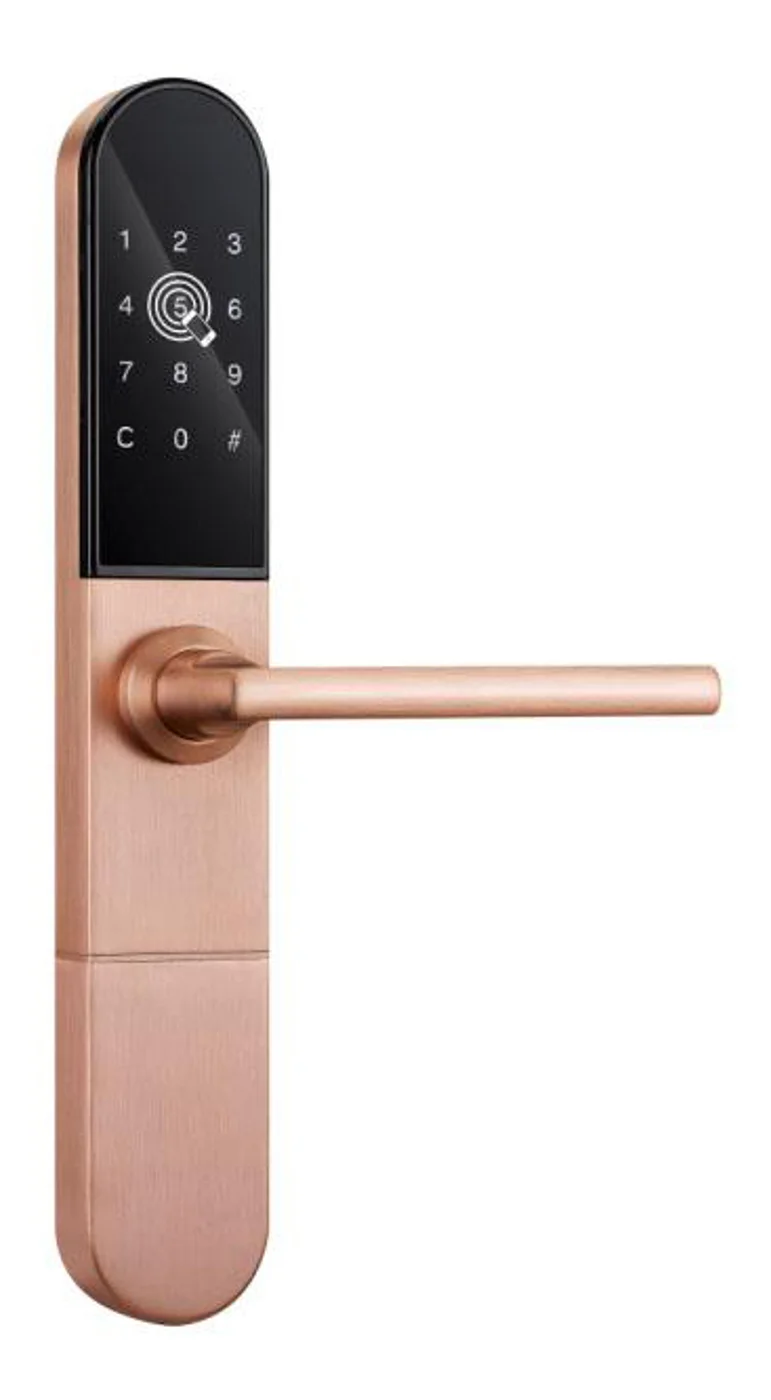
Kunci Lemari Pintar — Dikelola Aplikasi, Dasbor Multi-Lokasi
Kunci lemari pintar yang dikelola via aplikasi untuk kantor, paket, dan armada multi-lokasi. Dasbor aplikasi BLE, jejak audit, buka jarak jauh, tanpa server per kunci.
Halaman ini sudah menunjuk ke halaman tersebut sebagai referensi yang direkomendasikan berikutnya.
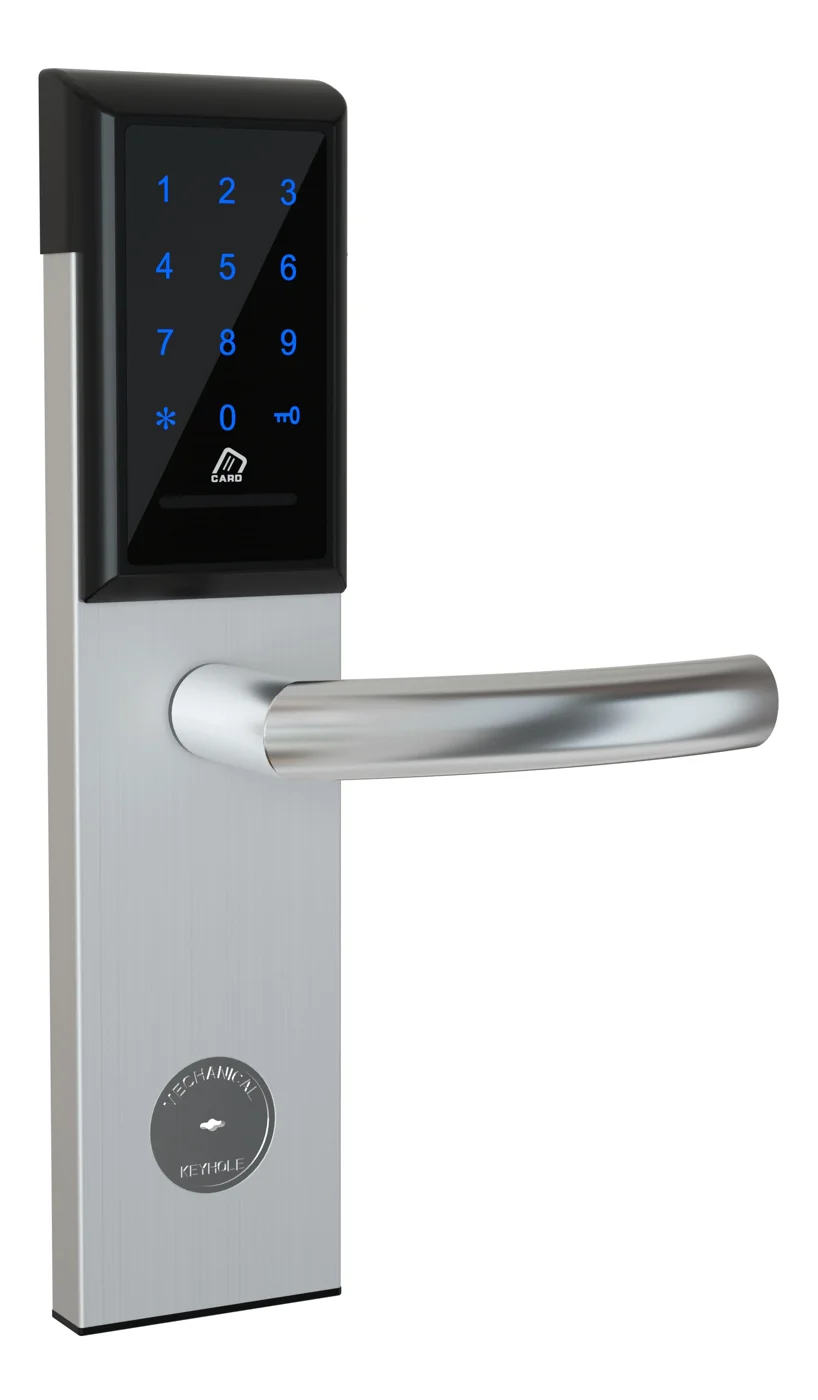
Kunci Lemari Kantor — PIN + Kartu untuk Arsip & Pedestal
Kunci lemari kantor PIN + kartu offline untuk lemari arsip, pedestal, dan laci. Retrofit baterai 5 menit, tanpa WiFi, tanpa manajemen kunci. CE/FCC/RoHS.
Halaman ini sudah menunjuk ke halaman tersebut sebagai referensi yang direkomendasikan berikutnya.
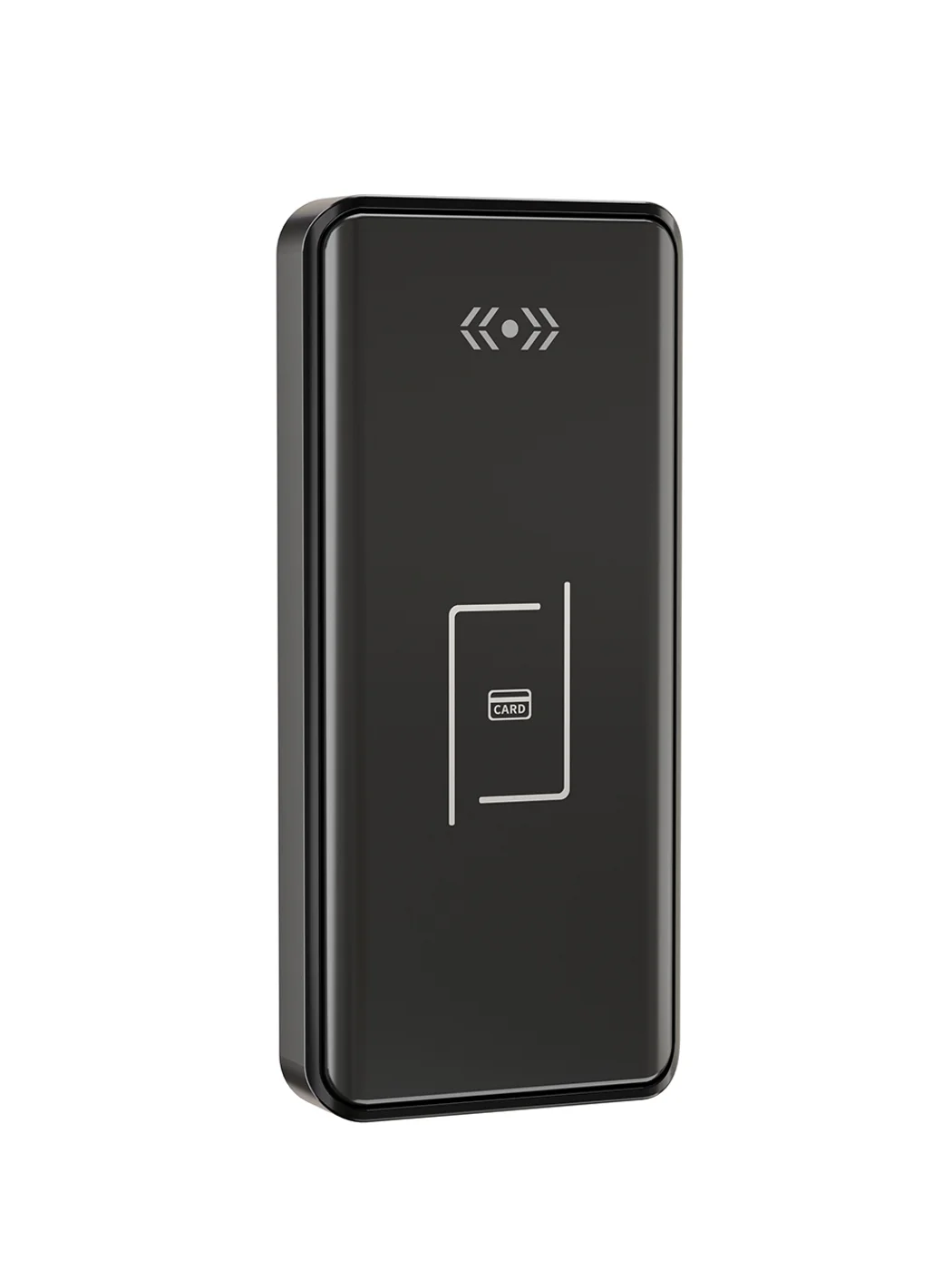
Kunci Loker Gym — Kartu Offline, Tanpa WiFi
Kunci loker gym kartu offline untuk loker fitness dan kolam. Kartu MIFARE, baterai, retrofit 5 menit, tanpa WiFi atau server. Zinc alloy, CE/FCC/RoHS.
Halaman ini sudah menunjuk ke halaman tersebut sebagai referensi yang direkomendasikan berikutnya.
Artikel blog terkait
3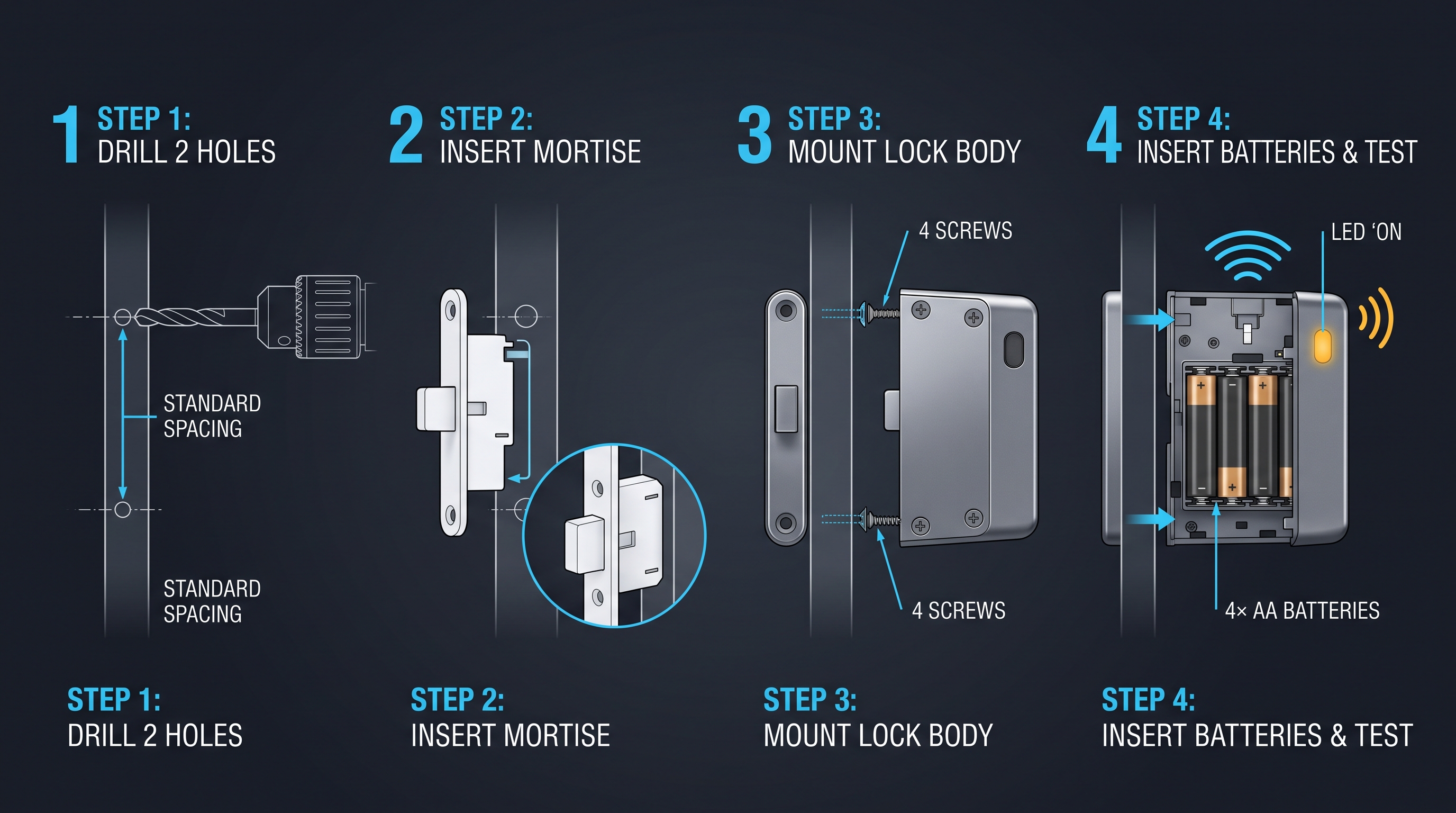
Gembok Lemari Cloud: Panduan Utama Kontrol Akses Kabinet
Panduan lengkap teknologi gembok lemari cloud mencakup manajemen jarak jauh, jejak audit waktu nyata, dan kontrol akses kabinet multi-lokasi untuk perusahaan.
Halaman tersebut mendukung konteks produk yang sama: Kunci Lemari Pintar — Dikelola Aplikasi, Dasbor Multi-Lokasi, Kunci Lemari Kantor — PIN + Kartu untuk Arsip & Pedestal, Kunci Loker Gym — Kartu Offline, Tanpa WiFi.
Kunci Lemari Kartu: Panduan Utama Keamanan Lemari Pintar
Jelajah lengkap teknologi kunci lemari kartu: MIFARE, DESFire, kredensial NFC ponsel, instalasi, protokol keamanan, dan strategi integrasi enterprise.
Halaman tersebut mendukung konteks produk yang sama: Kunci Lemari Pintar — Dikelola Aplikasi, Dasbor Multi-Lokasi, Kunci Lemari Kantor — PIN + Kartu untuk Arsip & Pedestal, Kunci Loker Gym — Kartu Offline, Tanpa WiFi.
Cabinet Smart Lock: Panduan Lengkap Keamanan Kabinet Terhubung dan Kontrol Akses
Panduan komprehensif sistem cabinet smart lock mencakup WiFi, Zigbee, biometrik, RFID, instalasi, integrasi, dan praktik terbaik untuk rumah dan bisnis.
Halaman tersebut mendukung konteks produk yang sama: Kunci Lemari Pintar — Dikelola Aplikasi, Dasbor Multi-Lokasi, Kunci Lemari Kantor — PIN + Kartu untuk Arsip & Pedestal, Kunci Loker Gym — Kartu Offline, Tanpa WiFi.
Rinci proyek hotel Anda bersama insinyur kami
Kirimkan jumlah kamar, jenis plafon, dan preferensi protokol Anda. Kami akan mengirimkan rencana sampel dan penawaran dalam 24 jam kerja.
- Beralih dari panduan umum ke diskusi produk atau aplikasi.
- Gunakan RFQ saat harga, gambar teknis, MOQ, atau jadwal peluncuran membutuhkan struktur.
- Jaga jalur kontak langsung tetap terlihat untuk klarifikasi cepat dan serah terima.