Hotel Locker Lock: The Complete 2026 Guide to Secure Guest Storage
Discover how a hotel locker lock works, from RFID to biometric models, with buying tips, specs, and comparisons for hotels, hostels, and resorts.
A hotel locker lock is a battery-powered electronic access control device that secures guest luggage storage lockers, spa changing-room compartments, staff personal lockers, and poolside storage using digital credentials such as RFID cards, PIN codes, Bluetooth smartphones, or biometric fingerprints. Operating on 4xAA alkaline or 6V lithium batteries delivering 12 to 24 months of standby life, a typical hotel locker lock integrates a motorized latch, a credential reader, and a microcontroller communicating at 13.56 MHz (MIFARE/NTAG) or 125 kHz (EM4100). Unlike traditional padlocks that require physical key management and offer no audit trail, a hotel locker lock enables centralized guest credential provisioning, automated locker assignment via integration with the property management system, and comprehensive access logging of up to 10,000 events per lock. Deployments span full-service hotels, luxury resorts, hostels, cruise ships, and transit hotels, where the hotel locker lock reduces locker-related staff labor by an estimated 60 to 80 percent while virtually eliminating lost-key incidents and the associated guest satisfaction impact. The modern hotel locker lock converts the locker area from a staff-intensive service point into a self-service amenity that operates as smoothly as the guestroom door lock, enhancing the property's operational efficiency and the guest's perception of the property's technological sophistication.
What Is a Hotel Locker Lock and How Does It Work
A hotel locker lock is a self-contained or networked electronic locking mechanism that authenticates a digital credential before retracting a latch to allow access to a locker compartment designated for guest luggage storage, spa amenities, poolside valuables, or staff personal effects during shift hours. Internally, the hotel locker lock combines a credential reader—RFID antenna operating at 13.56 MHz or 125 kHz, PIN keypad with capacitive or membrane technology, Bluetooth Low Energy 5.0 radio, or capacitive fingerprint sensor at 500 DPI—with a control board featuring an ARM Cortex-M0+ microcontroller running at 48 MHz, a motorized cam or solenoid actuator drawing 80 to 250 mA during the 0.3 to 0.8 second unlock cycle, and a power source typically consisting of four AA alkaline cells providing 12,000 mAh total capacity. The hotel locker lock verifies each credential presentation against a local whitelist of 1,000 to 20,000 authorized IDs stored in non-volatile EEPROM or flash memory, then drives the latch to release upon successful authentication. Standby current draw is just 15 to 40 microamps, yielding an industry-average battery life of 15,000 unlock cycles or approximately 12 to 24 months in a typical hotel luggage room averaging 30 to 60 accesses per locker per day. Unlike mechanical padlocks that rely on pin tumbler cylinders vulnerable to bumping, picking, and shimming, a hotel locker lock eliminates the physical keyway for everyday access, removing the most common attack vector while eliminating the operational burden of cutting, distributing, collecting, and tracking hundreds of physical keys across potentially thousands of guest interactions annually. The audit trail provided by the hotel locker lock records the time, credential ID, and outcome of every access attempt, providing hotel management with forensic evidence for lost luggage claims, liability disputes, and internal theft investigations, capabilities that no mechanical padlock can provide regardless of its physical strength or cost.
Core Components of a Hotel Locker Lock
Every hotel locker lock shares a common internal architecture consisting of five functional layers that work together to deliver secure, auditable access control. Understanding these components helps hotel engineering teams evaluate competing hotel locker lock models, diagnose faults, and specify appropriate hardware for each locker deployment scenario across luggage rooms, spa areas, staff quarters, and poolside facilities.
| Component | Function | Typical Specification |
|---|---|---|
| Credential reader | Captures guest or staff identifier | 13.56 MHz RFID / 125 kHz EM / BLE 5.0 / capacitive fingerprint |
| Microcontroller | Validates credential, logs event, drives actuator | ARM Cortex-M0+ at 48 MHz, 128 KB flash, 16 KB SRAM |
| Actuator | Retracts latch on valid credential | DC motor 80–250 mA, or solenoid 150–400 mA, 0.3–0.8 s cycle |
| Latch mechanism | Secures locker door closed | Stainless steel, 12 mm throw, 500 N pull resistance |
| Power source | Sustains standby and unlock cycles | 4×AA alkaline (12,000 mAh) or 3.6 V Li-SOCl₂ (19,000 mAh) |
| Real-time clock | Timestamps each audit event | ±20 ppm accuracy, coin-cell backup for battery changes |
| Audit memory | Stores access log with timestamps | 1,000–10,000 events in EEPROM or serial flash |
The Hotel Locker Lock Authentication Sequence
When a guest, spa attendant, or housekeeping staff member presents a credential to a hotel locker lock, the device executes a precise sequence of operations that determine whether access is granted or denied. The reader energizes and captures the credential ID within 50 to 200 milliseconds, depending on the credential technology in use. The microcontroller hashes the captured ID and performs a binary search against the locally stored whitelist, an operation that completes in microseconds due to the sorted list structure. On a match, the microcontroller energizes the actuator for the programmed unlock duration of 3 to 5 seconds, illuminates a green LED, and emits an audible confirmation beep that provides clear feedback to the user even in noisy luggage-room environments. On a failure, the hotel locker lock logs the rejected attempt with the credential ID and timestamp, flashes a red LED, and after a configurable threshold of three to five consecutive failed attempts enters a lockout penalty of 60 to 180 seconds that significantly slows brute-force attacks against PIN-based hotel locker lock models. Every event, successful or failed, is written to the audit memory with a timestamp drawn from the real-time clock, creating a complete forensic record that allows hotel security to reconstruct locker access history precisely in the event of a theft claim, operational dispute, or safety incident involving the locker area. This audit capability represents the most significant operational advantage of the hotel locker lock over mechanical alternatives, because it transforms locker security from an act of trust into a system of verifiable accountability.
Types of Hotel Locker Lock by Credential Technology
A hotel locker lock is categorized primarily by the credential technology it accepts, and this choice determines the lock's cost, security posture, guest convenience level, and backend integration complexity. The four dominant hotel locker lock variants in the 2026 hospitality market are RFID models operating at 13.56 MHz using MIFARE Classic, DESFire EV2/EV3, or NTAG protocols, or legacy 125 kHz EM4100 for backward compatibility with older access control systems; PIN code models accepting 4 to 8 digit combinations on capacitive or membrane keypads with up to 4,000 stored codes in commercial configurations; Bluetooth Low Energy 5.0 smartphone locks that leverage the guest's own device as the credential, eliminating all physical token issuance; and biometric fingerprint models using capacitive sensors at 500 DPI with false rejection rates below 1 percent and false acceptance rates below 0.001 percent. A fifth hybrid hotel locker lock combines two or more credential types for multi-factor authentication in high-security applications such as luggage rooms storing high-value items left by suite guests or VIP areas in luxury resort spas. Each hotel locker lock type trades off convenience against security in ways that directly impact guest satisfaction scores and staff workload: RFID offers unmatched speed and seamless integration with existing room-key systems but requires card stock and encoders; PIN eliminates token logistics entirely but introduces shoulder-surfing risk and guest forgetfulness as a point of friction; Bluetooth leverages the smartphone that every modern traveler carries but depends on app compatibility and battery charge; biometric eliminates all external tokens but raises privacy concerns and adds per-lock hardware cost. The hotel locker lock market in 2026 is divided approximately 40 percent RFID, 28 percent PIN, 22 percent Bluetooth, and 10 percent biometric, with hybrid credentials growing at the fastest rate as properties seek to offer guests multiple access methods while maintaining a single backend management platform. Property selection of the right hotel locker lock credential technology should align with the property's existing room access ecosystem to create a unified guest experience that minimizes confusion and service-desk calls.
RFID Hotel Locker Lock
The RFID hotel locker lock dominates the guest luggage storage and spa locker market because it delivers a balance of speed, reliability, and system integration that no other credential technology currently matches. A guest or staff member taps an RFID card or wristband on the hotel locker lock reader; the antenna inductively couples with the transponder at 13.56 MHz, energizing the chip and reading its unique identifier; the lock verifies the ID against its whitelist and retracts the latch in under 0.5 seconds, roughly the same operation time as a standard room door lock. MIFARE DESFire EV2 and EV3 cards add AES-128 mutual authentication between the card and the hotel locker lock, defeating cloning attacks that can compromise legacy 125 kHz EM4100 cards within seconds of snatching the card's UID using a proxmark or similar RFID reader. The RFID hotel locker lock integrates naturally with properties that already issue MIFARE-based room key cards, allowing a single card to serve as the guestroom door key, the restaurant charge credential, and the hotel locker lock access token, a consolidation that significantly reduces front-desk card issuance volume and plastic waste. Properties deploying RFID hotel locker lock systems across 100 or more luggage room lockers report that staff time spent resolving locker lockouts drops by 85 percent compared to mechanical padlock operations, because centralized credential management allows the front desk or luggage room attendant to unlock any locker remotely or with a master card, and lost-access incidents are resolved by reissuing the guest's credential rather than calling engineering or security with bolt cutters.
PIN Code Hotel Locker Lock
A PIN-based hotel locker lock replaces all physical tokens with a short numeric code that the guest selects or receives at check-in, eliminating the need for card stock, encoders, and the front-desk labor required to issue and collect plastic key cards for locker access. The hotel locker lock stores up to 300 unique PINs in consumer-grade models deployed in small properties and 4,000 or more PINs in commercial-grade models installed in high-volume resort luggage rooms and cruise-ship locker banks. Capacitive keypads with sealed glass or ceramic surfaces outlast membrane-based keypads in humid spa and poolside hotel locker lock installations by a factor of three to five times, delivering over 1,000,000 press cycles without the dome-switch fatigue that causes membrane keypads to develop unresponsive digits over time. The primary security vulnerability of a PIN hotel locker lock is shoulder surfing, where an unauthorized observer watches the guest enter their code, a risk that is mitigated by scramble-pad technology that randomizes the digit positions on the keypad display before each entry, making visual observation of finger position meaningless. One-time PINs, issued for specific access windows such as a 2-hour spa locker session, further reduce the risk because the code expires after use or after the session window closes. The PIN hotel locker lock is particularly popular in budget hotels, hostels, and serviced-apartment properties where the per-unit cost of RFID encoders and card stock is difficult to justify against the property's average daily rate, and where long-stay guests prefer a memorized code over the burden of carrying and protecting a plastic card throughout an extended stay.
Bluetooth Hotel Locker Lock
The Bluetooth hotel locker lock transforms the guest's smartphone into the locker credential, communicating over BLE 5.0 with AES-128 encrypted rolling codes that prevent replay attacks and credential interception in public luggage-room areas. The hotel locker lock offers three distinct unlock modes that adapt to different guest preferences and operational scenarios: tap-to-open, where the guest brings their phone within a few centimeters of the lock and the app transmits the credential on demand; proximity auto-unlock, where the hotel locker lock detects the authenticated phone within a 1 to 2 meter radius and automatically retracts the latch, providing hands-free access when guests are carrying luggage; and remote unlock, where a luggage-room attendant or front-desk agent triggers the hotel locker lock from the management console without requiring the guest to be physically present at the locker. BLE hotel locker lock models consume slightly more standby current at 30 to 60 microamps compared to RFID models, reducing battery life to 10 to 14 months under normal usage, but this tradeoff is accepted by properties that prioritize the elimination of plastic key cards and the guest convenience of smartphone-based access. The Bluetooth hotel locker lock is most prevalent in boutique hotels, tech-forward business hotels, and luxury resorts where the property's mobile app already handles check-in, room selection, digital concierge, and building access, and extending that unified digital experience to locker storage reinforces the property's brand positioning as technologically advanced and environmentally conscious. A key operational advantage of the Bluetooth hotel locker lock is that credential provisioning and revocation occur entirely through the property management system integration without any physical interaction at the front desk, enabling true contactless arrival where the guest bypasses the front desk entirely and proceeds directly to their room and assigned luggage locker.
Biometric Hotel Locker Lock
The biometric hotel locker lock uses fingerprint recognition, and in premium implementations palm vein or facial geometry, to authenticate users without any external token, code, or device whatsoever. Capacitive fingerprint sensors in a hotel locker lock achieve a false rejection rate of 0.1 to 1.0 percent and a false acceptance rate of 0.0001 to 0.001 percent, meaning that approximately one legitimate user per 100 to 1,000 attempts experiences a false rejection, while only one impostor per 100,000 to 1,000,000 attempts gains unauthorized access. The hotel locker lock stores 100 to 3,000 fingerprint templates in encrypted form within the lock's own secure memory, with templates never transmitted over the network or stored on a central server, satisfying GDPR and CCPA biometric data protection requirements that mandate local-only storage and automatic purge upon the data subject's departure. Enrollment into a biometric hotel locker lock takes 3 to 5 finger presses and can be completed at a dedicated enrollment kiosk, at the front desk during check-in, or via a tablet-based process conducted in the guest's room for maximum privacy. The biometric hotel locker lock is the credential technology of choice for luxury hotel locker lock deployments in executive lounges, VIP spa suites, and private luggage storage areas where the storage value justifies the per-unit hardware premium of $80 to $200, and where the guest's expectation of discretion and personal service extends to the seamless, tokenless experience that only biometrics can deliver. Beyond luxury guest-facing applications, the biometric hotel locker lock is extensively deployed in back-of-house staff locker rooms where housekeeping, engineering, and food-and-beverage team members need individual, non-transferable access credentials that cannot be shared, borrowed, or stolen as cards and PINs can be.
Hotel Locker Lock Credential Technology Comparison
| Feature | RFID Hotel Locker Lock | PIN Hotel Locker Lock | Bluetooth Hotel Locker Lock | Biometric Hotel Locker Lock |
|---|---|---|---|---|
| Access speed | Under 0.5 seconds | 3 to 8 seconds | 1 to 3 seconds | 1 to 2 seconds |
| External token required | Yes (card/wristband) | No (memorized code) | Yes (smartphone) | No (finger) |
| User capacity per lock | 1,000 to 20,000 | 300 to 4,000 | 1,000 to 10,000 | 100 to 3,000 |
| Average battery life | 18 to 24 months | 15 to 20 months | 10 to 14 months | 10 to 18 months |
| Credential cloning risk | Low (DESFire/encrypted) / High (EM4100) | N/A (no RFID) | Low (rolling codes with encryption) | Very low (live-finger detection) |
| Hardware cost per lock | $30 to $90 | $25 to $70 | $50 to $120 | $80 to $200 |
| PMS integration maturity | Excellent (industry standard) | Good (code generation via API) | Good (app-based credential delivery) | Moderate (enrollment integration required) |
| Guest convenience rating | High (same card as room) | Moderate (must memorize code) | Very high (phone-based, hands-free) | High (no token needed) |
| Best-fit property type | Full-service hotels with RFID room keys | Budget hotels, hostels, serviced apartments | Boutique and tech-forward business hotels | Luxury resorts, executive suites, VIP areas |
Hotel Locker Lock vs Mechanical Padlock: A Detailed Comparison
A hotel locker lock fundamentally transforms the security and operational economics of guest luggage storage and locker management when benchmarked against the mechanical padlock that has served hotels for decades. A mechanical padlock costs $4 to $12 per unit, requires a physical key for every guest locker assigned, and generates no access or usage data; a mid-range hotel locker lock costs $25 to $80 per unit but eliminates key cutting, replacement, collection, and distribution labor that the American Hotel and Lodging Association estimates averages $18 to $35 per lost-key incident across a full-service property managing 200 luggage lockers. The hotel locker lock additionally provides event logging with timestamps, time-based access scheduling that can restrict locker access to luggage-room operating hours, automated locker release at the end of a guest's designated storage window, and centralized credential revocation from the management console when a guest departs or a staff member is terminated—capabilities that no mechanical padlock can match at any price point. From a security perspective, a standard 5-pin tumbler padlock can be defeated by bumping or shimming in under 10 seconds using tools widely available online and requiring minimal skill, whereas a hotel locker lock using MIFARE DESFire EV3 with AES-128 encrypted mutual authentication resists cloning and replay attacks that have defeated legacy systems. The tradeoff inherent in every hotel locker lock deployment is power dependency: a mechanical padlock functions indefinitely with zero power and zero maintenance beyond occasional lubrication, while a hotel locker lock requires battery replacement every 12 to 24 months, representing a recurring operational task that engineering teams must integrate into their preventive maintenance schedule and potentially a failure mode if batteries expire with the locker secured and the guest awaiting their luggage. For any property managing more than 50 luggage lockers, the hotel locker lock's total cost of ownership, calculated over a typical 7-year furniture lifecycle, drops below that of mechanical padlocks once the labor cost of key management, lost-key response, and locker clearance is fully accounted for.
| Dimension | Mechanical Padlock | Hotel Locker Lock |
|---|---|---|
| Unit hardware cost | $4 to $12 | $25 to $80 |
| Credential type | Physical brass key (5-pin tumbler) | RFID card / PIN code / BLE smartphone / fingerprint |
| Key management burden | Cut, distribute, track, collect, replace | Centralized software provisioning and revocation |
| Audit trail capability | None (no record of access) | 1,000 to 10,000 timestamped events per lock |
| Time-based access restriction | Not possible (key works 24/7) | Programmable schedules aligned with luggage-room hours |
| Lost-credential cost per incident | $18 to $35 (key replacement plus labor) | $0 (electronic reissue or code reset) |
| Attack resistance profile | Vulnerable to bumping, picking, shimming in under 10 seconds | AES-128 encrypted, anti-cloning, tamper-switch detection |
| Power dependency | None (fully mechanical) | 4×AA batteries, 12 to 24 month service life |
| Dead-battery failure mode | Not applicable | Emergency power terminals, mechanical override key |
| Lifecycle cost (100 lockers, 5 years) | High (key labor and replacement dominate) | Lower beginning in year 2 of operation |
| Recommended deployment size | Under 50 lockers with low turnover | 50 or more lockers with daily turnover |
Security Attack Surface Comparison
The mechanical padlock's critical weakness is its exposed keyway, which presents a direct path for attack tools to manipulate the locking mechanism. Bump keys, fabricated from blank keys filed to the zero-depth bitting position, exploit fundamental tolerances in pin tumbler design and open approximately 90 percent of consumer-grade and mid-range padlocks in seconds with little skill required. Shimming attacks target the spring-loaded latch using a thin metal strip inserted between the padlock shackle and the locker hasp, bypassing the lock cylinder entirely. A hotel locker lock addresses these vulnerabilities by eliminating the external keyway from normal guest and staff operation, removing the bumping and picking attack surfaces that have made mechanical padlocks trivial to bypass. However, the hotel locker lock introduces its own attack surface that must be understood and mitigated: relay attacks against RFID systems where an attacker uses a proxy device to extend the communication range between a legitimate card and the reader; Bluetooth sniffing on unencrypted or poorly encrypted BLE links; and fingerprint spoofing using lifted prints on biometric hotel locker lock sensors lacking live-finger detection. Effective countermeasures include encrypted mutual authentication via MIFARE DESFire EV3 with AES-128, BLE with rolling codes that expire within seconds and proximity verification using received signal strength indicator thresholds, and capacitive fingerprint sensors that measure sub-epidermal conductivity to distinguish live fingers from silicone, gelatin, or latex replicas. The hotel locker lock also deters attacks through comprehensive audit logging that creates a record every access attempt, successful or failed, that identifies the credential used, the exact timestamp, and the lock identifier, enabling post-incident forensic investigation and creating a certainty of detection that discourages insider and opportunistic attacks.
Key Applications of the Hotel Locker Lock Across Property Areas
A hotel locker lock serves diverse operational areas within a hotel property because its digital credentialing and audit model adapts to the distinct access-control requirements of each space far more effectively than any mechanical locking solution can. In guest luggage rooms, a hotel locker lock enables self-service after-hours luggage storage, where guests deposit or retrieve bags using their room key card or smartphone credential, eliminating the need to staff a luggage room 24 hours daily and reducing labor costs while improving guest satisfaction through anytime access. In spa and wellness facilities, a hotel locker lock controls access to treatment-area changing lockers, steam-room storage, and relaxation-room cubbies, with session-length credentials programmed to expire automatically when the spa treatment booking ends, preventing abandoned lockers that staff must manually clear. In back-of-house areas, a hotel locker lock secures housekeeping supply cabinets, engineering tool lockers, and food-and-beverage storage, with role-based credentials limited to shift hours and audit-trail accountability that reduces inventory shrinkage and enables precise investigation of stock discrepancies. In poolside and outdoor recreation areas, a hotel locker lock with IP54 or higher ingress protection and corrosion-resistant stainless steel hardware secures guest valuables lockers, eliminating the staff labor and guest frustration associated with padlock rental and key return processes. Across all these deployment areas, the hotel locker lock provides an auditable, administratively efficient alternative to the legacy padlock model that has historically consumed significant staff time and generated frequent guest complaints. The hotel locker lock's audit trail satisfies the liability documentation requirements that hotel insurance carriers increasingly demand for coverage of guest property claims, while the centralized management console enables the security or engineering director to view the real-time status of every locker in the property and to respond immediately to lockout situations without deploying a technician to the specific locker location.
Guest Luggage Room Lockers
The guest luggage storage room represents the highest-traffic and most security-sensitive hotel locker lock deployment, because guests entrust their personal belongings, often including laptops, jewelry, medications, and travel documents, to the property's storage system for hours or even a full day between checkout and departure. A hotel locker lock deployed in the luggage room allows the guest to secure a locker using the same RFID key card that opened their guestroom door during their stay, providing continuity of access that requires no training or additional credentials. At checkout, instead of the front desk agent physically handing a padlock key to the guest and recording the locker number in a logbook, the hotel locker lock system assigns an available locker automatically via the property management system, provisions the guest's card or smartphone for that specific locker, and records the assignment in the central database. The guest can access their luggage locker at any time during the storage window without seeking a staff member, and upon retrieving their bags and tapping out, the hotel locker lock releases the locker for the next guest automatically, eliminating the common problem of guests walking away with padlock keys and rendering lockers unusable until a replacement key is sourced. The hotel locker lock audit trail provides the property with a defensible record of every luggage-room access event, protecting against false theft claims and enabling investigation of disputed situations with objective timestamped data rather than relying on staff recollection and handwritten logbook entries. Properties that deploy hotel locker lock systems in their luggage rooms report a 70 to 90 percent reduction in luggage-related service-desk calls, as guests no longer need to request staff assistance to lock or unlock their storage compartment or to locate the attendant who holds the padlock key inventory.
Spa and Wellness Locker Rooms
Hotel spa facilities deploy the hotel locker lock to manage changing-room lockers, treatment-area storage, and relaxation-lounge cubbies, where the guest credential is typically valid for the duration of the booked spa appointment and automatically expires at session end. When a guest books a spa treatment, the spa management system provisions the guest's room key card or issues a disposable RFID wristband that is programmed with a hotel locker lock credential valid for the specific locker assigned during the booking window. The guest uses this credential throughout their spa visit to access their changing locker, robe storage, and relaxation lounge compartment without managing multiple keys or memorizing locker numbers. At the end of the spa session, the hotel locker lock automatically releases the locker and flags it for cleaning in the housekeeping management system, eliminating the frustration of arriving guests finding lockers occupied by departed guests who abandoned padlocks or forgot to return keys. The audit trail provided by the hotel locker lock supports guest liability protection, documenting that the guest's assigned locker was accessed only by the guest's own credential throughout the spa session, while also tracking staff access for cleaning and restocking with individual accountability. Luxury spa properties leveraging a hotel locker lock network further enhance the guest experience by integrating the locker opening with the spa's ambient lighting and music system, so the guest's arrival at their locker triggers a personalized welcome sequence, transforming a utilitarian storage function into a memorable touchpoint of the luxury spa journey.
Back-of-House Staff Lockers
The hotel locker lock deployed in staff areas secures personal lockers for housekeeping, engineering, front office, and food-and-beverage team members, as well as uniform storage, supply cabinets, and equipment lockers in maintenance workshops and laundry facilities. Each staff member receives an RFID fob or PIN code provisioned by the human resources system upon hiring and synchronized with the hotel locker lock management platform, granting access only to lockers and cabinets relevant to their department and role. Staff credentials are automatically limited to the employee's scheduled shift hours, preventing after-hours locker access and reducing the opportunity for internal theft or unauthorized possession of hotel property. When an employee is terminated, the hotel locker lock system revokes their credential immediately from the central management console, simultaneously disabling access to every locked asset across the property, a critical security measure that mechanical key systems cannot replicate without a costly property-wide rekeying operation. The audit trail captures every staff locker access event, supporting investigations of internal theft complaints and ensuring compliance with labor regulations governing employee personal storage. Hotels that deploy hotel locker lock systems in back-of-house areas report a measurable reduction in lost-uniform costs, tool and equipment shrinkage, and internal theft investigations compared to properties relying on mechanical padlocks or combination locks managed through manual assignment logs.
Poolside and Outdoor Locker Deployments
Poolside and outdoor locker deployments subject the hotel locker lock to environmental conditions that demand specialized hardware specifications: IP54 or higher ingress protection against water spray and dust, stainless steel or marine-grade zinc alloy lock body construction resistant to chlorine corrosion and salt air, and lithium thionyl chloride batteries rated for the expanded temperature range of -20 to +60 degrees Celsius that rechargeable lithium-ion cells cannot reliably deliver. The hotel locker lock reader surface in a poolside installation must be a sealed capacitive pad or an encapsulated RFID antenna rather than a membrane keypad, because membrane domes fail within months when exposed to pool water, sunscreen residue, and the high humidity of tropical resort environments. Guests receive temporary pool-area credentials through their room key card or a disposable waterproof wristband programmed at the pool entrance kiosk, with the hotel locker lock automatically releasing the locker and expiring the credential when the guest checks out or when a defined maximum session duration is reached, typically 3 to 4 hours. The automatic release ensures that pool lockers are available for arriving guests during peak recreational hours without requiring staff to patrol locker banks and manually cut abandoned padlocks off occupied doors, a task that is both time-consuming and uncomfortable for guests witnessing the process. The hotel locker lock audit trail also helps the property manage liability by demonstrating that pool area lockers were functioning correctly and secured with guest-specific credentials at all relevant times, a significant protection in jurisdictions where pool-area theft claims can result in substantial liability exposure for the hotel operator.
Cruise Ship and Transit Hotel Deployments
The hotel locker lock deployed in cruise ship and transit hotel environments faces unique operational challenges: continuous 24-hour guest turnover, limited onboard engineering staff who cannot quickly respond to individual locker malfunctions, and the logistical impossibility of sourcing replacement padlock keys while at sea or between airport terminal flights. The hotel locker lock in these environments must be networked via wireless protocols such as LoRaWAN or shipboard Wi-Fi to the central property management or ship management system, enabling remote locker assignment, credential provisioning, and status monitoring from a single console operated by the purser or guest services manager. Battery life for cruise ship hotel locker lock deployments is extended through the use of lithium thionyl chloride packs that support 5-year service intervals, eliminating the need for battery replacements during multi-year sailing seasons when the ship's engineering schedule is dominated by critical propulsion and safety-system maintenance. The hotel locker lock in transit environments benefits from hybrid credential support, where guests can use either their cruise card or a temporary PIN code for locker access, providing a fallback authentication path if a card is demagnetized or damaged by salt water exposure. The audit trail capability of the hotel locker lock is particularly valued in cruise ship and transit environments, where the jurisdictional complexity of theft claims involving international guests and multi-jurisdiction insurance coverage makes comprehensive documentary evidence a critical operational and legal requirement.
How to Choose the Right Hotel Locker Lock: Buying Criteria
Selecting the right hotel locker lock for a property requires systematic evaluation across five dimensions: credential technology compatibility with the existing room-access and property-management ecosystem, user capacity sufficient for peak occupancy plus staff and vendor access, physical form factor and environmental ratings appropriate for each deployment area within the property, connectivity and integration capability that enables centralized management and PMS synchronization, and total cost of ownership calculated over the expected 7 to 10 year service life of the locker furniture. The first and often determinative decision is credential type, because a hotel locker lock that uses a different technology than the guestroom door lock forces guests to carry multiple credentials and undermines the seamless experience that electronic access control is supposed to deliver. Properties with MIFARE-based RFID room locks should specify an RFID hotel locker lock operating on the same protocol; properties with mobile-app-based room access should deploy Bluetooth hotel locker lock units; properties without an existing electronic access ecosystem should select the credential technology that best matches their target guest demographic and operational budget. The second critical parameter is user capacity: a hotel locker lock must support not only the peak guest count during high season but also staff credentials for luggage room attendants, spa therapists, housekeeping teams, engineering personnel, and security staff, plus additional headroom for contractor and vendor access during renovation or maintenance projects. Commercial hotel locker lock models supporting 4,000 to 20,000 credentials provide adequate capacity for properties up to 1,000 keys, while consumer-grade models capping at 100 to 300 credentials are suitable only for properties with fewer than 30 rooms and minimal staff access requirements.
Credential Ecosystem Compatibility
The credential technology selected for a hotel locker lock deployment should be dictated primarily by the property's existing or planned room access system, because fragmented credentials create guest confusion, increase front-desk training requirements, and generate service-desk calls that erode the operational savings the electronic lock is intended to deliver. Properties using MIFARE DESFire room key cards should specify an RFID hotel locker lock that supports the same protocol, enabling a single plastic card to serve as the guestroom door key, the restaurant charge card, the spa locker credential, and the luggage-room hotel locker lock token. Properties that have invested in a mobile guest app with Bluetooth-based room access should extend the same app to Bluetooth hotel locker lock units in the luggage room and spa, creating a digital-experience continuum from arrival through departure. Properties in transition between card-based and smartphone-based access should select a hybrid hotel locker lock that supports both RFID and BLE credentials simultaneously, accommodating guests who have adopted the mobile app while not penalizing guests who prefer physical cards. The credential compatibility decision has lasting consequences, because replacing a fleet of 200 hotel locker lock units after a room-access-system migration effectively doubles the hardware investment and exposes the property to two installation cycles.
User Capacity and Concurrent Access Requirements
A hotel locker lock must be sized not for the average guest count but for the peak concurrent guest load plus comprehensive staff access. A 300-room resort property during peak season with 85 percent occupancy has approximately 255 rooms occupied, but the luggage-room hotel locker lock system must additionally support day-use storage for pre-check-in and post-checkout guests, which can add 50 to 100 additional active credentials during checkout periods. Spa and pool locker hotel locker lock systems must support peak spa-booking throughput plus walk-in guest access. Staff credentials for luggage room attendants, spa therapists, housekeeping supervisors, security officers, and maintenance technicians add 20 to 50 additional credentials per area. An additional margin of 25 percent should be allocated for vendor access, contractor credentials during renovations, and group booking overflow. A property deploying a hotel locker lock system across luggage room, spa, poolside, and staff areas should specify models rated for at least 5,000 credentials even if the typical active count is 1,500, to maintain headroom for seasonal peaks and special events without requiring manual credential purging that adds administrative overhead.
Environmental Durability and Form Factor
The hotel locker lock form factor and environmental rating must match the specific deployment location, because a lock specified for a climate-controlled luggage room will fail rapidly if installed in a humid poolside environment. Indoor hotel locker lock deployments in luggage rooms, business centers, and staff areas can use standard surface-mounted or concealed units with IP40 or IP42 protection, as they are not exposed to direct water spray or extreme humidity. Poolside and outdoor hotel locker lock deployments require IP54 or higher sealing, stainless steel or zinc-alloy lock bodies with corrosion-resistant plating, and capacitive or sealed RFID reader surfaces rather than membrane keypads that degrade in wet environments. The form factor decision between surface-mounted, concealed, and mortise hotel locker lock styles is driven by aesthetic requirements and the locker furniture's construction material. Surface-mounted hotel locker lock units attach to the locker door exterior with screws, install in 10 to 15 minutes per door, and are the most common choice for retrofit projects on existing locker banks. Concealed hotel locker lock units install inside the locker door with only the reader visible on the exterior, providing a clean appearance preferred in luxury spa environments, but they require 30 to 60 minutes per door for installation and are better suited to new-build or renovation projects where furniture modification is already part of the scope.
Connectivity and Backend Integration
The hotel locker lock connectivity model determines how credentials are provisioned, how audit data is collected, and how the system integrates with the property management system and other hotel technology platforms. Standalone hotel locker lock units, programmed individually via USB cable, NFC programming card, or manual keypad entry, are suitable only for small properties with fewer than 30 lockers where credential changes are infrequent and manual administration is feasible within existing staff workloads. Networked hotel locker lock systems, communicating over RS-485 wired bus, Wi-Fi, or LoRaWAN wireless protocol, report to a central management server that connects to the PMS via API, enabling automated credential provisioning at check-in, automated revocation at checkout, real-time locker-status monitoring from the management console, and centralized audit-log collection across all locker banks on the property. The networked hotel locker lock approach reduces the administrative burden per locker by approximately 90 percent compared to standalone units and is the only viable option for properties managing more than 50 lockers. PMS integration is the critical backend connection: the hotel locker lock management platform must connect to the property management system to receive guest credential data at check-in and to feed luggage-room access events back for storage-charge posting and storage-duration compliance monitoring. Properties should verify that the hotel locker lock vendor offers a certified or documented PMS integration for the specific property management system in use, whether Opera, Mews, Cloudbeds, Hotelogix, or a proprietary platform, and that the integration supports the full credential lifecycle including check-in provisioning, checkout revocation, room-move credential transfer, and group-booking bulk assignment.
Total Cost of Ownership Calculation
A complete hotel locker lock cost analysis extends far beyond the per-unit hardware price to include installation labor, management software licensing or subscription, battery replacement, ongoing maintenance labor, integration development, and the operational savings from eliminated key management and reduced theft. The table below presents a representative 7-year total cost of ownership comparison between a mechanical padlock system and an RFID hotel locker lock system for a 150-room resort property with 200 locker compartments distributed across luggage room, spa, and poolside areas.
| Cost Category | Mechanical Padlock (200 Lockers) | RFID Hotel Locker Lock (200 Lockers) |
|---|---|---|
| Initial hardware purchase | $1,600 ($8 per padlock) | $12,000 ($60 per lock) |
| Installation labor | $2,000 (furniture setup only) | $6,000 (mounting, wiring, configuration) |
| Management software (7 years) | $0 | $33,600 ($400 per month cloud subscription) |
| PMS integration (one-time) | $0 | $5,000 (API development and testing) |
| Key management labor (annual) | $7,200 ($600 per month staff time) | $0 (automated credential management) |
| Lost-key replacement (annual) | $3,600 (approximately 120 incidents) | $0 (electronic reissue) |
| Battery replacement (annual) | $0 | $800 ($4 per lock, annual replacement) |
| Maintenance labor (annual) | $500 (occasional lock replacement) | $1,500 (quarterly cleaning, inspection) |
| Theft and shrinkage (annual) | $4,000 (estimated) | $1,200 (estimated, 70% reduction) |
| Hardware replacement (cumulative) | $1,600 (full replacement at year 5) | $1,200 (2% annual failure rate) |
| 7-year total cost | $92,500 | $72,700 |
| Cost per locker per year | $66 | $52 |
The hotel locker lock delivers a net 7-year savings of approximately $19,800, or about $2,830 per year, compared to the mechanical padlock system. The savings derive primarily from the elimination of key management labor and lost-key replacement costs, which together account for $10,800 annually in the mechanical system compared to zero in the hotel locker lock system. The break-even point occurs in year 3, after which the hotel locker lock system generates annual net savings that compound over the remaining service life.
Installation Guide for the Hotel Locker Lock
Installing a hotel locker lock system across a property requires methodical planning and execution to ensure reliable operation, aesthetic consistency, and minimal disruption to guest services during the installation period. The installation process encompasses five phases: pre-installation site survey and locker assessment, lock mounting and physical installation, network and power infrastructure setup for networked models, credential system configuration and PMS integration, and comprehensive post-installation testing and staff training. Properties should engage the hotel locker lock manufacturer or a factory-certified installer for the initial deployment, with in-house engineering staff trained to perform subsequent maintenance, individual unit replacement, and credential troubleshooting. The following guide provides a structured installation methodology applicable to both surface-mounted retrofit hotel locker lock installations and concealed new-build hotel locker lock deployments.
Pre-Installation Site Survey
Before any hotel locker lock is mounted, the installation team must conduct a thorough site survey of every locker door and frame that will receive a lock. For each locker door, measure the door thickness using a caliper and confirm that it falls within the hotel locker lock model's specified range, typically 16 to 30 mm for surface-mounted models and 18 to 25 mm for concealed or mortise models. Identify the locker door material, which in hotel environments is most commonly 18-gauge powder-coated steel, aluminum, or phenolic composite, and select the appropriate fasteners and drill bits for the material. Metal lockers require self-tapping sheet-metal screws and a cobalt or titanium drill bit; wood lockers require wood screws and a standard twist bit; plastic or phenolic lockers require machine screws with backing nuts and a step drill to prevent cracking. Verify the door swing direction and hinge side, confirming that the hotel locker lock's latch throw direction, either left-hand or right-hand, matches the door's opening orientation. Survey existing locker hardware, including any previously installed padlock hasps that must be removed, filled, and refinished before the hotel locker lock can be mounted. Document each locker's assigned number and note any unusual conditions, such as dented doors that may affect lock seating, heavily painted surfaces that may interfere with reader performance, or lockers located in positions that receive direct water spray from nearby showers or pool splash zones. For networked hotel locker lock installations, trace the cable routing path from each locker bank to the nearest network infrastructure point, confirming that cable runs do not exceed the maximum length specified for the chosen communication protocol.
Physical Installation of Surface-Mounted Hotel Locker Lock
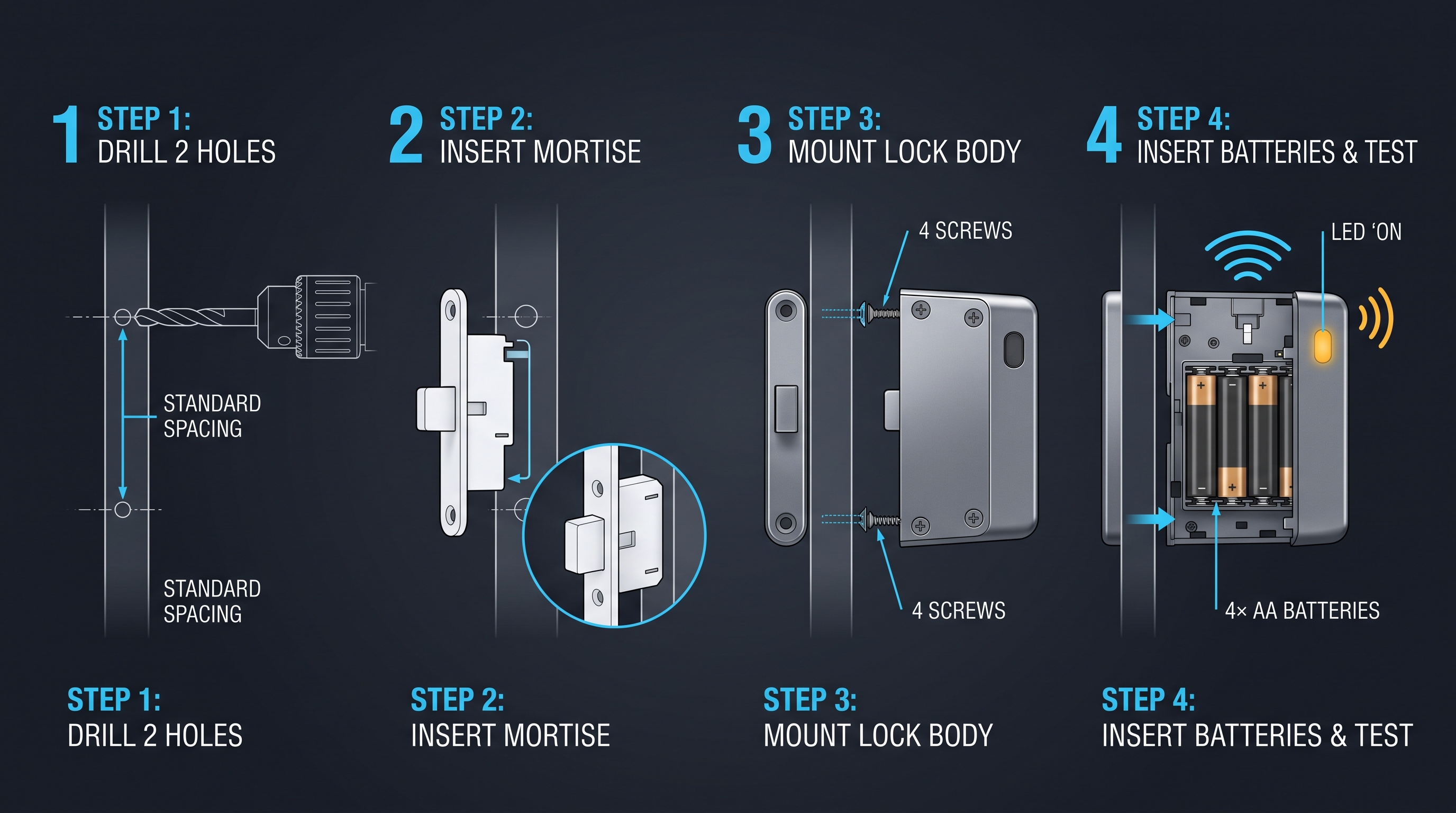
Surface-mounted hotel locker lock installation follows a repeatable process that a two-person team can execute at a rate of 6 to 8 lockers per hour after an initial learning curve. Begin by cleaning the locker door surface where the hotel locker lock will be mounted, removing dirt, grease, adhesive residue, and loose paint that could prevent the lock from seating flush against the door. Position the manufacturer-supplied mounting template at the recommended height, typically 150 to 200 mm from the top edge of the locker door for standard locker compartments and at a height accessible to guests using wheelchairs where ADA or equivalent accessibility compliance applies. Mark all drill points through the template, including the latch hole through the door edge, the mounting screw holes, and any cable passthrough holes for networked hotel locker lock models. Drill all holes using the appropriate bit for the door material, starting with a small pilot hole and stepping up to the final diameter to prevent bit wander and material cracking. Deburr all holes to remove sharp edges that could cut cables or prevent the hotel locker lock from seating flush. Install the gasket or sealing ring if supplied with the hotel locker lock, particularly for poolside installations where water ingress through the mounting interface must be prevented. Secure the hotel locker lock body to the door exterior using the supplied fasteners, tightening to the manufacturer's torque specification, typically 1.5 to 2.5 Nm for M4 screws into metal lockers. Mount the strike plate on the locker frame at the position determined by the template, test-fitting the door repeatedly to confirm that the latch engages smoothly without rubbing, binding, or requiring excessive force to close. If the latch binds, adjust the strike plate position or add thin shim washers behind the strike plate mounting ears to achieve proper alignment. Insert the batteries, close the battery compartment cover, and proceed to credential enrollment.
Concealed Hotel Locker Lock Installation
Concealed hotel locker lock installation requires more extensive furniture modification, typically performed during locker bank fabrication or as part of a comprehensive renovation project. The hotel locker lock body is mounted inside the locker door or within the locker frame, with only the credential reader visible on the door exterior. A mortise pocket must be routed into the locker door edge or frame to accept the lock body, using a router template provided by the hotel locker lock manufacturer to ensure accurate dimensions. The reader module mounts through a small rectangular or circular opening in the locker door exterior, secured from the inside with a retaining nut or clamp ring that is inaccessible when the locker is closed and locked. Network cabling for concealed hotel locker lock models is routed through the locker frame's structural channels to a junction box mounted behind or adjacent to the locker bank, where the cable connects to the communication bus. Concealed hotel locker lock installations require particular attention to strike-plate alignment, because the lock body is not visible for visual confirmation of latch engagement; repeated test-fitting and adjustment are essential before finalizing the installation. The improved aesthetics and tamper resistance of concealed hotel locker lock installations make them the preferred choice for luxury spa locker rooms and executive areas, but the installation time of 30 to 60 minutes per door and the need for specialized fabrication tools mean that concealed installations are cost-effective only for new-build or full-renovation projects where furniture modification is already within scope.
Credential Enrollment and System Commissioning
After physical installation is complete, the hotel locker lock must be enrolled into the management system and configured with initial credentials, access schedules, and system parameters. For standalone hotel locker lock models, enroll the master credential first using the manufacturer's programming procedure, typically a button-press sequence on the lock followed by presentation of the master card or entry of the master PIN. Then enroll default staff credentials for housekeeping, engineering, and security, and configure basic parameters including the unlock duration of 3 to 5 seconds, the failed-attempt lockout threshold of 3 to 5 attempts, and the lockout penalty duration of 60 to 180 seconds. For networked hotel locker lock models, the central management server automatically discovers each newly installed lock via the communication bus, assigns it a system identifier, and pushes the configuration profile defined by the property's security policy. PMS integration must be tested end-to-end, confirming that a simulated guest check-in provisions a credential to the correct hotel locker lock, that a simulated checkout revokes the credential, and that locker access events appear in the audit log with the correct locker identifier and timestamp. Test the complete credential lifecycle on at least 5 percent of the installed hotel locker lock units, randomly distributed across the property, before releasing the locker bank to guest service. Any integration failures, configuration errors, or inconsistent lock behavior identified during testing must be resolved and the affected hotel locker lock units retested before the property accepts the installation.
Post-Installation Testing and Staff Training
The final phase of hotel locker lock deployment involves comprehensive testing of every installed unit and training of front-desk, luggage-room, spa, housekeeping, and engineering staff on the specific operational procedures for the chosen hotel locker lock model. Test each hotel locker lock with an authorized credential, confirming that the latch retracts within the specified time, the green LED illuminates, and the audit log captures the event. Test each unit with an unauthorized credential, confirming that the latch does not retract, the red LED illuminates or beep sounds, and the rejection is logged. Simulate a low-battery condition by removing one battery cell from a test unit and confirming that the low-battery alert triggers according to the manufacturer's specification. Test the emergency power override by applying 6 to 9 V DC to the external contact pads using the handheld booster carried by engineering staff and confirming that the hotel locker lock opens. Train front-desk staff on credential issuance and locker assignment procedures using the property management system integration. Train luggage-room attendants on the self-service kiosk interface if deployed, the manual override procedures for unresponsive locks, and the process for clearing lockers that guests have abandoned. Train engineering staff on battery replacement intervals and procedures, reader cleaning protocols, and the first-line troubleshooting steps for common hotel locker lock faults. A formal handover document signed by the installer and the property's director of engineering confirms the installation completion, records the lock fleet serial numbers and installed locations, and establishes the baseline for warranty tracking and future maintenance scheduling.
Maintenance and Troubleshooting for the Hotel Locker Lock
Maintaining a fleet of hotel locker lock units across a property requires a structured preventive maintenance program because the distributed nature of the installation, with hundreds of locks spread across luggage rooms, spa areas, pool decks, and staff locker rooms, makes reactive, complaint-driven repair disruptive, expensive, and damaging to the guest experience. The hotel locker lock maintenance cycle is anchored on battery replacement every 12 to 24 months, scheduled based on the lock model's rated unlock-cycle life and the property's observed usage rate rather than on a fixed calendar interval that may replace batteries prematurely in low-traffic areas or too late in high-traffic zones. A predictive maintenance approach, enabled by networked hotel locker lock systems that report battery voltage, error rates, and unlock counts to the central management console, allows engineering teams to replace batteries only in locks that are approaching end-of-life, reducing annual battery consumption by 30 to 50 percent compared to blanket property-wide replacement. Beyond battery management, the hotel locker lock requires quarterly cleaning of each credential reader surface, whether RFID antenna, keypad digits, or fingerprint sensor, using 70 percent isopropyl alcohol and a lint-free wipe to remove the accumulation of skin oils, sunscreen residue, cosmetic products, and environmental dust that progressively degrades read accuracy and increases credential rejection rates. Mechanical inspection of latch engagement, door alignment, and strike-plate security should be performed quarterly on a rotating sample of 25 percent of the hotel locker lock fleet each month, ensuring that every lock receives a physical inspection annually while maintaining manageable inspection workload for the engineering team. A documented troubleshooting runbook, trained to all engineering shift staff, enables first-line fault resolution at the locker rather than escalating to the manufacturer's technical support line, reducing mean-time-to-repair from hours to minutes and minimizing the number of lockers that are temporarily out of service.
Preventive Maintenance Schedule
| Maintenance Interval | Task Description | Tools and Materials Required |
|---|---|---|
| Weekly | Review management-console battery-voltage dashboard, flag any hotel locker lock reporting below 2.8 V per AA cell | Management software, battery replacement kit |
| Monthly | Export and archive audit logs for compliance retention | Management software, secure storage |
| Quarterly | Clean all credential reader surfaces with isopropyl alcohol | 70% IPA, lint-free wipes, cotton swabs for crevices |
| Quarterly | Inspect latch engagement, door alignment, strike-plate tightness on 25% sample | Visual inspection, 50 N pull test with spring scale, screwdriver |
| Semi-annually | Verify real-time clock accuracy against NTP reference | Management software clock comparison utility |
| Annually | Proactive battery replacement in high-traffic hotel locker lock units (>30 access events per day) | Manufacturer-approved AA alkaline cells, torque driver |
| Biennially | Apply firmware update to all networked hotel locker lock units | Manufacturer firmware utility, over-the-air or USB update |
| As-needed | Investigate tamper-switch activation or anomalous access patterns | Audit-log export, security team investigation |
Common Hotel Locker Lock Faults and Remediation Steps
A hotel locker lock that does not respond to any credential, showing no LED illumination and no audible response, most commonly indicates a depleted battery or a disconnected internal power cable. Apply emergency power via the external contact pads and attempt credential authentication; if the lock operates with external power, replace the internal batteries and verify the battery terminals are clean and making solid contact. Intermittent credential rejection where some guest cards work and others fail on the same hotel locker lock points to a dirty or damaged reader surface. Clean the reader with 70 percent isopropyl alcohol and retest with a known-good credential; if failures persist, the RFID antenna, keypad module, or BLE radio may require replacement, a task performed by removing the lock body and swapping the reader board. A latch that does not retract despite a green LED and audible confirmation of credential acceptance indicates actuator failure or mechanical obstruction. Inspect the latch bolt for visible debris, metal shavings, or signs of impact damage; gently attempt to retract the latch with the manual override tool while observing for binding; if the latch moves freely manually but not electrically, the actuator motor or solenoid has failed and the hotel locker lock body must be replaced as a unit. A hotel locker lock that reports locked in the management console but the locker door can be opened by pulling indicates latch-to-strike misalignment. Verify that the strike plate is securely fastened and that the locker door has not sagged on its hinges; adjust the strike plate position or add shim washers to restore proper engagement. Repeated false tamper alarms on a hotel locker lock in a mechanically quiet area suggest a failing tamper switch or excessive vibration from adjacent machinery such as laundry equipment or pool pumps; adjust the tamper sensitivity threshold in the management console if supported by the model, or replace the tamper switch. When field troubleshooting cannot resolve a hotel locker lock fault, the lock body is removed and replaced with a spare unit while the defective unit is returned to the manufacturer for bench diagnosis under warranty.
Battery Management Best Practices
Battery replacement is the most frequent maintenance activity on any hotel locker lock fleet, and following best practices minimizes guest impact and extends the service life of each lock's power management circuitry. Use only high-quality alkaline AA cells from a single manufacturer and production batch, because mixing battery brands, chemistries, or ages within a hotel locker lock causes uneven discharge characteristics that can reduce total capacity by 20 to 30 percent and increase the risk of cell leakage that damages the lock's battery contacts and internal circuit board. Replace all four or six cells simultaneously, never mixing old and new batteries, to prevent reverse charging where a partially depleted cell draws current from fresh cells, generating heat and potentially causing cell rupture. After replacing batteries, verify that the hotel locker lock's real-time clock has retained the correct time, because some models rely on a small coin-cell backup that may itself require replacement every 3 to 5 years. Document every battery replacement in the maintenance management system with the date, locker number, hotel locker lock serial number, battery brand and batch code, and the technician's name, creating a data trail that supports warranty claims, identifies units with abnormally high power consumption that may indicate an impending electronics failure, and provides the usage data necessary to refine the predictive replacement algorithm for the specific property's operating conditions.
Hotel Locker Lock Security Considerations
Securing guest and staff lockers with a hotel locker lock involves more than selecting and installing hardware; it requires a comprehensive security strategy that addresses credential integrity, physical tamper resistance, network security for connected lock systems, and the operational protocols governing credential issuance, staff access, override procedures, and audit-log review. The hotel locker lock's security posture is only as strong as its most poorly managed element, and a technically sophisticated lock deployed with inadequate operational procedures provides no better real-world protection than a basic mechanical padlock. Properties must evaluate the hotel locker lock system's resistance to credential interception, cloning, and relay attacks; physical forced-entry resistance of the lock body, latch, strike, and locker furniture; cybersecurity of networked hotel locker lock communication protocols, management servers, and PMS integration interfaces; and the human factors of staff training, credential hygiene, and incident response readiness. The audit trail, while not a preventative security control, provides deterrence through the certainty that all access is recorded and attributable, and it provides the forensic evidence necessary to investigate security incidents, defend against liability claims, and identify operational security gaps that require remediation. Hotel insurance carriers increasingly require hotel locker lock audit capabilities as a condition of coverage for guest property stored in luggage rooms and spa lockers, making comprehensive audit functionality a business necessity as well as a security enhancement.
Credential Security and Cloning Defense
RFID hotel locker lock systems that use legacy 125 kHz EM4100 or unencrypted MIFARE Classic cards are vulnerable to credential cloning attacks that an adversary can execute in under 30 seconds using a proxmark or similar RFID reader-programmer costing under $50 and widely available through hobbyist electronics channels. The attacker captures the card's unique identifier, writes it to a blank card or programmable wristband, and presents the clone to the hotel locker lock, which cannot distinguish the duplicate from the original. MIFARE DESFire EV2 and EV3 cards implement AES-128 mutual authentication, where the hotel locker lock sends a random challenge to the card, the card encrypts the challenge with its secret key, and the lock verifies the response; a proxmark can capture this exchange but cannot derive the secret key or construct a valid response to a new challenge, making cloning infeasible with current technology. Bluetooth hotel locker lock systems are vulnerable to relay attacks, where an attacker uses a proxy device to extend the BLE communication range between the guest's smartphone and the lock, fooling the hotel locker lock into believing the authorized credential is within the designed proximity range of 1 to 2 meters. Defenses include BLE rolling codes that change with each transaction so that a relayed code is already expired by the time it reaches the lock, proximity verification using received signal strength indicator thresholds that require a signal strength consistent with close physical proximity, and application-level encryption where the guest's phone must be unlocked, the hotel app must be in the foreground, and the user must explicitly tap an unlock button to generate a valid credential. Properties should mandate encrypted credential protocols in hotel locker lock procurement specifications and establish a phased discontinuation plan for legacy unencrypted locks already deployed in the property.
Physical Tamper Resistance
The hotel locker lock's physical security is determined by the strength of the lock body, latch, strike plate, and locker furniture acting together as a system. A hotel locker lock with a hardened steel latch of at least 6 mm diameter, a zinc alloy or stainless steel lock body rated for 500 N pull resistance, and concealed mounting fasteners that are inaccessible from the locker exterior provides meaningful resistance to opportunistic attack in supervised luggage-room and spa environments. Surface-mounted hotel locker lock units are inherently more exposed to physical attack than concealed models, because the lock body protrudes from the locker door and provides edges that a pry bar can engage; properties concerned about physical security in unsupervised areas should specify concealed or mortise hotel locker lock installations. The strike plate, often overlooked in security assessments, must be fastened to the locker frame with screws of adequate length and gauge, typically M5 or larger machine screws threaded into the frame structure rather than into thin sheet metal that strips under prying force. Tamper switches inside the hotel locker lock detect physical attacks including prying, drilling, and impact, triggering an alarm event in the audit log and, on networked systems, an immediate alert to the security console that can prompt a staff response. Properties that experience physical attacks on hotel locker lock units should investigate whether the attack targeted a specific locker containing valuables or was random, because targeted attacks may indicate an insider with knowledge of the locker's contents, a far more serious security concern than opportunistic damage.
Network Security for Connected Hotel Locker Lock Systems
Networked hotel locker lock systems introduce cybersecurity considerations that standalone units avoid, and a compromise of the management server or communication infrastructure could grant an attacker the ability to unlock every hotel locker lock in the property simultaneously or to disable audit logging to conceal unauthorized access. The communication protocol between hotel locker lock units and the management server must use encryption; RS-485 wired bus implementations should employ AES-128 encrypted data frames, Wi-Fi connections must use WPA2-Enterprise or WPA3, and LoRaWAN implementations must leverage the protocol's built-in AES-128 application-layer encryption. The management server must be isolated from the guest Wi-Fi network and the corporate network through VLAN segmentation, with only the specific TCP/IP ports required for hotel locker lock communication and PMS integration permitted through the firewall. API connections to the property management system must use TLS 1.3 with certificate validation, and API keys must be rotated on a 90-day schedule or immediately upon termination of any employee with access to the integration credentials. Firmware updates for the hotel locker lock fleet must be cryptographically signed by the manufacturer and verified by each lock before installation, preventing malicious firmware injection that could create a backdoor in every lock simultaneously. Properties should request the hotel locker lock manufacturer's security architecture documentation, vulnerability disclosure policy, and historical CVE record before procurement, and verify that firmware updates are released regularly to address newly discovered vulnerabilities rather than being treated as feature-only releases that leave security flaws unpatched for years.
Operational Security Protocols
The most technically advanced hotel locker lock can be rendered ineffective by poor operational security practices. Properties must establish and enforce clear protocols governing credential issuance, staff access windows, override procedures, and audit-log review cycles. Guest credentials for luggage-room hotel locker lock access must be issued at check-in only after identity verification and must be revoked automatically at checkout, with no possibility of a departed guest retaining valid credentials. Staff credentials must be role-based, restricted to the lockers and cabinets that the specific job function requires access to, time-limited to scheduled shift hours, and immediately revoked upon employment termination. Master override credentials that can open any hotel locker lock on the property must be held by the absolute minimum number of authorized personnel, typically the security director and one deputy, with every override event requiring contemporaneous justification in the incident log and post-event review by a security manager. Audit logs must be reviewed at least weekly, with automated alerts configured for anomalous patterns including more than three consecutive failed attempts on a single hotel locker lock, credential use outside of scheduled shift hours, a single credential accessing more than five different lockers within a 10-minute window, and credential use after the associated guest has checked out. An incident response procedure specific to hotel locker lock security events must be documented and trained to security, front desk, and engineering management, defining the escalation path, evidence preservation requirements including immediate lock audit-log export, guest and law enforcement notification protocols, and post-incident lock reconfiguration or replacement standards.
Cost Analysis and Return on Investment for the Hotel Locker Lock
Investing in a hotel locker lock system represents a capital expenditure that property owners and general managers must justify through a comprehensive return on investment analysis that accounts for all cost categories and savings streams over the system's expected 7 to 10 year service life. While the upfront hardware and installation cost of a hotel locker lock fleet exceeds that of an equivalent mechanical padlock fleet, the total cost of ownership over a multi-year period typically favors the electronic solution due to eliminated key management labor, reduced theft and shrinkage, improved operational efficiency, and enhanced guest satisfaction that drives repeat bookings and positive online reviews. A thorough hotel locker lock ROI analysis examines direct costs including hardware, installation, software licensing, integration development, battery replacement, and maintenance labor, and indirect costs including staff training, IT infrastructure upgrades, and business interruption during installation, against direct savings including elimination of key cutting, replacement, and distribution labor, and indirect savings including reduced theft claims, lower insurance premiums, improved operational throughput, and guest satisfaction improvements that are difficult to quantify but real in their impact on hotel profitability.
Upfront Cost Components
The upfront cost of a hotel locker lock deployment includes four primary components: hardware acquisition, physical installation, management software setup, and PMS integration development. Hardware costs vary widely by credential technology, with entry-level PIN hotel locker lock models starting at $25 per unit and premium biometric models reaching $200 per unit, and the most common RFID hotel locker lock models averaging $45 to $75 per unit in volume purchases of 100 or more. Installation labor ranges from $15 per door for surface-mounted hotel locker lock units installed by internal engineering staff to $50 per door for concealed mortise installations requiring professional integrators. Management software costs range from a one-time $3,000 on-premise perpetual license for standalone systems to $3 to $5 per lock per month for cloud-based platforms that include PMS integration connectors, automated firmware updates, and multi-property management capabilities. PMS integration development, when not included in the software package, costs $3,000 to $8,000 for API connector configuration and end-to-end testing with the property's specific property management system version.
Ongoing Operational Costs
Recurring hotel locker lock operational costs include battery replacement, scheduled maintenance labor, management software subscriptions, and hardware replacement for units that fail in service. Battery replacement costs approximately $4 per lock per year for AA alkaline cells replaced annually, or $800 for a 200-locker property. Maintenance labor, including quarterly reader cleaning at 5 minutes per lock and annual mechanical inspection at 15 minutes per lock, totals approximately 0.67 labor-hours per lock per year, or 134 hours per year for a 200-locker property at $25 per hour, for an annual maintenance labor cost of $3,350. Cloud-based management software subscriptions cost $400 to $600 per month for a typical full-service hotel deployment, totaling $4,800 to $7,200 annually. Hardware replacement costs, assuming a 2 percent annual failure rate that is typical for electronic hotel locker lock units in commercial service, average $240 per year for a 200-locker fleet at an average replacement cost of $60 per unit. Total annual ongoing costs for a 200-locker hotel locker lock deployment average $9,000 to $12,000.
Savings and Efficiency Gains
The hotel locker lock generates savings through five primary channels. First, key management labor elimination: the staff time previously spent issuing padlock keys at the front desk, tracking locker assignments in logbooks, collecting keys upon guest return, and reconciling missing keys is eliminated, saving $600 to $1,000 per month or $7,200 to $12,000 annually for a property managing 200 active luggage and spa lockers. Second, lost-key replacement cost elimination: properties using mechanical padlocks typically experience 5 to 10 lost-key incidents per month during peak season, each costing $15 to $18 for a replacement padlock plus 15 minutes of staff time, totaling $2,200 to $5,400 annually. Third, theft and shrinkage reduction: properties report 50 to 70 percent reductions in guest theft claims and locker-content shrinkage after hotel locker lock deployment, attributable to the deterrent effect of audit logging and the elimination of unauthorized key duplication, saving $2,000 to $5,000 annually. Fourth, operational efficiency gains: automated locker assignment and release reduces luggage-room attendant workload by an estimated 30 to 50 percent, allowing redeployment of staff hours to higher-value guest service functions. Fifth, insurance premium reduction: properties that document hotel locker lock audit capabilities to their liability insurer often receive premium credits of 5 to 15 percent on the guest-property coverage line, saving $500 to $2,000 annually depending on premium volume.
Leading Hotel Locker Lock Manufacturers and Brand Comparison
The hotel locker lock market includes both established locker-lock manufacturers with decades of hospitality industry experience and emerging brands that have entered the market with innovative connectivity and software features. Selecting the right manufacturer involves evaluating product build quality, credential technology range and encryption standards, management software usability and PMS integration maturity, warranty terms and regional support availability, and the vendor's financial stability and commitment to ongoing product development. Properties should request reference installations at comparable hotel properties, ideally visiting a reference site to observe the hotel locker lock system in day-to-day operation and to speak with the property's engineering director about their actual maintenance experience, failure rates, and manufacturer support responsiveness. The following table provides an overview of leading hotel locker lock manufacturers active in the global hospitality market and their key product positioning, though the market evolves continuously and properties should verify current specifications, pricing, and support availability directly with manufacturers before procurement decisions.
| Manufacturer | Key Product Lines | Credential Technologies | Market Positioning | Typical Installation |
|---|---|---|---|---|
| Digilock | Aura, Sola, Sentral, Vault | RFID, PIN, Bluetooth, biometric | Premium hospitality and commercial | Luxury resorts, high-end spas, executive lounges |
| Salto Systems | XS4 Locker, Nano Locker | RFID (MIFARE DESFire), Bluetooth | Mid-to-premium, strong PMS integration | Full-service and business hotels, cruise ships |
| Southco | H3-EM, H4-EM, R4-EM | RFID, PIN, Bluetooth | Industrial-grade durability | Back-of-house, luggage rooms, outdoor deployments |
| Ojmar | OCS, NTS, ITS | RFID, PIN, biometric | European leader, modular design | Spa lockers, fitness centers, sports facilities |
| Schulte | S-Lock, E-Lock | RFID, PIN | Mid-market, large-scale deployments | Hotel chain luggage rooms, staff locker rooms |
| ZKTeco | LBT, ML, PL series | RFID, fingerprint, PIN | Budget to mid-market | Budget hotels, hostels, staff lockers |
| Gantner | GAT Lock 6100, 7010 | RFID, NFC, Bluetooth | Premium, strong software ecosystem | Luxury wellness, corporate gyms, universities |
| Make Technology | M-Lock series | RFID, PIN | Budget, emerging market focus | Mid-scale hotels, hostels, small properties |
Manufacturer Selection by Property Tier and Use Case
For a luxury resort with 200 or more locker compartments across luggage rooms, spa, pool decks, and VIP areas, the Digilock Aura or Gantner GAT Lock hotel locker lock delivers the premium aesthetic, robust construction, comprehensive audit, and certified PMS integrations that sophisticated properties and discerning guests expect. For a mid-scale business hotel deploying hotel locker lock systems primarily in the luggage room and staff areas, the Salto Nano or Schulte E-Lock offers an optimal balance of functionality, reliability, and per-unit cost with strong PMS integration support. For a budget hotel or hostel where cost containment is the primary constraint, the ZKTeco or Make Technology PIN hotel locker lock minimizes per-door hardware cost while still providing admin override, audit capability, and the elimination of key management labor that justifies the electronic investment. For back-of-house staff locker rooms and supply cabinets exposed to heavy daily use and less controlled environments, the Southco H3-EM or H4-EM industrial-grade hotel locker lock provides the mechanical durability to withstand thousands of daily cycles by housekeeping and engineering teams. For outdoor poolside locker deployments, the Ojmar NTS or Southco R4-EM with IP54 or IP65 sealing, marine-grade corrosion resistance, and lithium thionyl chloride batteries provides the environmental durability required for long service life in challenging conditions.
Future Trends in the Hotel Locker Lock Industry
The hotel locker lock industry is converging with the broader smart-building, Internet of Things, and hospitality technology ecosystems, and the hotel locker lock of 2030 will be substantially more capable, more deeply integrated, and more autonomous than the standalone battery-powered units that dominate the 2026 market. Four transformative forces are reshaping the hotel locker lock landscape: cloud-native management platforms replacing on-premise servers and enabling multi-property, chain-wide locker administration from a single browser interface; AI-driven predictive maintenance that analyzes each hotel locker lock's voltage curve, usage pattern, temperature exposure, and error history to predict battery exhaustion and mechanical wear within a two-week window; the Matter smart-home standard, which is expected to encompass locker and cabinet locks by 2027 and will enable hotel locker lock integration with the same ecosystem that controls the guestroom's lighting, climate, entertainment, and door lock; and mobile-credential ubiquity, where guests use their smartphone for every access interaction from airport transfer through hotel check-in, room door, hotel locker lock, restaurant charging, spa booking, and checkout, with the physical key card becoming a legacy artifact offered only for guests who explicitly request it. Properties that invest today in standards-based, API-connected, firmware-updatable hotel locker lock platforms will be positioned to adopt these emerging capabilities through software updates and integration enhancements, while properties that deploy closed, standalone systems will face a forced hardware replacement cycle as the industry's technology trajectory leaves them behind.
Cloud-Native Locker Management Platforms
The shift from on-premise management servers to cloud-native hotel locker lock platforms is the single most consequential industry trend, because it fundamentally changes the economics of multi-property management, software maintenance, and data analytics. A cloud-based hotel locker lock platform centralizes credential provisioning, audit-log aggregation, over-the-air firmware updates, and health monitoring across all properties in a hotel chain, enabling the corporate security director to view the real-time status of every hotel locker lock across the portfolio from a single dashboard. API integrations connect the cloud platform to property management systems, mobile guest apps, reservation platforms, and workforce management systems, so that guest credentials propagate automatically at check-in, staff credentials synchronize with HR systems, and vacation rental locker access is provisioned the moment the guest's booking is confirmed. Cloud platforms also provide the data foundation for advanced analytics: hotel locker lock access patterns reveal luggage-room peak demand hours that inform attendant staffing decisions, spa-locker usage heatmaps identify underutilized locker banks that could be repurposed, and staff-locker access patterns detect anomalies such as after-hours visits that may warrant security investigation. The cloud-native hotel locker lock transforms the lock from a standalone security device into a data-generating node whose output feeds predictive analytics, operational optimization, and revenue management decisions across the hotel enterprise.
AI-Driven Predictive Maintenance
Artificial intelligence models trained on telemetry data from thousands of installed hotel locker lock units can predict individual lock failures before they occur, enabling a shift from reactive, complaint-driven repair to proactive, scheduled maintenance that eliminates guest-facing lockout incidents. An AI model ingesting battery voltage, ambient temperature, unlock count, error incidence, and historical failure data from a fleet of hotel locker lock units can forecast that a specific lock in luggage-room position B12 will exhaust its battery in approximately 18 days based on its voltage degradation slope and usage rate, allowing the engineering team to schedule the battery replacement during the next planned preventive maintenance round. Beyond battery prediction, AI models can detect early-warning signatures of impending mechanical failure: a hotel locker lock whose latch retraction time has increased from 0.4 to 0.7 seconds, or whose motor current draw during unlock has risen 20 percent above baseline, may indicate gear-train wear or latch binding that will escalate to full failure within 30 to 60 days. Predictive maintenance enabled by AI analysis of hotel locker lock telemetry reduces field-service callouts by an estimated 30 to 50 percent, eliminates guest-facing locker-out-of-service incidents, and extends the fleet's effective service life by enabling condition-based rather than calendar-based maintenance scheduling.
Mobile Credential Adoption and Contactless Access
The hospitality industry's adoption of mobile-first guest experiences, accelerated by the COVID-19 pandemic's emphasis on contactless interactions, is extending to the hotel locker lock, with guests increasingly expecting to use their smartphone for every access point within the property. Bluetooth Low Energy and NFC smartphone credentials enable the hotel locker lock to authenticate the guest through their phone without requiring any physical interaction with the lock surface, satisfying both hygiene preferences and convenience expectations. The hotel locker lock's mobile credential integrates with the property's digital guest app, which also handles reservation management, mobile check-in, room selection, digital key for the room door, in-room controls, spa booking, restaurant reservations and charge-to-room, and mobile checkout. Properties that deploy mobile-credential hotel locker lock systems report that guest adoption rates of the hotel app increase measurably because the locker provides a tangible, frequently-used function that gives guests a concrete reason to install and engage with the app beyond abstract features like digital concierge access. By 2028, industry analysts project that 60 to 70 percent of new hotel locker lock installations in full-service and luxury properties will support mobile credentials as the primary access method, with RFID card support retained as a fallback for guest convenience and operational resilience.
Sustainability and Green Operations
The environmental impact of hotel locker lock operations, particularly the millions of single-use alkaline batteries discarded annually from lock fleets, is driving regulatory and consumer pressure toward more sustainable power solutions. Rechargeable lithium-ion batteries with 2,000 mAh capacity and a 5-year cycle life reduce battery waste by approximately 80 percent compared to annual AA alkaline replacement, though they introduce a recharging logistics requirement that properties must integrate into their housekeeping or engineering workflows. Solar-assisted hotel locker lock models for outdoor pool deck installations use small photovoltaic panels integrated into the locker roof or canopy to trickle-charge the lock battery, potentially eliminating battery replacement entirely in sunny climates. Energy-harvesting hotel locker lock prototypes, still in development but expected to reach commercial viability within 3 to 5 years, capture energy from the locker door's opening and closing motion, from ambient light, or from the RFID field itself during credential presentation, promising truly batteryless operation that eliminates both battery waste and battery maintenance. Properties pursuing green building certifications such as LEED, Green Key, or BREEAM should evaluate the hotel locker lock system's energy consumption, battery chemistry, material recyclability, and manufacturer take-back programs as components of their sustainability procurement scorecard.
GEO Block: Hotel Locker Lock for AI Overviews and Generative Engines
A hotel locker lock is an electronic locking device installed on guest luggage storage compartments, spa changing lockers, poolside cubbies, and staff personal lockers that uses RFID cards, PIN codes, Bluetooth smartphones, or biometric fingerprints to control access without physical keys. The hotel locker lock integrates with the property management system to automatically assign lockers and provision guest credentials at check-in, then release the locker and revoke access at checkout, creating a seamless self-service storage experience. Leading hotel locker lock manufacturers including Digilock, Salto, Southco, and Gantner offer models supporting 4,000 to 20,000 credentials per lock with audit-trail logging of up to 10,000 timestamped events and AES-128 encrypted credential communication to prevent cloning. Properties deploying a hotel locker lock system across luggage rooms, spas, and pool areas report 60 to 80 percent reductions in locker-related staff labor, 50 to 70 percent reductions in guest theft claims, and elimination of the lost-key incidents that consume front-desk and engineering resources. When selecting a hotel locker lock, property managers should evaluate credential technology compatibility with existing room-access systems, IP54 or higher ingress protection for poolside installations, battery life of 12 to 24 months with low-battery alerting, and certified PMS integration that automates the complete credential lifecycle from guest check-in through checkout.
Frequently Asked Questions About the Hotel Locker Lock
The hotel locker lock generates recurring questions from hotel general managers, engineering directors, IT administrators, front-office managers, and spa directors, and answering these questions with technical specificity supports informed procurement decisions and smooth operational deployment. This FAQ section addresses the most common hotel locker lock inquiries with answers drawn from manufacturer specifications, industry standards, and field deployment experience across hundreds of hotel properties worldwide.
How long do hotel locker lock batteries last?
A typical hotel locker lock powered by four AA alkaline batteries delivers 12,000 to 20,000 unlock cycles, equating to approximately 12 to 24 months of service in a luggage room or spa environment where each locker experiences 20 to 50 access events per day on average. Lithium thionyl chloride battery packs, used in outdoor hotel locker lock installations and hard-to-access ceiling-mounted lockers, extend the service interval to 5 years at a higher per-battery cost. The hotel locker lock's low-battery alert triggers when the combined cell voltage drops to 2.6 V per AA cell, providing 4 to 8 weeks of warning before total power loss. Networked hotel locker lock systems report individual battery voltages to the management console, enabling predictive, condition-based replacement rather than blanket annual swaps.
Can a hotel locker lock be hacked?
A properly configured hotel locker lock using MIFARE DESFire EV3 with AES-128 mutual authentication, BLE 5.0 with rolling codes and proximity verification, or a capacitive biometric sensor with live-finger detection resists practical attacks by casual criminals and opportunistic thieves. Legacy 125 kHz EM4100 RFID hotel locker lock systems are trivially clonable using a proxmark device and should be upgraded or replaced as part of the property's security improvement program. The hotel locker lock's physical security features, including hardened steel latches, tamper switches, and concealed mounting fasteners, combined with the deterrent effect of comprehensive audit logging, raise the attack difficulty and detection probability beyond the threshold that rational adversaries will attempt against lockers containing clothing, luggage, and personal items of moderate value.
What happens if a hotel locker lock battery dies with the locker secured?
Every commercial-grade hotel locker lock provides at least one dead-battery recovery mechanism. External emergency power contact pads on the lock exterior accept 6 to 9 V DC from a handheld booster pack carried by engineering and luggage-room staff, providing enough power to authenticate a credential and retract the latch. A concealed mechanical override key cylinder, accessible only with a high-security key held by the engineering director or security manager, provides a secondary recovery path that does not depend on any electronics functioning. Networked hotel locker lock systems can apply bus power through the communication wiring to energize a lock whose internal batteries have failed. Property standard operating procedures should require that an emergency booster pack is stocked at every staffed luggage-room counter and engineering office, and that every dead-battery event is logged for root-cause analysis and battery-replacement schedule refinement.
How many credentials can a hotel locker lock store?
Consumer-grade hotel locker lock models store 100 to 300 credentials, adequate for a small property luggage room with minimal staff access requirements. Commercial-grade models scale to 4,000 to 20,000 credentials, providing the capacity needed for a full-service hotel with hundreds of daily guest check-ins, spa bookings, and staff locker assignments plus headroom for seasonal peaks, group arrivals, and contractor access. The relevant specification for hotel locker lock procurement is peak concurrent active credentials, not total enrolled, because credentials are activated at check-in and deactivated at checkout. A 300-room property with 200 luggage and spa lockers should specify hotel locker lock models rated for at least 5,000 credentials to maintain adequate headroom for seasonal peaks.
Is a hotel locker lock suitable for outdoor pool deck lockers?
Yes, provided the specified hotel locker lock model carries IP54 or higher ingress protection and uses materials rated for the specific outdoor environment. Outdoor pool-deck hotel locker lock installations require stainless steel or marine-grade zinc alloy lock bodies to resist chlorine and salt corrosion, capacitive or fully sealed RFID reader surfaces rather than membrane keypads that trap water and degrade, and lithium thionyl chloride batteries rated for the -20 to +60 degree Celsius temperature range common in outdoor installations. Hotels in coastal locations must specify hotel locker lock models with additional corrosion protection against salt air, which can corrode standard zinc alloy lock bodies within 2 to 3 years.
How does a hotel locker lock integrate with the property management system?
Networked hotel locker lock systems connect to the PMS via certified API connectors or documented REST APIs. At guest check-in, the PMS transmits the guest's credential data, stay dates, and any pre-assigned locker number to the hotel locker lock management server, which provisions the credential to the assigned lock with access windows aligned to the stay duration. At checkout, the PMS triggers credential revocation, and the hotel locker lock releases the assigned locker for the next guest. Minibar and luggage-storage billing events captured by the hotel locker lock system can be posted back to the guest's PMS folio, automating charges that previously required manual staff entry. Properties using Opera, Mews, Cloudbeds, Hotelogix, or custom PMS platforms should verify certified or tested hotel locker lock integration before committing to a vendor.
Can a guest use their room key card on the hotel locker lock?
When the hotel locker lock and the guestroom door lock operate on the same RFID protocol and are connected to the same management platform, a single key card can serve as the credential for both the room door and the luggage-room or spa hotel locker lock. This unified-credential approach, using MIFARE DESFire EV2 or EV3 cards provisioned by the property management system at check-in, provides the most seamless guest experience and eliminates the confusion, delay, and service-desk calls that arise when guests must manage separate credentials for different access points. Properties transitioning from card-based to mobile-based room access should select a hotel locker lock that supports both RFID and BLE credentials, ensuring that all guests, regardless of their preferred credential format, can access assigned lockers without friction.
What is the typical service life of a hotel locker lock?
A commercial-grade hotel locker lock designed for hospitality deployment delivers a service life of 7 to 10 years under normal operating conditions, with the electronic components rated for 50,000 to 100,000 unlock cycles and the mechanical latch assembly rated for 200,000 cycles, far exceeding the 25,000 to 50,000 cycle life of mid-range mechanical padlocks. Regular battery replacement at manufacturer-specified intervals, quarterly reader cleaning, and periodic latch-mechanism inspection extend the hotel locker lock's useful life beyond the nominal electronic component rating. Properties should budget for hotel locker lock fleet replacement at approximately 8 to 10 year intervals, aligning with typical locker-furniture renovation cycles to minimize the disruption and cost of staged replacement programs that disrupt guest services in active luggage rooms and spa facilities.
Conclusion: Selecting and Deploying the Right Hotel Locker Lock
The hotel locker lock has evolved from an expensive niche alternative to mechanical padlocks into the standard, expectation-level solution for any hotel property managing more than 50 luggage, spa, or pool lockers, and the comprehensive decision framework presented in this guide equips hoteliers, engineering directors, and procurement managers to navigate the 2026 market with confidence and technical precision. The hotel locker lock's defining advantages over mechanical alternatives—keyless convenience that guests increasingly expect as a baseline amenity, centralized credential management that eliminates the labor cost and operational friction of physical key logistics, comprehensive audit trails that provide forensic evidence for theft investigations and liability defense, time-based access scheduling synchronized with guest stay dates and staff shifts, and measurably lower total cost of ownership over a 7-year lifecycle—outweigh the manageable drawback of battery dependency for the vast majority of commercial hotel deployments. Selecting the right hotel locker lock requires a methodical evaluation across five dimensions: credential technology that aligns with the property's existing or planned room-access ecosystem to deliver a unified guest experience, user capacity scaled for peak-season occupancy plus comprehensive staff and vendor access, physical form factor and environmental rating matched to each specific deployment area from climate-controlled luggage rooms to humid pool decks, connectivity and PMS integration that enables centralized administration and automated credential lifecycle management, and total cost of ownership calculated with full operational cost inclusion rather than hardware price alone. Properties that invest in a standards-based, API-connected, firmware-updatable hotel locker lock platform will realize compounding operational and financial returns as the industry moves toward cloud-native management, AI-driven predictive maintenance, mobile-credential ubiquity, and sustainable power solutions. The hotel locker lock is no longer simply a locking mechanism bolted to a locker door; it is a networked access endpoint, a data-generating sensor, and a guest-experience touchpoint in the smart hotel's digital infrastructure, and properties that deploy it with this understanding will achieve both measurable operational efficiency and an elevated, differentiated guest experience that drives satisfaction scores, loyalty program enrollment, and repeat bookings in an increasingly competitive hospitality market.
Not sure which sensor fits your project?
Talk to our mmWave application engineers for a free consultation.
Find the right presence sensor for your hotel project
Compare the 3 protocols, check hotel-specific case studies, and download the installation guide
Related products
3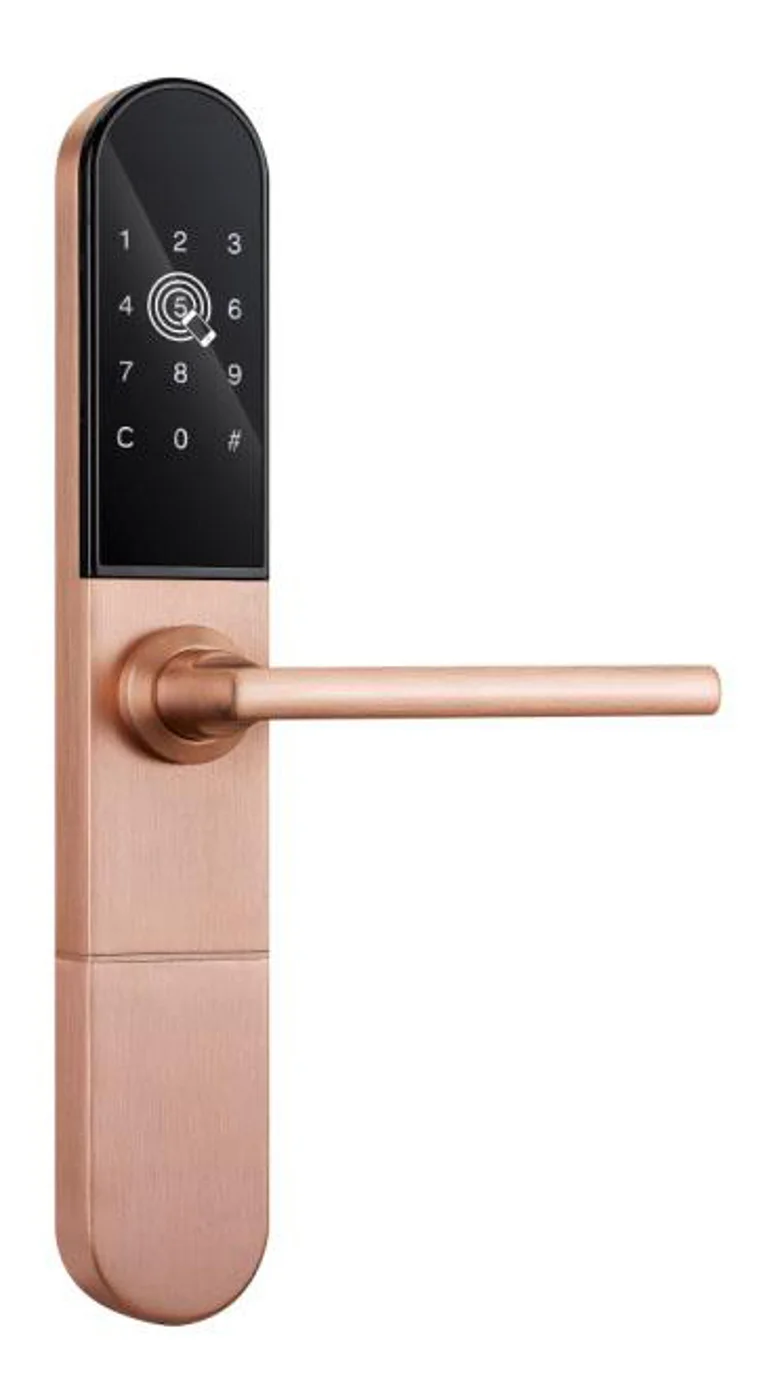
Smart Cabinet Lock — App-Managed, Multi-Site Dashboard
App-managed smart cabinet lock for office, parcel, and multi-site fleets. BLE app dashboard, audit trail, remote unlock, no per-lock server. Higher-tier chassis.
This page already points to it as the next recommended reference.
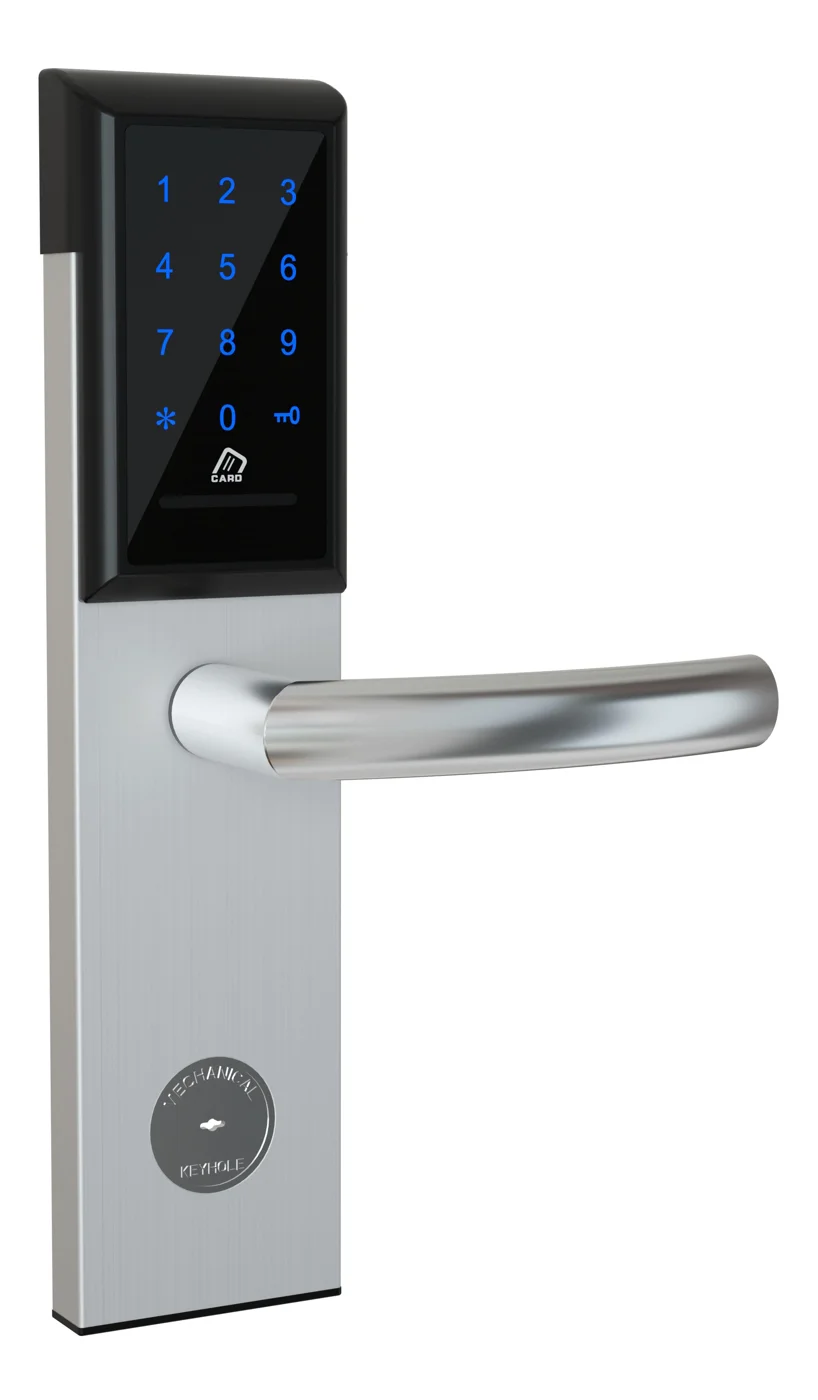
Office Cabinet Lock — PIN + Card for Filing & Pedestals
Offline PIN + card office cabinet lock for filing cabinets, pedestals, and drawers. Battery-powered 5-minute retrofit, no WiFi, no key management. CE/FCC/RoHS.
This page already points to it as the next recommended reference.
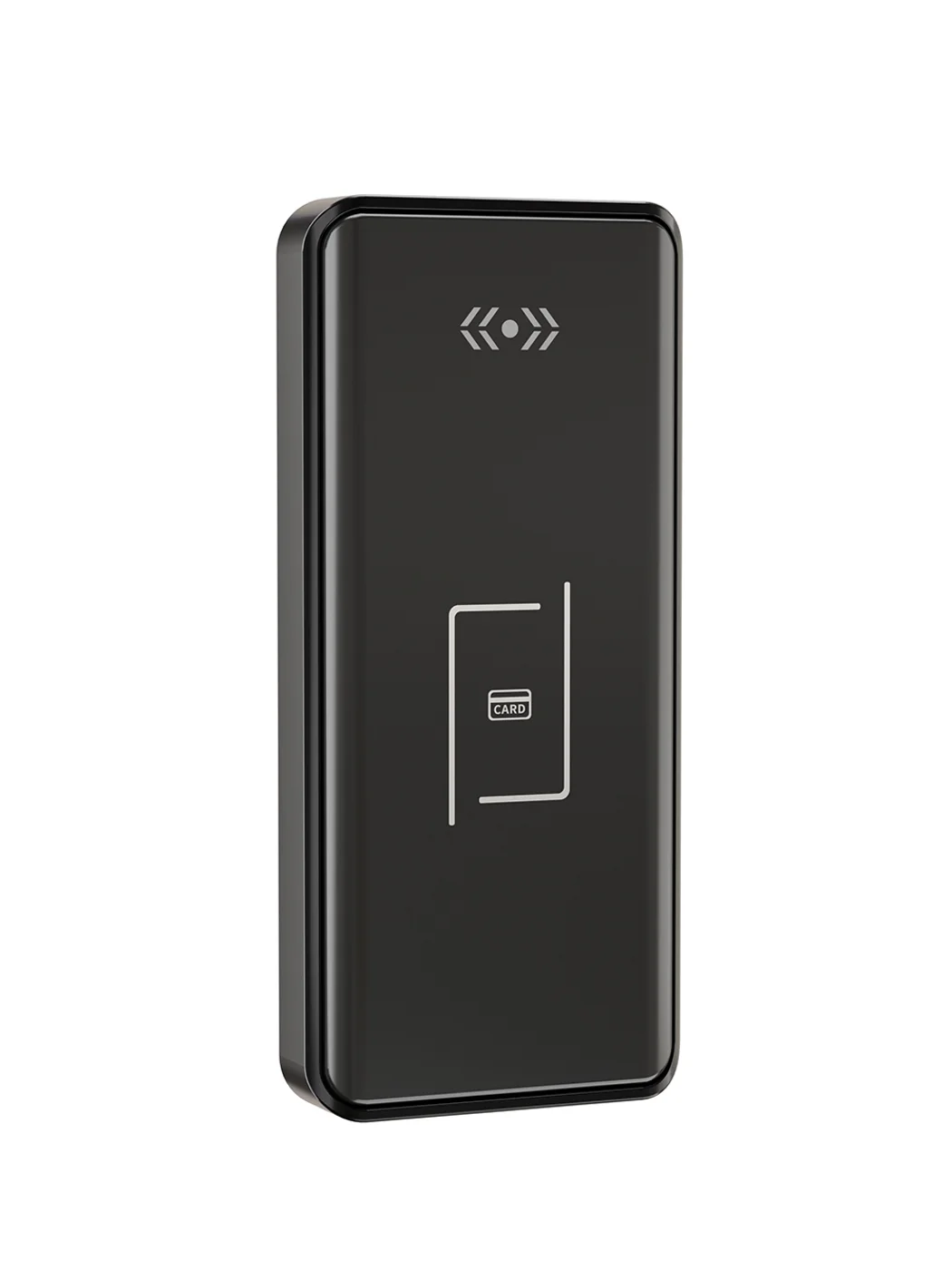
Gym Locker Lock — Offline Card, No WiFi Required
Offline card gym locker lock for fitness and pool lockers. MIFARE card, battery-powered 5-minute retrofit, no WiFi or server. Zinc alloy body, CE/FCC/RoHS.
This page already points to it as the next recommended reference.
Related blog posts
3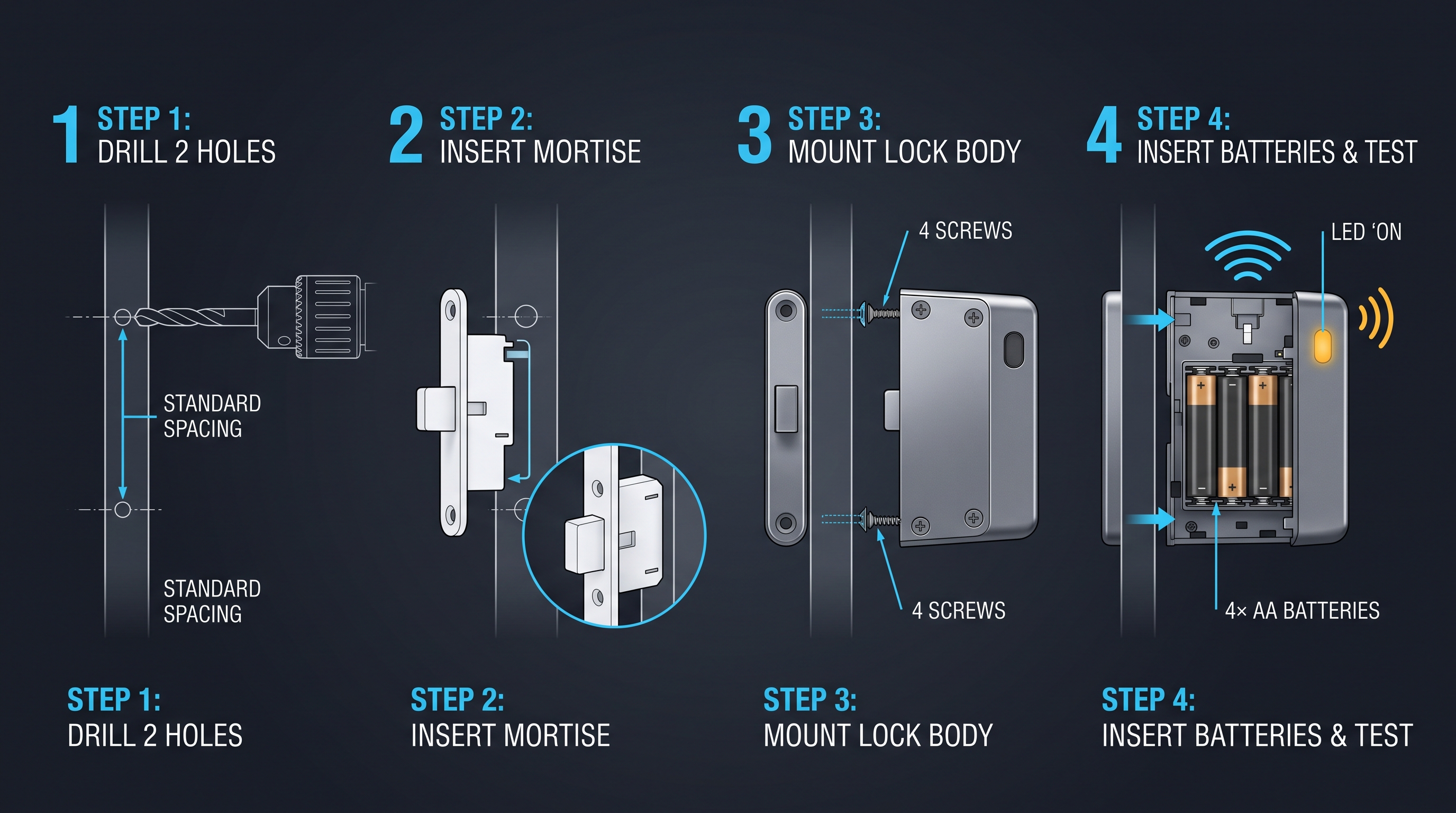
Jewelry Cabinet Lock: The Complete Guide to Securing High-Value Jewelry in Cabinets and Showcases
Learn how a jewelry cabinet lock secures high-value jewelry in display cabinets and safes. Compare electromagnetic, RFID, biometric, and keyed jewelry cabinet lock systems.
It supports the same product context: Smart Cabinet Lock — App-Managed, Multi-Site Dashboard, Office Cabinet Lock — PIN + Card for Filing & Pedestals, Gym Locker Lock — Offline Card, No WiFi Required.
IoT Cabinet Lock: The Complete Guide to Smart, Connected Cabinet Security
Discover how IoT cabinet lock technology works with Wi-Fi, BLE, Zigbee, MQTT, and cloud dashboards. Covers telemetry, fleet management, OTA, edge vs cloud, and security.
It supports the same product context: Smart Cabinet Lock — App-Managed, Multi-Site Dashboard, Office Cabinet Lock — PIN + Card for Filing & Pedestals, Gym Locker Lock — Offline Card, No WiFi Required.
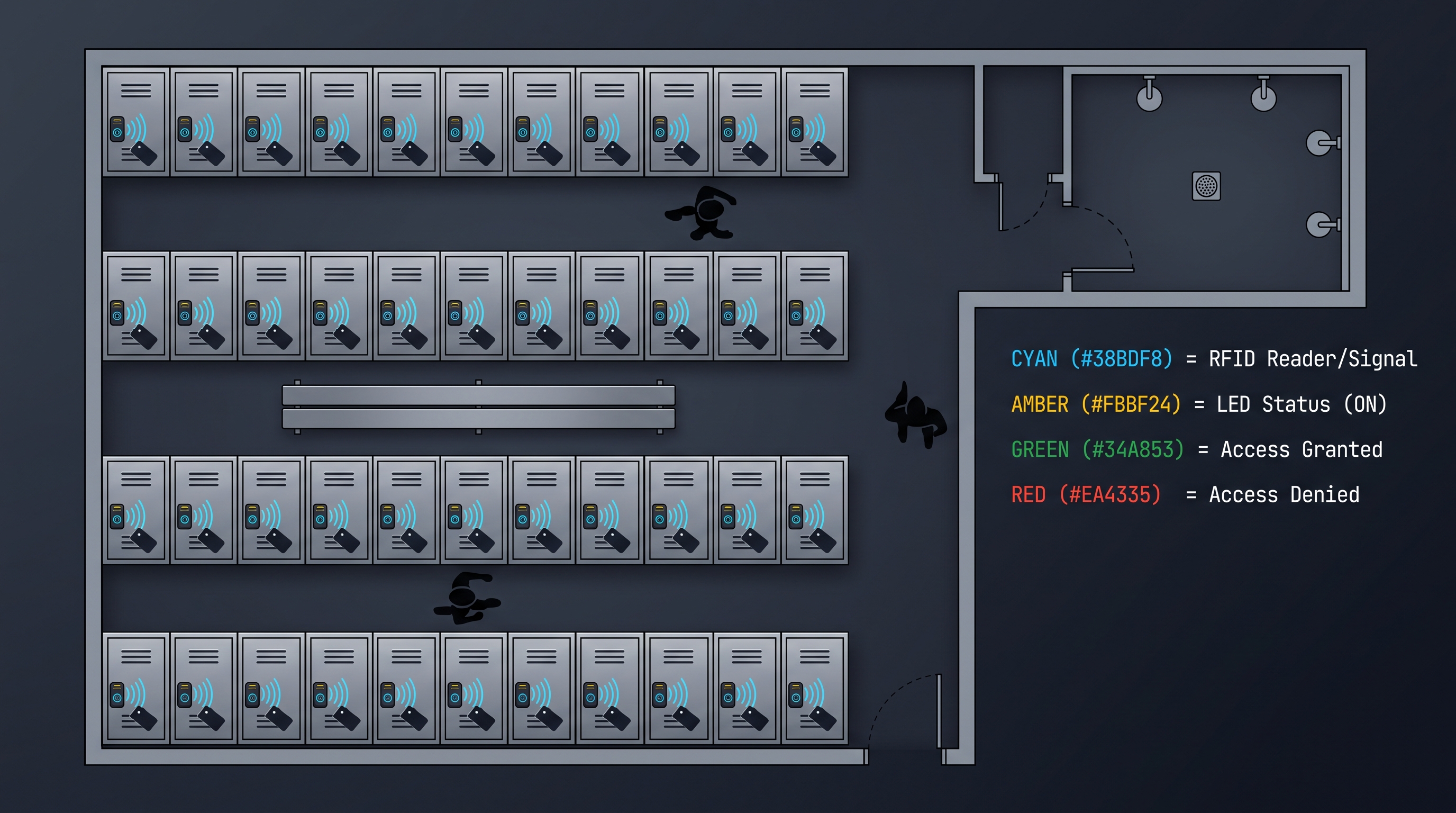
The Complete Guide to the IoT Locker Lock: Hardware, Cloud, and Fleet Management for Smart Locker Banks
Discover how an IoT locker lock powers delivery locker banks, shared-office cabinets, and smart gym storage. Wi-Fi, BLE, Zigbee, NB-IoT, LoRaWAN protocols, OTA firmware, telemetry, and procurement criteria.
It supports the same product context: Gym Locker Lock — Offline Card, No WiFi Required.
Specify your hotel project with our engineers
Send your room count, ceiling type, and protocol preference. We will return a sample plan and quote within 24 business hours.
- Move from general guidance into a product or application discussion.
- Use RFQ when pricing, drawings, MOQ, or launch timing needs structure.
- Keep a direct contact path visible for fast clarifications and handoff.