Cabinet Lock Electronic: Complete Technical Guide for 2026 Buyers and Integrators
Comprehensive guide to cabinet lock electronic systems covering types, working principles, installation, pricing, and buying criteria for commercial applications.
A cabinet lock electronic is a battery-powered or hardwired locking mechanism designed to secure cabinets, lockers, and storage enclosures using electrical actuation rather than a mechanical key. Unlike traditional cam locks that rely on a physical tumbler, a cabinet lock electronic uses a solenoid or motor-driven bolt controlled by a credential input such as a PIN code, RFID card, or fingerprint. Typical operating voltage ranges from 4.5 V (three AA batteries) to 12 V DC, with standby current draw below 30 microamps and an operational cycle time of 0.3 to 0.8 seconds. Cabinet lock electronic systems are deployed across hospitality, healthcare, education, and industrial environments where audit trails, multi-user access, and centralized management are required. Key selection criteria for any cabinet lock electronic include lock type, credential modality, power source, communication protocol, and compliance certifications such as CE, FCC, and RoHS. The cabinet lock electronic market has expanded significantly as organizations transition from mechanical key management to digital access control.
Cabinet Lock Electronic Types and Classifications
A cabinet lock electronic is categorized by its actuation method, credential modality, and power source, with the three dominant types being keypad PIN locks, RFID card locks, and biometric fingerprint locks. Keypad-based cabinet lock electronic models operate at 4.5 to 6 V DC with typical battery life of 12 to 18 months, while RFID cabinet lock electronic variants use 13.56 MHz (ISO 14443) or 125 kHz frequency credentials and support up to 10,000 unique card entries. Motor-driven bolt mechanisms in a cabinet lock electronic deliver 5 to 8 N of locking force, compared to solenoid-based cabinet lock electronic designs that achieve 3 to 5 N but with faster response times of 0.2 seconds versus 0.5 seconds. Cabinet lock electronic classifications also extend to communication protocols, with standalone, networked (RS-485 or TCP/IP), and wireless (Zigbee 3.0, Bluetooth Low Energy 5.2, or Wi-Fi 802.11 b/g/n) configurations available. Certification requirements for a cabinet lock electronic vary by region, with CE marking mandatory for European markets and FCC Part 15 compliance required for all radio-equipped cabinet lock electronic models sold in the United States.
Keypad-Based Cabinet Lock Electronic
The keypad cabinet lock electronic remains the most widely deployed variant due to its simplicity and low cost. Users enter a 4 to 8 digit PIN on a numeric membrane or capacitive touch keypad, which the microcontroller in the cabinet lock electronic compares against stored codes. Most keypad cabinet lock electronic units support 1 to 9 user codes, with admin codes for management override. Battery life for a keypad cabinet lock electronic typically spans 8,000 to 12,000 unlock cycles on four AAA alkaline cells. The keypad cabinet lock electronic is ideal for environments where physical credentials are impractical, such as wet or dusty industrial settings. A keypad cabinet lock electronic also eliminates the risk of lost keys or cards, making it suitable for high-turnover environments like gyms and shared offices.
RFID Cabinet Lock Electronic
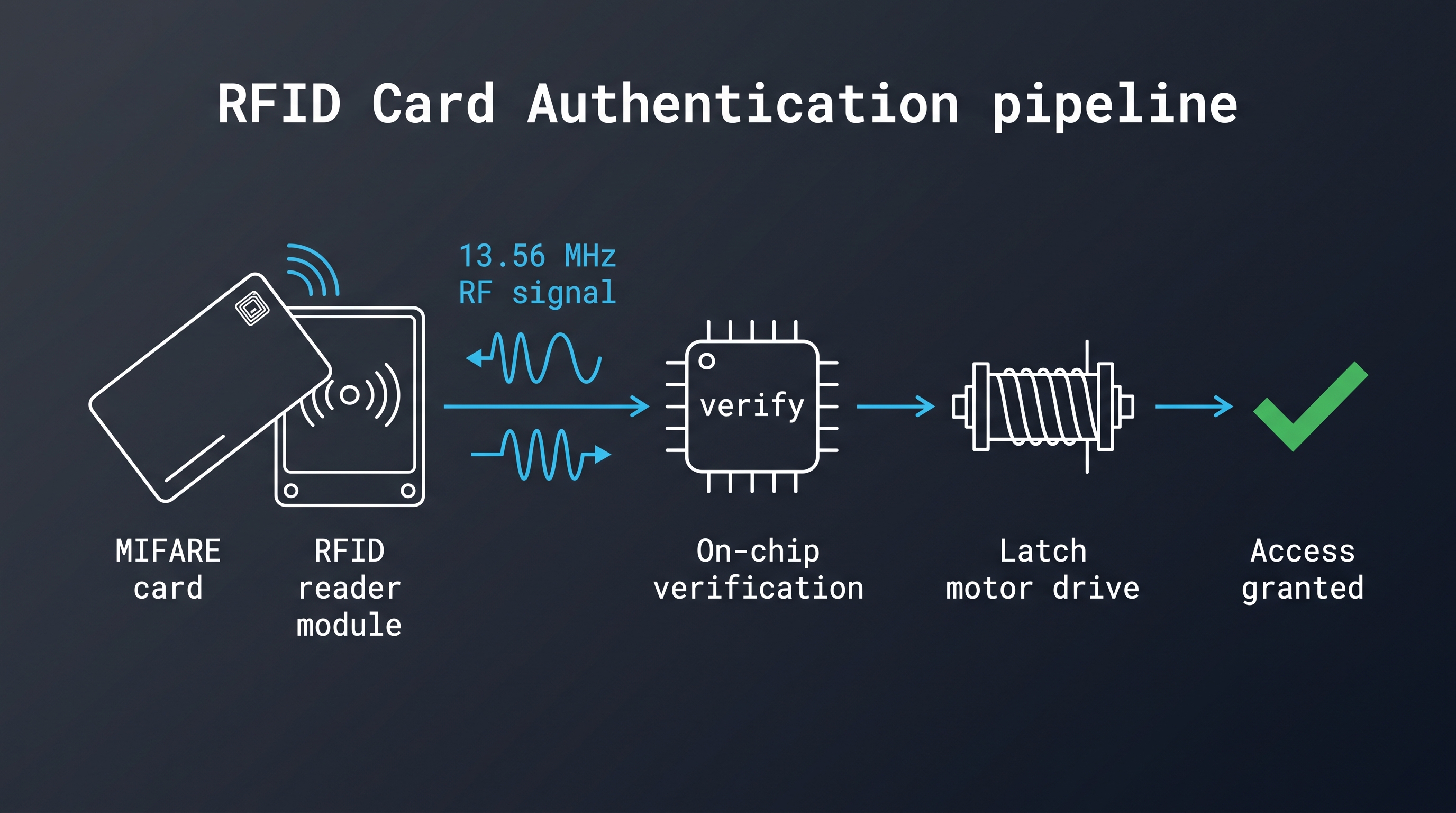
The RFID cabinet lock electronic uses radio-frequency identification to authenticate users via card, fob, or wristband. Operating at 13.56 MHz (MIFARE Classic, DESFire, or NTAG) or 125 kHz (EM410x), the RFID cabinet lock electronic reads a credential UID in under 50 milliseconds. High-end RFID cabinet lock electronic models support read-write sectors for bi-directional data exchange, enabling time-based access windows and anti-passback logic. The RFID cabinet lock electronic is preferred in hospitality and shared-workspace settings where users already carry compatible credentials. An RFID cabinet lock electronic can store user permissions directly on the card memory, allowing offline operation without requiring a network connection for every access decision.
Biometric Cabinet Lock Electronic
The biometric cabinet lock electronic integrates a fingerprint sensor (optical or capacitive) to grant access based on unique physiological characteristics. Capacitive sensors in a biometric cabinet lock electronic capture 500 dpi ridge patterns and match against stored templates in 0.3 to 0.5 seconds with a false acceptance rate below 0.0001 percent. The biometric cabinet lock electronic stores 50 to 500 fingerprint templates depending on memory capacity, making it suitable for multi-user cabinets in healthcare, laboratories, and secure document storage. A biometric cabinet lock electronic provides the highest level of user accountability since fingerprints cannot be shared or transferred between users.
Hidden Cabinet Lock Electronic
A hidden cabinet lock electronic is concealed behind the cabinet panel, with no externally visible locking mechanism. Actuation of a hidden cabinet lock electronic is triggered by an internal RFID reader, magnetic sensor, or Bluetooth signal from a smartphone. The hidden cabinet lock electronic is popular in residential furniture, display cases, and high-end retail where aesthetic integrity is paramount. Installation of a hidden cabinet lock electronic requires a mortise cutout of approximately 18 by 42 mm and a minimum panel thickness of 16 mm. The hidden cabinet lock electronic preserves the clean lines of designer furniture while providing electronic access control.
Cabinet Lock Electronic by Communication Protocol
The cabinet lock electronic product range includes standalone, networked, and wireless configurations. A standalone cabinet lock electronic operates independently without any connection to external systems, managing credentials and audit logs locally. A networked cabinet lock electronic connects via RS-485 or TCP/IP to a central management platform, enabling real-time monitoring and bulk credential management. A wireless cabinet lock electronic uses Zigbee, BLE, or Wi-Fi to communicate with a gateway or smartphone, eliminating the need for physical wiring. Each cabinet lock electronic communication architecture has distinct trade-offs in terms of installation cost, scalability, and power consumption.
Cabinet Lock Electronic Working Principles and Mechanisms
The working principle of a cabinet lock electronic centers on converting an electrical signal into mechanical bolt displacement through either a solenoid or a geared DC motor. When a valid credential is presented, the cabinet lock electronic microcontroller (typically an ARM Cortex-M0 or M3 running at 48 MHz) sends a pulse to the actuator driver circuit. In a solenoid-based cabinet lock electronic, this pulse energizes a coil, generating a magnetic field that pulls a ferrous plunger against a return spring, retracting the bolt for 0.2 to 0.5 seconds. In a motor-driven cabinet lock electronic, a 6 V DC micro-gearmotor rotates a cam that displaces the bolt laterally, providing higher holding force and quieter operation. The cabinet lock electronic firmware manages credential verification, audit logging, anti-tamper monitoring, and low-battery alerts. Communication between the credential reader and the lock body in a cabinet lock electronic uses a 3-wire UART or I2C bus at 9600 to 115200 baud. Power management is critical: the cabinet lock electronic spends 99.97 percent of its duty cycle in sleep mode at 5 to 30 microamps, waking only on credential detection to perform a 200 to 500 millisecond authentication and actuation sequence.
Solenoid Actuation in Cabinet Lock Electronic
The solenoid-based cabinet lock electronic is the simplest and most cost-effective actuation method. A cylindrical coil wound around a hollow bobbin generates a magnetic field when energized at 6 to 12 V DC, pulling a spring-loaded plunger into the coil body within the cabinet lock electronic. This linear motion retracts a latch bolt, allowing the cabinet door to open. The cabinet lock electronic solenoid draws 150 to 400 mA during its 0.2-second activation pulse, with peak force ratings of 3 to 5 N. Solenoid cabinet lock electronic designs are compact, typically measuring 35 by 35 by 20 mm, but produce an audible click that may be undesirable in quiet environments. The solenoid cabinet lock electronic is well-suited for applications where cost is the primary concern and acoustic noise is not a limiting factor.
Motor-Driven Bolt in Cabinet Lock Electronic
A motor-driven cabinet lock electronic uses a subminiature DC motor (typically 6 V, 6 mm diameter) coupled to a multi-stage gear reduction train that converts rotational motion to linear bolt travel. The motor in a cabinet lock electronic operates at 80 to 150 mA, significantly lower than a solenoid, and delivers 5 to 8 N of locking force through a hardened steel deadbolt. Motor-driven cabinet lock electronic units provide smoother, quieter operation and support auto-relock functionality, where the bolt extends automatically after a configurable timeout of 3 to 30 seconds. The motor-driven cabinet lock electronic is preferred in premium applications where silent operation and higher holding force justify the incremental cost.
Credential Authentication Logic in Cabinet Lock Electronic
The cabinet lock electronic authentication pipeline begins with credential capture, followed by feature extraction, template matching, and access decision. For PIN-based cabinet lock electronic models, the microcontroller hashes the entered code using SHA-256 and compares it against a stored hash table, preventing plaintext code extraction. For RFID cabinet lock electronic systems, the reader interrogates the credential at 13.56 MHz, retrieves the UID, and performs a lookup in EEPROM or flash memory. Biometric cabinet lock electronic units extract minutiae points from the fingerprint image and perform a Hamming distance comparison against stored templates. The cabinet lock electronic authentication process must complete in under 500 milliseconds to maintain a responsive user experience.
Power Management in Cabinet Lock Electronic
Power management is a defining characteristic of every cabinet lock electronic design. The cabinet lock electronic spends the vast majority of its operational life in ultra-low-power sleep mode, consuming only 5 to 30 microamps. Upon credential detection, the cabinet lock electronic wakes, performs authentication, actuates the bolt, logs the event, and returns to sleep within 200 to 500 milliseconds. Battery-powered cabinet lock electronic models achieve 1 to 3 years of operation on standard alkaline or lithium cells. Hardwired cabinet lock electronic units draw power from a 12 V DC or PoE (Power over Ethernet) supply, eliminating battery replacement concerns. The power architecture of a cabinet lock electronic directly impacts total cost of ownership and maintenance scheduling.
Cabinet Lock Electronic Features Comparison
The feature set of a cabinet lock electronic determines its suitability for specific applications, with key differentiators including access management, audit trail capacity, communication protocol, power source, and physical security ratings. Modern cabinet lock electronic models increasingly integrate wireless connectivity, with Zigbee 3.0 (2.4 GHz, 250 kbps), Bluetooth Low Energy 5.2 (2.4 GHz, 2 Mbps), and Wi-Fi 802.11 b/g/n being the dominant protocols. The cabinet lock electronic audit trail depth ranges from 1,000 entries on budget models to 100,000 entries on enterprise-grade units, with each log record containing timestamp, credential ID, and action type. Advanced cabinet lock electronic features include vacation mode, duress codes, and remote unlock via cloud API. Physical security of a cabinet lock electronic is quantified by bolt projection (15 to 25 mm), bolt diameter (8 to 12 mm), and anti-pry ratings tested to 500 N of lateral force. The comparison table below summarizes the cabinet lock electronic feature landscape across major categories.
| Feature | Keypad Cabinet Lock Electronic | RFID Cabinet Lock Electronic | Biometric Cabinet Lock Electronic | Hidden Cabinet Lock Electronic |
|---|---|---|---|---|
| Credential type | 4 to 8 digit PIN | 13.56 MHz / 125 kHz card | Fingerprint template | RFID / Bluetooth |
| User capacity | 1 to 9 codes | 100 to 10,000 cards | 50 to 500 templates | 100 to 1,000 credentials |
| Battery life | 8,000 to 12,000 cycles | 10,000 to 15,000 cycles | 5,000 to 8,000 cycles | 6,000 to 10,000 cycles |
| Audit trail | 1,000 to 3,000 entries | 3,000 to 10,000 entries | 5,000 to 50,000 entries | 3,000 to 10,000 entries |
| Communication | Standalone | RS-485 / TCP/IP | RS-485 / Wi-Fi | Zigbee / BLE 5.2 |
| Operating voltage | 4.5 to 6 V DC | 6 V DC | 6 to 12 V DC | 6 V DC |
| Locking force | 3 to 5 N | 5 to 8 N | 5 to 8 N | 3 to 5 N |
| Response time | 0.3 to 0.5 s | 0.2 to 0.3 s | 0.3 to 0.5 s | 0.3 to 0.8 s |
| IP rating | IP54 | IP54 to IP65 | IP54 | IP42 |
| Price range | $15 to $60 | $25 to $120 | $40 to $250 | $30 to $150 |
Access Management Capabilities of Cabinet Lock Electronic
The cabinet lock electronic access management system governs how credentials are enrolled, modified, and revoked. Standalone cabinet lock electronic units require physical proximity to the lock for management, typically using a programming code and keypad sequence. Networked cabinet lock electronic systems centralize management through a software platform accessible via web browser or mobile app, supporting bulk credential import, role-based access control, and time-scheduled access windows. Enterprise cabinet lock electronic platforms integrate with Active Directory or LDAP for single sign-on, automatically provisioning and de-provisioning access based on employee status. The access management architecture of a cabinet lock electronic directly impacts administrative overhead and security posture.
Audit Trail and Logging in Cabinet Lock Electronic
A cabinet lock electronic audit trail records every lock and unlock event with timestamp, credential identifier, and action result. Budget cabinet lock electronic models store 1,000 to 3,000 events in volatile memory that may be lost during battery failure, while enterprise cabinet lock electronic models use non-volatile flash storage retaining 50,000 to 100,000 events even without power. The cabinet lock electronic audit trail is exported via USB, RS-485, or network download in CSV or JSON format, enabling integration with security information and event management (SIEM) systems. A cabinet lock electronic with comprehensive audit logging supports compliance with HIPAA, DEA, and other regulatory frameworks that mandate access tracking.
Communication and Connectivity in Cabinet Lock Electronic
Networked cabinet lock electronic connectivity options determine the system's scalability and integration depth. RS-485 bus wiring supports up to 32 cabinet lock electronic units per segment at distances up to 1,200 meters, making it cost-effective for large locker banks. TCP/IP connectivity provides higher bandwidth and direct cloud integration for a cabinet lock electronic but requires PoE or local power at each unit. Wireless cabinet lock electronic protocols eliminate cabling but introduce battery drain from radio transmissions, with Zigbee offering the lowest power consumption at 30 mA transmit current versus Wi-Fi at 200 to 350 mA. The connectivity choice for a cabinet lock electronic deployment must balance installation cost, ongoing operational cost, and functional requirements.
Physical Security Ratings of Cabinet Lock Electronic
The physical security of a cabinet lock electronic is measured by bolt projection, bolt diameter, housing material, and anti-tamper features. A cabinet lock electronic with a 20 mm bolt projection and 10 mm bolt diameter provides significantly greater resistance to prying than a model with a 10 mm bolt and 6 mm diameter. The cabinet lock electronic housing is typically constructed from die-cast zinc alloy or stainless steel, with tamper detection switches that trigger alerts if the housing is removed. High-security cabinet lock electronic models are tested to EN 14450 and EN 1143-1 standards for burglary resistance, with some achieving S1 or S2 security grades. The physical security profile of a cabinet lock electronic should be matched to the value of the assets being protected.
Cabinet Lock Electronic Applications and Use Cases
The cabinet lock electronic serves diverse applications across industries, with deployment patterns shaped by user volume, security requirements, and management complexity. In hospitality, the cabinet lock electronic secures in-room minibars, personal safes, and staff storage, with RFID credentials linked to the property management system for seamless guest access. Healthcare facilities deploy the cabinet lock electronic on medication cabinets, patient belongings lockers, and controlled substance storage, requiring audit trails compliant with DEA and HIPAA regulations. Educational institutions use the cabinet lock electronic for student lockers, lab equipment cabinets, and athletic storage, with networked management enabling semester-based credential provisioning. Industrial applications of the cabinet lock electronic include tool cribs, hazardous material storage, and maintenance parts cabinets, where integration with inventory management systems tracks tool checkout and return. Retail environments use the cabinet lock electronic on display cases, back-room storage, and fitting room lockers, with audit trails supporting loss prevention investigations. The cabinet lock electronic is also gaining traction in residential settings for home office cabinets, gun storage, and medication safes, where biometric and smartphone-based access provides convenience without sacrificing security.
Hospitality Cabinet Lock Electronic Deployments
Hotels and resorts deploy the cabinet lock electronic on in-room safes, minibar cabinets, and staff lockers. The hospitality cabinet lock electronic integrates with property management systems (PMS) such as Opera or Mews, linking guest room keys to cabinet access for the duration of the stay. RFID cabinet lock electronic models operating at 13.56 MHz dominate this segment, with MIFARE DESFire EV2 credentials providing mutual authentication and encrypted data transfer. The hospitality cabinet lock electronic must withstand 50,000 to 100,000 open/close cycles per year and operate reliably in humidity levels of 30 to 70 percent. Guest satisfaction depends on a cabinet lock electronic that responds instantly and never fails during a stay, making reliability the paramount selection criterion for hospitality deployments.
Healthcare Cabinet Lock Electronic Systems
Healthcare facilities represent one of the most demanding deployment environments for any cabinet lock electronic. Medication cabinets secured by a cabinet lock electronic must comply with DEA controlled substance regulations, requiring dual authentication (two authorized users) for access to Schedule II drugs. The healthcare cabinet lock electronic maintains detailed audit trails showing who accessed which compartment, at what time, and for how long, with this data retained for regulatory inspection periods of 3 to 7 years depending on jurisdiction. A healthcare cabinet lock electronic must withstand frequent cleaning with hospital-grade disinfectants, requiring an IP54 or higher ingress protection rating. The cabinet lock electronic in healthcare also integrates with electronic health record (EHR) systems to verify that medication access is aligned with active prescriptions.
Educational Institution Cabinet Lock Electronic Deployments
Schools and universities deploy the cabinet lock electronic across student lockers, laboratory equipment cabinets, and faculty storage. The educational cabinet lock electronic benefits from networked management that enables mass credential provisioning at semester start and automatic deactivation at semester end. A cabinet lock electronic in educational settings must withstand rough handling by students, requiring reinforced housings and tamper detection. The educational cabinet lock electronic typically uses RFID cards that double as student ID badges, reducing the cost of separate credential issuance. Budget-constrained institutions often select a keypad cabinet lock electronic for areas with limited user turnover, while high-traffic zones warrant RFID cabinet lock electronic systems for faster throughput.
Industrial Cabinet Lock Electronic Applications
Manufacturing facilities and warehouses deploy the cabinet lock electronic on tool cribs, maintenance parts cabinets, and hazardous material storage. The industrial cabinet lock electronic integrates with inventory management and enterprise resource planning (ERP) systems, tracking tool checkout by employee and triggering reorder alerts when consumable stock reaches minimum levels. An industrial cabinet lock electronic must operate in challenging environments with temperature ranges of minus 20 to plus 60 degrees Celsius, dust, vibration, and exposure to cutting fluids. The industrial cabinet lock electronic typically uses RS-485 networking for reliability in electrically noisy environments, with hardened connectors and conformal-coated circuit boards.
Retail Cabinet Lock Electronic Use Cases
Retail environments deploy the cabinet lock electronic on high-value display cases, stockroom cabinets, and fitting room lockers. The retail cabinet lock electronic supports dynamic access permissions where sales associates gain access to specific display cases during their shift and lose access automatically at shift end. A retail cabinet lock electronic with audit trail provides forensic evidence for loss prevention, identifying which employee accessed a display case before inventory discrepancy was discovered. The retail cabinet lock electronic must be aesthetically unobtrusive, with hidden or low-profile designs that do not detract from merchandise presentation.
Residential Cabinet Lock Electronic Applications
Homeowners are increasingly adopting the cabinet lock electronic for home office filing cabinets, gun safes, medication cabinets, and wine storage. The residential cabinet lock electronic leverages smartphone-based access via Bluetooth Low Energy, eliminating the need to remember PIN codes or carry separate credentials. A residential cabinet lock electronic with biometric authentication provides family members with individualized access while preventing children from accessing dangerous items. The residential cabinet lock electronic market is driven by smart home integration, with Matter and Apple HomeKit compatibility enabling voice-controlled locking and unlocking via Siri, Alexa, or Google Assistant.
Cabinet Lock Electronic Installation and Setup Guide
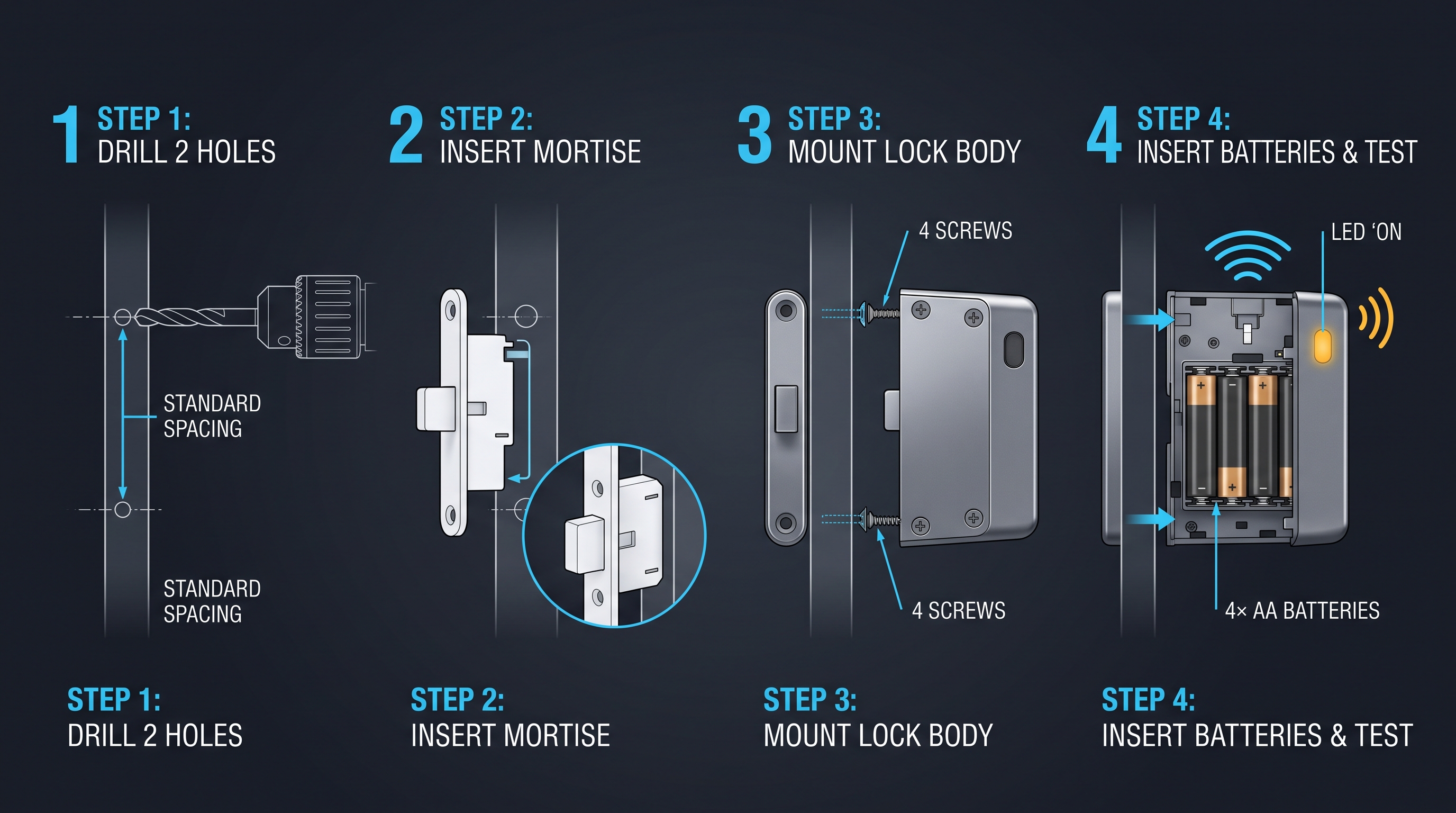
Installing a cabinet lock electronic requires mechanical preparation of the cabinet door or drawer, electrical wiring if applicable, and software configuration. The mechanical installation of a cabinet lock electronic involves drilling mounting holes according to the manufacturer's template, typically requiring a 19 mm or 22 mm hole saw for the lock body and smaller pilot holes for mounting screws. Surface-mount cabinet lock electronic models attach to the interior cabinet surface with screws, while mortise cabinet lock electronic designs require routing a rectangular pocket into the door edge. The electrical installation of a cabinet lock electronic connects the reader module to the lock body via a 3-wire or 4-wire harness carrying power, ground, and data signals. Wireless cabinet lock electronic models eliminate the wiring step but require battery installation and gateway pairing. Software configuration of a cabinet lock electronic enrolls the first admin credential, sets the clock, and configures operational parameters such as auto-relock delay and alarm thresholds.
Mechanical Installation of Cabinet Lock Electronic
The mechanical installation of a cabinet lock electronic begins with template placement and hole drilling. The installer aligns the paper template provided with the cabinet lock electronic against the door interior, marks hole centers, and drills a 19 to 22 mm diameter hole through the door for the lock barrel. Surface-mount cabinet lock electronic models require additional screw holes for the lock body and strike plate. Mortise cabinet lock electronic units require routing a cavity of approximately 18 by 42 by 12 mm into the door edge, best accomplished with a plunge router and template guide. The strike plate for a cabinet lock electronic mounts on the cabinet frame or adjacent door, aligned to receive the extended bolt with 1 to 2 mm of clearance. Proper alignment is critical: a misaligned cabinet lock electronic strike plate causes binding, premature wear, and potential lock failure.
Electrical Wiring for Hardwired Cabinet Lock Electronic
Hardwired cabinet lock electronic installations require routing low-voltage wiring from a central power supply or PoE switch to each lock location. A cabinet lock electronic network using RS-485 typically uses 4-conductor cable (two for power, two for data) with 22 to 24 AWG conductors, supporting cable runs up to 1,200 meters. TCP/IP cabinet lock electronic models use Cat5e or Cat6 cable with RJ45 terminations, limited to 100 meters per segment without a repeater. The power budget for a cabinet lock electronic installation must account for peak current draw during actuation, with a typical 12-lock RS-485 segment requiring a 2 A, 12 V DC power supply. All cabinet lock electronic wiring must comply with local electrical codes, with plenum-rated cable required for above-ceiling installations.
Wireless Cabinet Lock Electronic Setup
Wireless cabinet lock electronic installation is significantly simpler than wired alternatives, requiring only battery insertion and gateway pairing. The installer inserts the specified batteries (typically 4 AA or CR123A lithium cells) into the cabinet lock electronic, observing polarity markings. Pairing a Zigbee cabinet lock electronic involves placing the Zigbee coordinator in permit-join mode and pressing the enrollment button on the lock for 3 to 5 seconds until the LED indicates successful joining. BLE cabinet lock electronic pairing uses a smartphone app that scans for nearby locks and initiates pairing with a factory-default PIN. The wireless cabinet lock electronic signal strength should be verified at each lock location, with RSSI values of minus 65 dBm or better required for reliable communication. Repeaters or additional mesh nodes may be needed for wireless cabinet lock electronic deployments in large facilities or buildings with metal-framed walls.
Software Configuration for Cabinet Lock Electronic
After physical installation of a cabinet lock electronic, software configuration establishes the operational parameters. The first step in configuring a cabinet lock electronic is enrolling the administrator credential, which grants unrestricted access to programming functions. The cabinet lock electronic clock is set to the current date and time, either manually or via NTP synchronization for networked models. Auto-relock delay on a cabinet lock electronic is configured, typically between 3 and 30 seconds, determining how long the bolt remains retracted before automatically extending. Additional cabinet lock electronic parameters include wrong-try lockout threshold (3 to 10 failed attempts), alarm duration (30 to 180 seconds), and low-battery warning threshold (typically 4.2 V for a 6 V system). Each cabinet lock electronic parameter should be documented in the installation record for future maintenance reference.
Integration with Access Control Systems
Enterprise deployments of cabinet lock electronic systems require integration with existing physical access control infrastructure. A cabinet lock electronic network connects to an access controller via Wiegand, OSDP, or RS-485 protocol, with each cabinet lock electronic appearing as a door in the access control software. The cabinet lock electronic integration maps cabinet groups to access levels, granting different permissions to different user roles. Time-based access schedules on a cabinet lock electronic restrict access to business hours or specific shifts, with the lock automatically engaging outside authorized periods. The integration of a cabinet lock electronic with access control systems enables centralized reporting, where cabinet access events appear alongside door access events in unified security dashboards.
Cabinet Lock Electronic Pricing and Total Cost of Ownership
The purchase price of a cabinet lock electronic represents only the initial acquisition cost, with total cost of ownership (TCO) including installation labor, batteries, maintenance, software licensing, and eventual replacement over a 5 to 10 year lifecycle. A basic keypad cabinet lock electronic retails for $15 to $60 per unit, while enterprise-grade networked cabinet lock electronic systems range from $120 to $350 per lock, with per-lock costs decreasing at volume. Installation labor for a cabinet lock electronic averages $50 to $150 per lock for wired systems and $25 to $75 for wireless models, with the labor differential driven by wiring complexity. Annual maintenance for a cabinet lock electronic includes battery replacement ($5 to $15 per lock per year) and firmware updates, which are typically included in software licensing fees of $5 to $25 per lock per year. The 5-year TCO for a cabinet lock electronic deployment of 100 locks ranges from $22,000 for standalone keypad models to $95,000 for fully networked biometric systems.
| Cost Component | Keypad Cabinet Lock Electronic | RFID Cabinet Lock Electronic | Biometric Cabinet Lock Electronic | Hidden Cabinet Lock Electronic |
|---|---|---|---|---|
| Unit hardware | $15 to $60 | $25 to $120 | $40 to $250 | $30 to $150 |
| Installation labor | $25 to $75 | $50 to $100 | $50 to $125 | $75 to $150 |
| Annual batteries | $5 to $10 | $5 to $12 | $8 to $15 | $5 to $10 |
| Software license/yr | $0 | $5 to $15 | $10 to $25 | $5 to $10 |
| 5-year TCO per lock | $40 to $115 | $100 to $310 | $175 to $570 | $110 to $310 |
| Credential cost each | $0 (PIN only) | $1 to $5 | $0 (biometric) | $0 to $2 |
Budget Cabinet Lock Electronic Options
Budget cabinet lock electronic models are primarily standalone keypad units priced between $15 and $40 per lock. These budget cabinet lock electronic units provide basic PIN-code access with 1 to 9 user codes and a simple audit trail of 1,000 to 3,000 events. A budget cabinet lock electronic typically lacks networking capability, requiring physical proximity for all management operations. The budget cabinet lock electronic is suitable for low-security applications in small offices, residential settings, and businesses with fewer than 20 cabinets. Despite the low price point, a budget cabinet lock electronic should still carry CE and FCC certifications to ensure basic quality and safety compliance.
Mid-Range Cabinet Lock Electronic Solutions
Mid-range cabinet lock electronic solutions, priced from $60 to $150 per lock, add RFID credential support, larger audit trails, and optional networking. A mid-range cabinet lock electronic typically supports 100 to 1,000 users, 10,000 to 50,000 audit events, and RS-485 or BLE connectivity. The mid-range cabinet lock electronic offers the best value for most commercial deployments, providing enterprise features at a per-lock cost that scales economically to 200 to 500 lock installations. A mid-range cabinet lock electronic often includes a software management platform at no additional per-lock license cost, reducing ongoing operational expenses.
Enterprise Cabinet Lock Electronic Platforms
Enterprise cabinet lock electronic platforms, priced from $200 to $500 per lock, deliver full networking, biometric support, cloud management, and advanced integration capabilities. An enterprise cabinet lock electronic supports 1,000 to 100,000 users, 100,000 audit events, and multiple concurrent credential types (PIN, RFID, biometric, mobile). The enterprise cabinet lock electronic integrates with Active Directory, LDAP, SCIM, and REST APIs for automated user provisioning and de-provisioning. An enterprise cabinet lock electronic platform includes real-time monitoring dashboards, anomaly detection, and compliance reporting modules that satisfy SOC 2, HIPAA, and PCI DSS audit requirements.
Total Cost of Ownership Analysis for Cabinet Lock Electronic
A rigorous TCO analysis for a cabinet lock electronic deployment must account for hardware, installation, training, maintenance, and decommissioning costs over the expected lifecycle. A cabinet lock electronic with a higher initial purchase price but lower battery consumption and easier maintenance may have a lower TCO than a budget model over 7 years. The TCO of a cabinet lock electronic deployment is also influenced by credential costs: PIN-based systems have zero credential cost, RFID systems require cards or fobs at $1 to $5 each, and biometric systems have zero recurring credential cost but higher initial hardware cost. Power consumption of a cabinet lock electronic affects TCO through both battery replacement labor and battery purchase cost, with hardwired or PoE models eliminating the battery line item at the expense of higher installation cost. Software licensing for a cabinet lock electronic management platform ranges from free (basic standalone programming) to $25 per lock per year for cloud-based enterprise platforms with API access and advanced analytics.
Cabinet Lock Electronic Security and Compliance Considerations
The security architecture of a cabinet lock electronic spans physical tamper resistance, electronic credential protection, communication encryption, and audit integrity. A cabinet lock electronic is only as secure as its weakest link, and attacks may target the lock body, the credential reader, the communication channel, or the stored data. Physical attacks on a cabinet lock electronic include prying, drilling, shimming, and magnet manipulation, each countered by specific design features. Electronic attacks on a cabinet lock electronic include replay attacks, relay attacks, side-channel analysis, and firmware exploitation. A security-hardened cabinet lock electronic implements defense-in-depth with multiple overlapping countermeasures validated by independent penetration testing. Compliance standards applicable to a cabinet lock electronic include UL 1034 for electric locks, EN 14450 for secure storage units, and NIST SP 800-63 for digital identity guidelines.
Physical Security of Cabinet Lock Electronic
The physical security of a cabinet lock electronic begins with the lock housing material and construction. A cabinet lock electronic with a die-cast zinc alloy or stainless steel housing provides greater resistance to drilling and impact than a plastic-housed model. The bolt of a cabinet lock electronic should be made of hardened steel with a minimum diameter of 10 mm and projection of 20 mm to resist prying attacks. Tamper detection in a cabinet lock electronic uses microswitches or optical sensors to detect housing removal, triggering an alarm and logging the event. The strike plate of a cabinet lock electronic should be secured with through-bolts or security screws rather than conventional wood screws that can be easily removed.
Electronic Security of Cabinet Lock Electronic
Electronic security in a cabinet lock electronic protects the credentials, communication, and stored data from unauthorized access. Credential storage in a cabinet lock electronic uses salted hashing for PIN codes, encrypted memory sectors for RFID card data, and template hashing for biometric data. Communication between the cabinet lock electronic reader and lock body is encrypted using AES-128 or AES-256, preventing wiretap attacks on the 3-wire or 4-wire interconnecting cable. Networked cabinet lock electronic communication uses TLS 1.3 for TCP/IP connections and AES-CCM for Zigbee and BLE wireless links. Firmware updates for a cabinet lock electronic must be digitally signed by the manufacturer, with the bootloader verifying the signature before applying the update.
Regulatory Compliance for Cabinet Lock Electronic
A cabinet lock electronic deployed in regulated industries must comply with applicable standards and regulations. Healthcare cabinet lock electronic installations must satisfy HIPAA physical safeguard requirements and DEA 21 CFR Part 1301 for controlled substance storage. Financial services cabinet lock electronic deployments must meet FFIEC physical security guidelines and PCI DSS requirement 9.1 for physical access controls. UL 1034 certification for a cabinet lock electronic validates electrical safety, fire resistance, and endurance testing of 250,000 cycles. FCC Part 15 compliance is mandatory for any cabinet lock electronic with radio transmitters in the United States, while CE marking encompasses EMC (EN 55032), safety (EN 62368-1), and radio (EN 300 328) requirements for the European market.
Data Privacy and Cabinet Lock Electronic
A cabinet lock electronic that collects and stores biometric data or personal identifiers must comply with data privacy regulations including GDPR in Europe and CCPA in California. The cabinet lock electronic manufacturer should provide a data processing agreement (DPA) that specifies data retention periods, encryption standards, and data subject access request procedures. Biometric templates stored in a cabinet lock electronic should be processed locally on the lock and never transmitted to cloud servers in raw form. The cabinet lock electronic audit trail should be configurable to exclude personally identifiable information where privacy regulations require minimization.
Redundancy and Fail-Safe Cabinet Lock Electronic Design
A cabinet lock electronic must maintain security during power failures, battery depletion, and component failures. Fail-secure cabinet lock electronic designs remain locked when power is lost, protecting contents but potentially preventing access. Fail-safe cabinet lock electronic designs unlock on power loss, ensuring egress and access but compromising security. The choice between fail-secure and fail-safe cabinet lock electronic operation depends on the application: fail-secure is standard for storage cabinets, while fail-safe is specified for egress doors and emergency equipment cabinets. A cabinet lock electronic with dual power inputs (battery plus external power) provides redundancy, automatically switching to battery if external power fails.
Cabinet Lock Electronic Maintenance and Troubleshooting
Regular maintenance of a cabinet lock electronic extends service life, prevents unplanned failures, and ensures consistent security. The maintenance schedule for a cabinet lock electronic includes battery replacement at predetermined intervals, mechanical inspection of the bolt and strike plate, firmware updates, and audit log review. A cabinet lock electronic that is not maintained may develop bolt binding, intermittent credential rejection, or complete lock failure, any of which compromises security and requires emergency service. Troubleshooting a cabinet lock electronic follows a structured diagnostic approach: verify power, check credentials, inspect mechanical alignment, test communication, and review audit logs for error codes. Facility managers should maintain a maintenance log for each cabinet lock electronic, recording service dates, replaced components, and firmware version history.
Battery Management for Cabinet Lock Electronic
Battery-powered cabinet lock electronic models require proactive battery management to prevent unexpected lockout. The cabinet lock electronic provides low-battery warning through LED indicators, audible beeps, or networked alerts when battery voltage drops below the threshold (typically 4.2 V for a 6 V nominal system). Battery replacement in a cabinet lock electronic should be scheduled at 12-month intervals for alkaline batteries and 24-month intervals for lithium batteries, regardless of remaining capacity. A cabinet lock electronic should retain all programmed credentials and audit logs during battery replacement, using non-volatile memory or a supercapacitor backup. Emergency external power terminals on a cabinet lock electronic allow temporary power application from a 9 V battery to unlock if internal batteries fail completely.
Mechanical Maintenance of Cabinet Lock Electronic
The mechanical components of a cabinet lock electronic require periodic inspection and lubrication to prevent binding and wear. The bolt of a cabinet lock electronic should be cleaned with isopropyl alcohol and lubricated with dry PTFE or graphite lubricant annually, avoiding wet lubricants that attract dust and cause gumming. Strike plate alignment on a cabinet lock electronic should be checked every 6 months, as cabinet doors can sag over time, causing the bolt to rub against the strike plate edge. The hinge side of the cabinet door affects cabinet lock electronic alignment and should be tightened if the door has shifted. A cabinet lock electronic with a motor-driven bolt generally requires less mechanical maintenance than a solenoid design due to lower impact forces during operation.
Firmware Maintenance for Cabinet Lock Electronic
Firmware updates for a cabinet lock electronic address security vulnerabilities, add features, and fix bugs discovered after deployment. A cabinet lock electronic should be checked for available firmware updates at least quarterly, with critical security patches applied within 30 days of release. Firmware update procedures for a cabinet lock electronic vary by model: standalone units require physical connection of a programming tool, while networked cabinet lock electronic models receive firmware-over-the-air (FOTA) updates pushed from the management platform. The cabinet lock electronic should be verified functional after each firmware update by testing with an admin credential and checking that all user credentials remain enrolled.
Common Cabinet Lock Electronic Issues and Solutions
The most frequent cabinet lock electronic issues and their resolutions are well-documented across the industry. A cabinet lock electronic that fails to respond to any credential typically has depleted batteries or a disconnected power supply, resolved by battery replacement or connection verification. Intermittent credential rejection by a cabinet lock electronic often indicates a dirty reader surface, which can be cleaned with a microfiber cloth and isopropyl alcohol. A cabinet lock electronic that unlocks but immediately relocks before the door can be opened usually has an auto-relock delay set too short, requiring adjustment to 5 to 10 seconds. A cabinet lock electronic with bolt binding or slow operation indicates mechanical misalignment or insufficient lubrication, requiring strike plate adjustment and bolt lubrication.
| Symptom | Likely Cause | Resolution |
|---|---|---|
| No response | Dead batteries | Replace batteries; check power connection |
| Slow bolt movement | Low battery or binding | Replace batteries; lubricate bolt |
| Intermittent credential failure | Dirty reader or low battery | Clean reader; replace batteries |
| Continuous beeping | Low battery alarm | Replace batteries immediately |
| Bolt binding | Misaligned strike plate | Adjust strike plate position |
| Network offline | Gateway or wiring fault | Check gateway; verify cable connections |
| All credentials rejected | Corrupted memory | Perform factory reset; reload credentials |
Emergency Access Procedures for Cabinet Lock Electronic
Every cabinet lock electronic deployment must include documented emergency access procedures for situations where normal credential methods fail. The primary emergency access method for a cabinet lock electronic is a mechanical override key that directly retracts the bolt, bypassing all electronic controls. The mechanical override on a cabinet lock electronic should be stored in a sealed envelope within a secure key management system, with access logged and audited. Secondary emergency access for a cabinet lock electronic involves applying external power to emergency terminals using a 9 V battery and entering a factory master code. A networked cabinet lock electronic may support remote emergency unlock via the management platform, provided network connectivity is still active.
Cabinet Lock Electronic Technology Trends and Future Outlook
The cabinet lock electronic market is evolving rapidly, driven by advances in wireless connectivity, biometric sensing, artificial intelligence, and cloud computing. The next generation of cabinet lock electronic products will feature seamless smartphone integration via Matter 1.3 and BLE 5.4 protocols, eliminating the need for proprietary hubs and credentials. AI-powered cabinet lock electronic systems will use machine learning algorithms to detect anomalous access patterns, flagging potential credential sharing or forced entry attempts in real time. Ultra-low-power cabinet lock electronic designs leveraging energy harvesting technology will eliminate battery replacement entirely, drawing power from RFID field energy or indoor solar cells. The cabinet lock electronic form factor will shrink through system-in-package integration, with complete lock electronics fitting into a 25 by 25 by 10 mm module. Biometric cabinet lock electronic sensors will evolve beyond fingerprint to include palm vein recognition, iris scanning, and 3D facial recognition.
Wireless Protocol Evolution for Cabinet Lock Electronic
The cabinet lock electronic wireless landscape is consolidating around three protocols: Matter 1.3 for smart home integration, BLE 5.4 for smartphone credentials, and Wi-Fi 6 for high-bandwidth cloud connectivity. Matter-compatible cabinet lock electronic products benefit from multi-vendor interoperability, allowing a single smart home controller to manage locks from different manufacturers. BLE 5.4 introduces Periodic Advertising with Responses (PAwR), enabling ultra-low-power cabinet lock electronic communication at 1 microamp receive current, extending battery life to 3 to 5 years. Wi-Fi 6 cabinet lock electronic models leverage OFDMA and target wake time (TWT) to reduce power consumption by 60 percent compared to Wi-Fi 4. The cabinet lock electronic of 2028 will seamlessly transition between these protocols based on use case and power availability.
Artificial Intelligence in Cabinet Lock Electronic
AI-enhanced cabinet lock electronic systems use edge machine learning to analyze access patterns and detect anomalies. The cabinet lock electronic microcontroller runs a lightweight neural network (typically 50 to 200 KB model size) that classifies each access event as normal, suspicious, or malicious based on factors such as time of day, credential history, and inter-event timing. When the cabinet lock electronic AI model flags a suspicious event, it can require secondary authentication, trigger a silent alarm, or temporarily disable the credential. Federated learning approaches allow multiple cabinet lock electronic units to share threat intelligence without transmitting raw user data, preserving privacy while improving detection accuracy through collective learning.
Energy Harvesting Cabinet Lock Electronic
Energy harvesting technology promises to eliminate the cabinet lock electronic battery as a maintenance item. RFID-powered cabinet lock electronic designs harvest energy from the 13.56 MHz credential reader field, generating 5 to 10 milliwatts during the 50-millisecond card presentation window. This energy charges a supercapacitor that powers the cabinet lock electronic actuator for the brief bolt retraction cycle. Indoor solar cells integrated into the cabinet lock electronic housing can generate 10 to 50 microwatts under typical office lighting (300 to 500 lux), sufficient to maintain the lock in sleep mode indefinitely. Piezoelectric energy harvesters on the door hinge generate a pulse each time the door is opened, providing supplemental charge to the cabinet lock electronic energy storage buffer.
Biometric Advancements in Cabinet Lock Electronic
The biometric cabinet lock electronic is advancing beyond fingerprint to include modalities that are harder to spoof and more convenient to use. Palm vein recognition uses near-infrared light (850 nm) to image the vascular pattern beneath the skin surface, achieving false acceptance rates below 0.00001 percent with no physical contact. Iris scanning cabinet lock electronic models use a compact near-infrared camera to capture iris patterns at 15 to 30 cm distance, authenticating users without requiring them to touch the sensor. 3D facial recognition cabinet lock electronic units use a structured-light or time-of-flight sensor to create a depth map of the user's face, resistant to photograph and video replay attacks. All of these biometric cabinet lock electronic modalities are being miniaturized to fit within the power and space constraints of a standard cabinet lock electronic form factor.
Sustainability and Circular Economy for Cabinet Lock Electronic
The cabinet lock electronic industry is responding to sustainability pressures with modular designs that allow field replacement of individual components rather than discarding the entire lock. Cabinet lock electronic housings are increasingly made from post-consumer recycled ABS or bioplastics, and manufacturers are publishing environmental product declarations documenting carbon footprint. Firmware-over-the-air updates extend the cabinet lock electronic functional lifespan by 3 to 5 years, reducing electronic waste and total cost of ownership. Some cabinet lock electronic manufacturers now offer take-back programs where end-of-life locks are disassembled and components are recovered for reuse or recycling.
Market Forecast for Cabinet Lock Electronic
The global cabinet lock electronic market is projected to grow from $1.3 billion in 2025 to $3.0 billion by 2032, representing a compound annual growth rate (CAGR) of 12.5 percent. Growth drivers include increasing adoption of smart building technology, regulatory mandates for audit-trail access control in healthcare and finance, and the replacement cycle for legacy mechanical cabinet locks. The Asia-Pacific region is the fastest-growing cabinet lock electronic market, driven by rapid commercial construction in China, India, and Southeast Asia. North America remains the largest cabinet lock electronic market by revenue, with enterprise-grade networked systems accounting for 55 percent of spending. The residential cabinet lock electronic segment is emerging as a significant growth opportunity, with smart home integration and DIY installation driving consumer adoption.
Cabinet Lock Electronic Buying Guide and Selection Criteria
Selecting the right cabinet lock electronic requires systematic evaluation of credential type, communication protocol, power source, physical security level, and total cost of ownership against the specific requirements of the deployment environment. The buying process for a cabinet lock electronic begins with a needs assessment that documents the number of cabinets, user count, existing credential infrastructure, environmental conditions, and compliance requirements. A cabinet lock electronic selection matrix weights each criterion by importance and scores candidate models to identify the best fit. Buyers should request evaluation samples of the cabinet lock electronic before committing to large orders, testing installation, operation, and management workflows in the actual deployment environment. The cabinet lock electronic vendor should provide technical documentation, API references, warranty terms, and references from deployments of similar scale and industry.
| Selection Criterion | Keypad Cabinet Lock Electronic | RFID Cabinet Lock Electronic | Biometric Cabinet Lock Electronic | Hidden Cabinet Lock Electronic |
|---|---|---|---|---|
| User capacity | 1 to 9 | 100 to 10,000 | 50 to 500 | 100 to 1,000 |
| Best for | Small deployments | Medium to large | High security | Aesthetics first |
| Credential cost | $0 | $1 to $5 each | $0 | $0 to $2 |
| Management effort | High (per-lock) | Low (centralized) | Medium | Low (app-based) |
| Installation complexity | Low | Medium | Medium | High |
| Ongoing cost | Batteries only | Batteries, software | Batteries, software | Batteries |
| Security level | Basic | Medium | High | Medium |
Needs Assessment for Cabinet Lock Electronic
The first step in selecting a cabinet lock electronic is a thorough needs assessment. Document the total number of cabinets to be secured, as this determines whether a standalone or networked cabinet lock electronic is appropriate. Count the number of users who will access each cabinet lock electronic, noting whether access patterns are individual, shared, or role-based. Identify any existing credential infrastructure (employee badges, hotel key cards, biometric enrollment) that a cabinet lock electronic can leverage to avoid duplicate credential issuance. Measure environmental conditions including temperature range, humidity, dust exposure, and cleaning chemical exposure at each cabinet lock electronic location. List all regulatory compliance requirements that apply to the cabinet lock electronic deployment, such as HIPAA, DEA, or PCI DSS. This needs assessment becomes the basis for the cabinet lock electronic selection criteria weighting.
Vendor Evaluation for Cabinet Lock Electronic
Cabinet lock electronic vendors should be evaluated on product quality, technical support, warranty, and industry experience. Request cabinet lock electronic specifications sheets, material safety data sheets, and third-party test reports demonstrating compliance with claimed certifications. Evaluate the cabinet lock electronic management software for usability, feature completeness, API documentation, and integration with existing systems. Contact cabinet lock electronic vendor references who deployed at least 6 months ago, asking about reliability, battery life in practice, and support responsiveness. The cabinet lock electronic vendor should provide a warranty of at least 2 years covering defects in materials and workmanship, with an extended warranty option available.
Sample Testing of Cabinet Lock Electronic
Before committing to a bulk cabinet lock electronic purchase, request 2 to 5 evaluation units and install them in the actual deployment environment. Test the cabinet lock electronic across the full range of expected conditions: normal operation, low battery, rapid successive access, and extreme temperatures if applicable. Verify that the cabinet lock electronic management software performs all required functions including credential enrollment, modification, revocation, and audit log export. Test the cabinet lock electronic emergency access procedures to ensure they work as documented. Operate the evaluation cabinet lock electronic units for at least 30 days to assess battery drain rates, mechanical wear, and user acceptance before committing to a production order.
Procurement and Deployment Planning for Cabinet Lock Electronic
A cabinet lock electronic procurement plan should account for lead times, spare units, installation scheduling, and user training. Order 5 to 10 percent extra cabinet lock electronic units as spares to cover installation damage, future expansion, and rapid replacement of failed units. Schedule cabinet lock electronic installation during low-activity periods to minimize disruption, and allow 30 to 60 minutes per lock for wired installations and 15 to 30 minutes per lock for wireless cabinet lock electronic models. Train facility staff on cabinet lock electronic management tasks including credential enrollment, battery replacement, and audit log retrieval before the system goes live. Document the cabinet lock electronic installation with photographs of wiring, device serial numbers, and configuration settings for future reference.
Part of this article content is generated by AI and optimized for professional accuracy and readability.
Not sure which sensor fits your project?
Talk to our mmWave application engineers for a free consultation.
Find the right presence sensor for your hotel project
Compare the 3 protocols, check hotel-specific case studies, and download the installation guide
Related products
3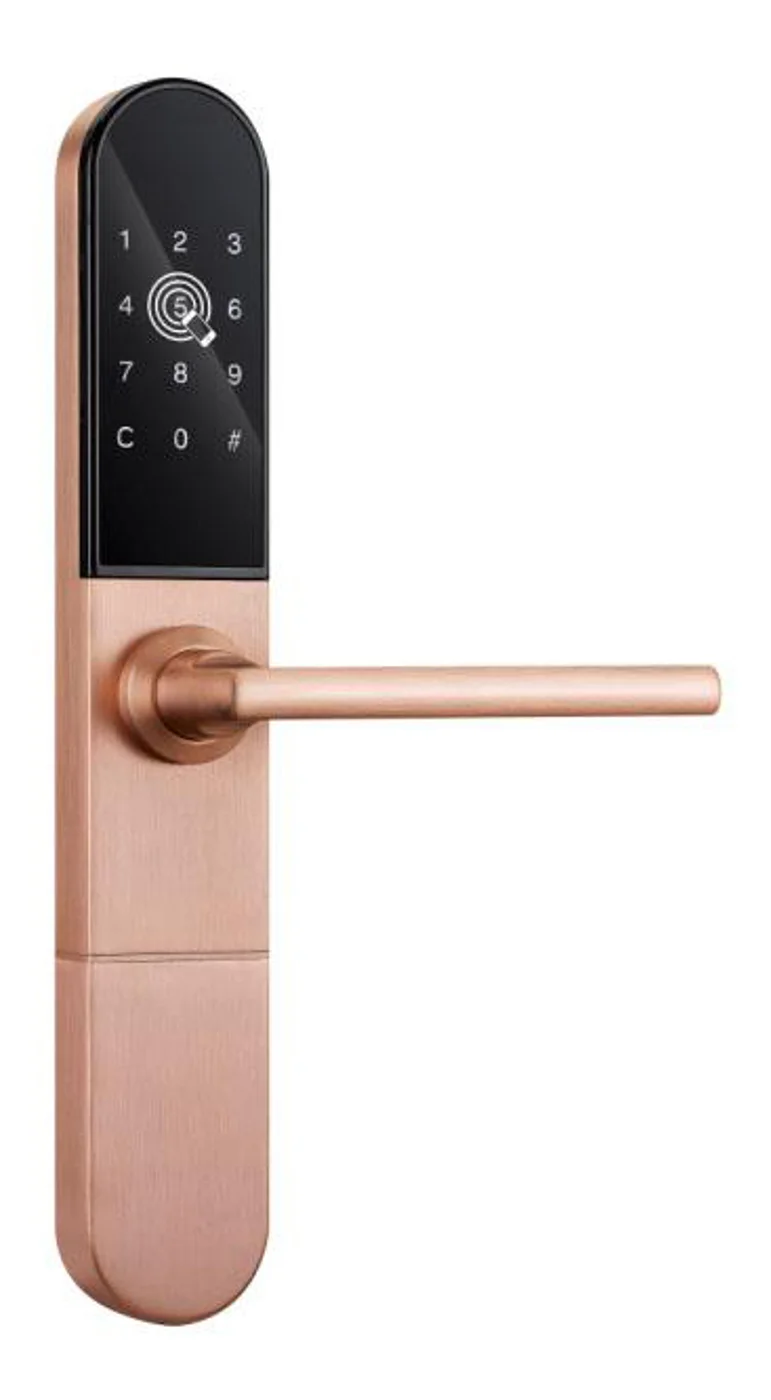
Smart Cabinet Lock — App-Managed, Multi-Site Dashboard
App-managed smart cabinet lock for office, parcel, and multi-site fleets. BLE app dashboard, audit trail, remote unlock, no per-lock server. Higher-tier chassis.
This page already points to it as the next recommended reference.
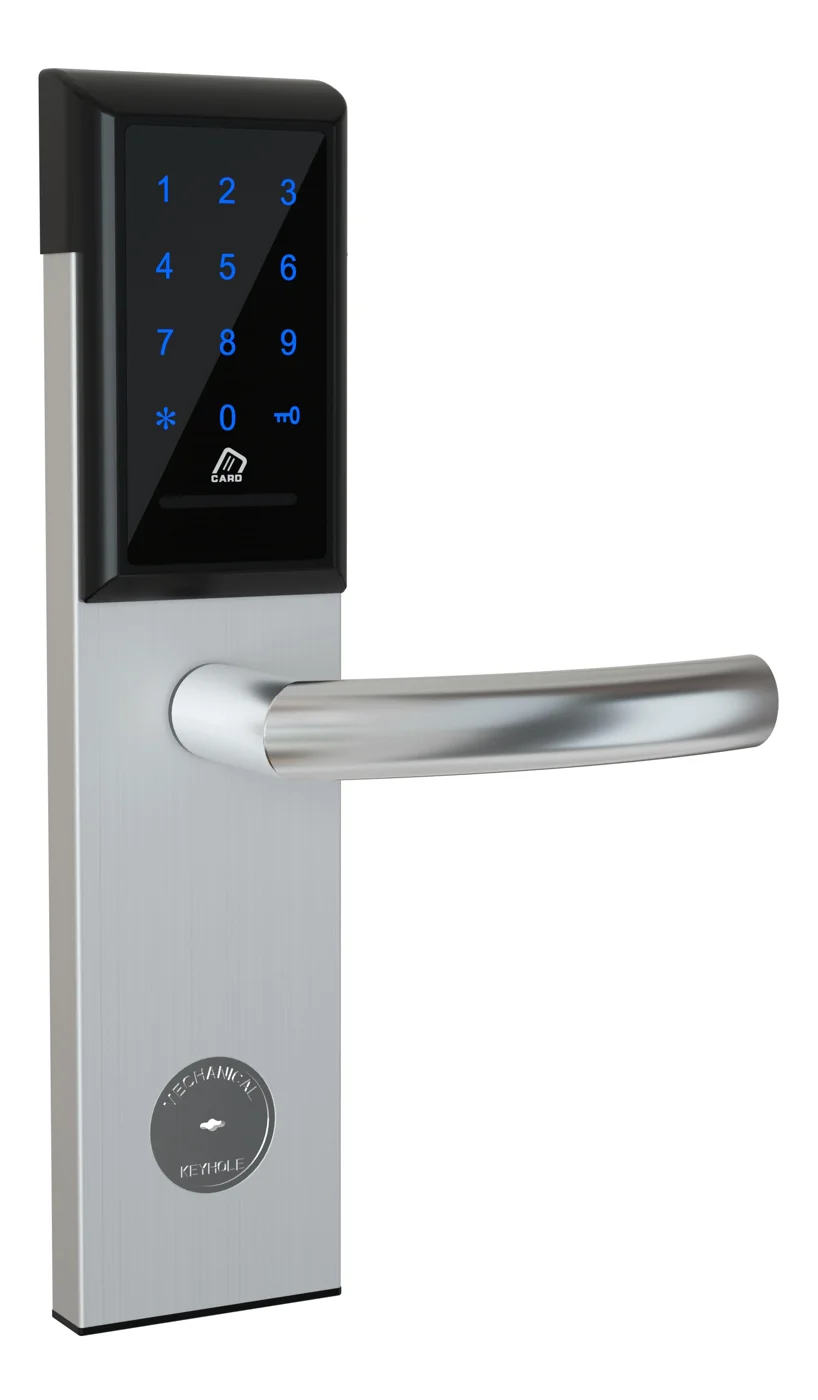
Office Cabinet Lock — PIN + Card for Filing & Pedestals
Offline PIN + card office cabinet lock for filing cabinets, pedestals, and drawers. Battery-powered 5-minute retrofit, no WiFi, no key management. CE/FCC/RoHS.
This page already points to it as the next recommended reference.
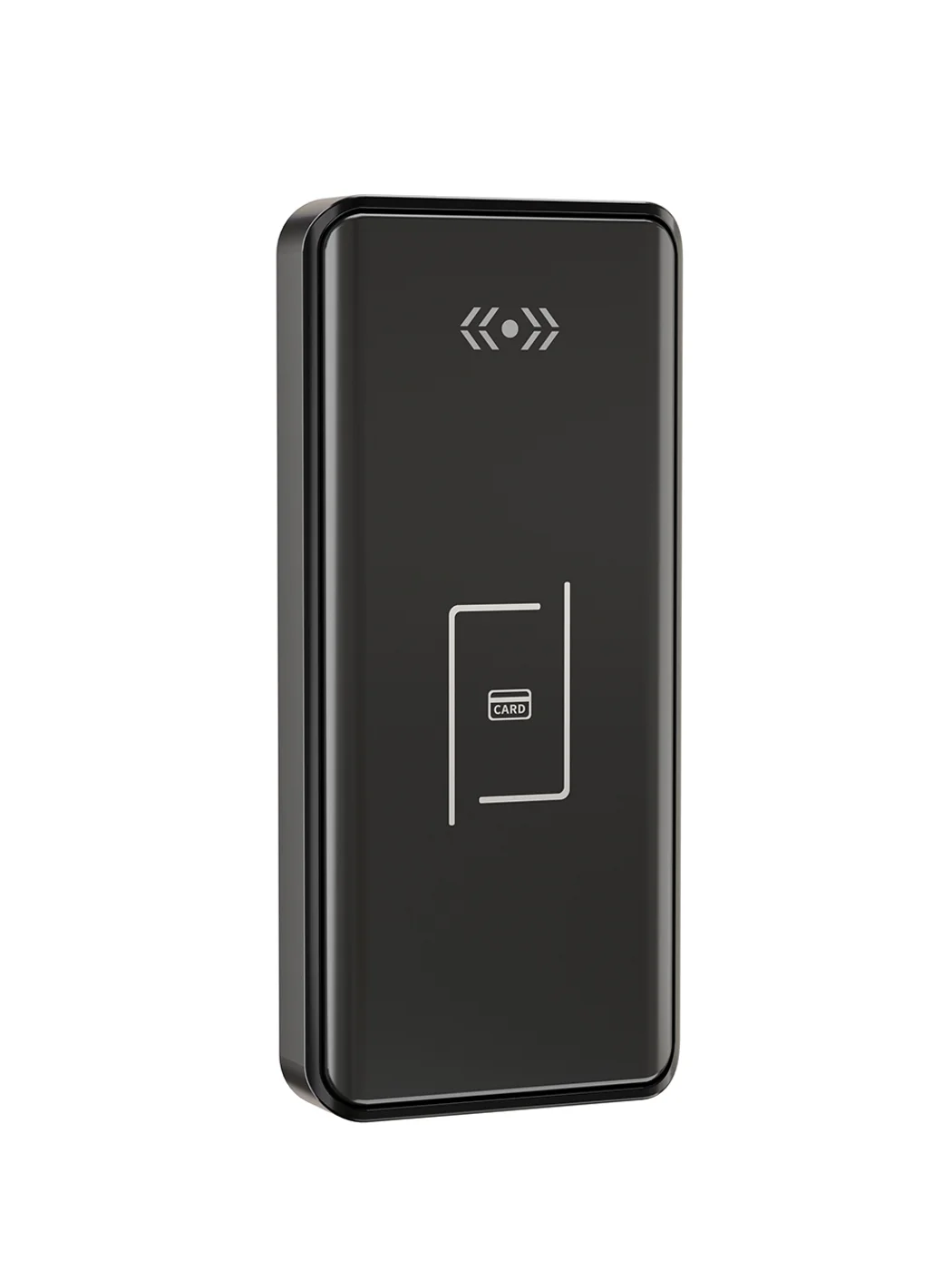
Gym Locker Lock — Offline Card, No WiFi Required
Offline card gym locker lock for fitness and pool lockers. MIFARE card, battery-powered 5-minute retrofit, no WiFi or server. Zinc alloy body, CE/FCC/RoHS.
This page already points to it as the next recommended reference.
Related blog posts
3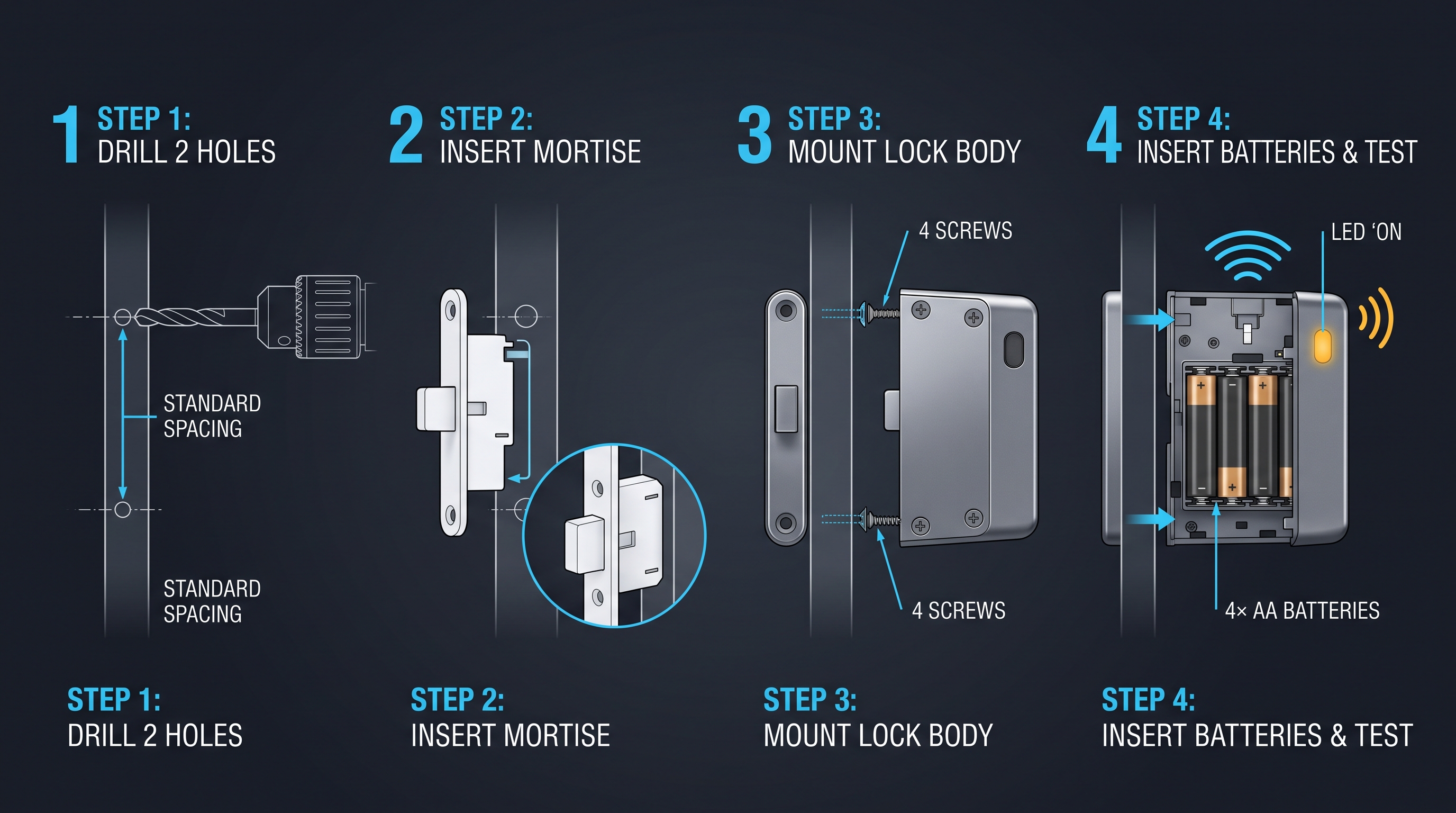
Cabinet Digital Lock: Complete Technical Guide for 2026 Buyers and Integrators
Comprehensive guide to cabinet digital lock systems covering types, working principles, installation, pricing, and buying criteria for commercial and residential applications.
It supports the same product context: Smart Cabinet Lock — App-Managed, Multi-Site Dashboard, Office Cabinet Lock — PIN + Card for Filing & Pedestals, Gym Locker Lock — Offline Card, No WiFi Required.
cabinet latch electronic: The Complete Guide to Electronic Latches for Cabinets, Furniture, and Enclosures
Learn what a cabinet latch electronic is, how solenoid, motor, electromagnetic strike, and push-to-open electronic latches work, plus 12V/24V wiring, fail-secure vs fail-safe, relay and app control, use cases, installation, pricing, and troubleshooting.
It supports the same product context: Smart Cabinet Lock — App-Managed, Multi-Site Dashboard, Office Cabinet Lock — PIN + Card for Filing & Pedestals, Gym Locker Lock — Offline Card, No WiFi Required.
Cabinet Cam Lock Electronic: Keyless Electronic Cam Locks Explained
A cabinet cam lock electronic is a keyless, motor-driven replacement for mechanical cam locks that fits standard 22.5 mm and 24 mm bores in metal cabinets.
It supports the same product context: Smart Cabinet Lock — App-Managed, Multi-Site Dashboard.
Specify your hotel project with our engineers
Send your room count, ceiling type, and protocol preference. We will return a sample plan and quote within 24 business hours.
- Move from general guidance into a product or application discussion.
- Use RFQ when pricing, drawings, MOQ, or launch timing needs structure.
- Keep a direct contact path visible for fast clarifications and handoff.