Panduan Kunci Loker IoT: Hardware, Cloud, Manajemen Armada
Pelajari cara kunci loker IoT mendukung bank loker pengiriman, kantor bersama, dan gym pintar. Wi-Fi, BLE, Zigbee, NB-IoT, LoRaWAN, firmware OTA, dan telemetri.
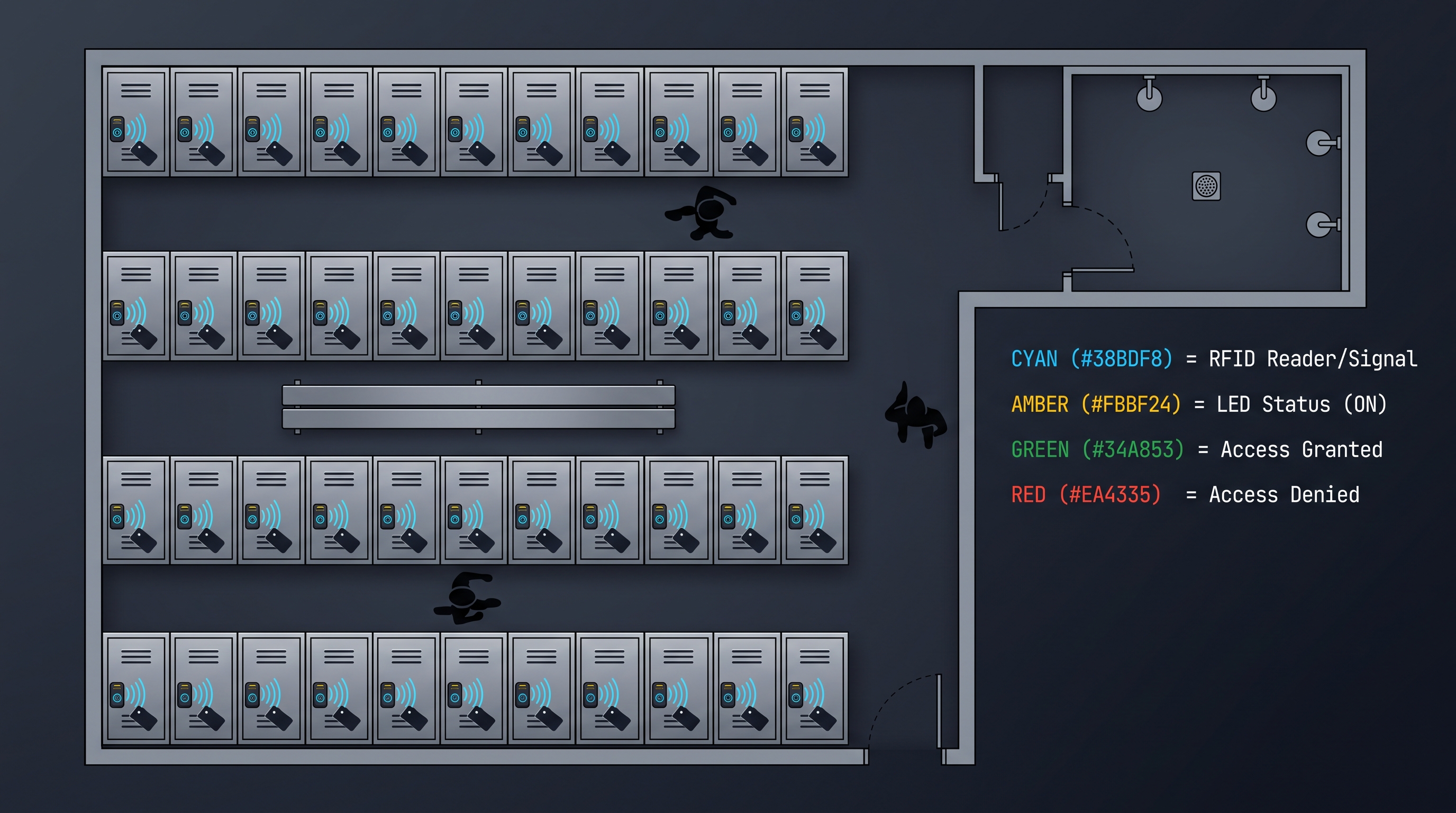
Apa Itu Kunci Loker IoT dan Apa Bedanya dengan Kunci Kabinet IoT?
Kunci loker IoT adalah mekanisme penguncian elektronik yang terhubung internet dan dirancang khusus untuk skenario bank loker komunal seperti kios pengiriman paket, stasiun click-and-collect, dinding penyimpanan kantor bersama, kabinet ruang ganti gym pintar, dan loker harian co-working. Berbeda dengan kunci kabinet IoT mandiri yang mengamankan satu perabot pribadi seperti lemari arsip atau kotak perkakas, kunci loker IoT dirancang untuk beroperasi sebagai satu simpul dalam susunan multi-kompartemen yang padat, tempat puluhan hingga ratusan kunci identik berbagi satu gateway cloud, satu bus daya bersama, dan satu mesin reservasi atau okupansi terpusat. Kunci loker IoT menarik arus antara 3 µA dalam siaga deep-sleep hingga 350–500 mA saat ledakan siklus penguncian pada tegangan nominal 3,7 V, dengan aktuasi selesai dalam 120–250 ms. Protokol nirkabel yang digunakan kunci loker IoT mencakup Wi-Fi 802.11b/g/n, Bluetooth 5.2/5.4 Low Energy, Zigbee 3.0, NB-IoT, dan LoRaWAN, masing-masing menimbulkan trade-off berbeda terhadap daya tahan baterai, kepadatan gateway, dan latensi cloud. Biaya satuan modul kunci loker IoT kelas produksi — mencakup solenoid, mikrokontroler, transceiver radio, rangkaian sensor reed-switch atau Hall-effect, dan sensor tamper — berkisar dari USD 18 hingga 62 pada volume sedang, dengan sertifikasi UL 294, CE, FCC, dan EN 16867 sebagai persyaratan umum untuk penerapan komersial. Setiap kunci loker IoT dalam bank komunal harus dapat dialamatkan satu per satu, terautentikasi secara kriptografis, dan mampu melaporkan status waktu nyatanya ke mesin okupansi cloud yang mengelola reservasi di seluruh bank. Arsitektur komunal multi-tenant inilah ciri pembeda yang memisahkan kunci loker IoT dari kunci kabinet IoT satu kabinet. Kunci loker IoT juga harus mendukung rentang suhu operasi yang lebih lebar daripada kunci kabinet karena bank loker sering dipasang di ruang tanpa pengaturan iklim seperti lobi gedung, garasi parkir, dan lokasi tepi jalan luar ruangan. Kunci loker IoT yang dirancang untuk penggunaan luar ruangan harus menyertakan conformal coating pada PCB-nya untuk melindungi dari kelembapan dan kondensasi yang tidak akan memengaruhi kunci kabinet khusus dalam ruangan. Kunci loker IoT yang diterapkan di lingkungan pesisir memerlukan pula konektor tahan korosi dan kompartemen baterai tersegel ber-rating IP65 untuk menahan udara yang mengandung garam. Kunci loker IoT untuk penggunaan gym dalam ruangan atau kantor dapat menghilangkan proteksi lingkungan ini, mengurangi biaya BOM-nya sekitar USD 2–4.
Komponen Perangkat Keras Utama Kunci Loker IoT untuk Bank Loker Komunal
Setiap kunci loker IoT mengintegrasikan lima subsistem perangkat keras esensial yang secara kolektif menentukan keandalan, efisiensi daya, kepatuhan keselamatan, dan total biaya kepemilikan di seluruh penerapan bank loker. Kunci loker IoT pada dasarnya adalah perangkat mekatronik di mana solenoid mekanis, MCU tertanam, radio nirkabel, susunan sensor, dan catu daya semuanya harus bekerja sama dalam enklop fisik pintu loker yang sempit. Aktuator dalam kunci loker IoT paling umum berupa solenoid bi-stable yang hanya mengonsumsi daya selama transisi status — sekitar 350 mA selama 150 ms untuk membuka dan pulsa serupa untuk mengunci — serta menahan posisi baut secara magnetis dengan arus siaga nol. Pulsa aktuasi ini adalah peristiwa penarikan daya terbesar dalam siklus operasi kunci loker IoT mana pun. Unit mikrokontroler dalam kunci loker IoT umumnya berupa inti Arm Cortex-M4 atau M33 yang berjalan pada 48–96 MHz dengan flash 256 KB–1 MB dan SRAM 64–256 KB, mengeksekusi tumpukan firmware kunci dan mengelola protokol radio. Transceiver nirkabel dalam kunci loker IoT dipilih dari lima keluarga protokol utama — Wi-Fi, BLE, Zigbee, NB-IoT, atau LoRaWAN — masing-masing menuntut desain RF front-end dan sertifikasi regulasi tersendiri. Rangkaian sensor dalam kunci loker IoT mencakup sensor Hall-effect atau reed switch untuk umpan balik posisi latch, mikro-saklar tamper yang memicu interupsi jika badan kunci dibobol, dan terkadang akselerometer untuk mendeteksi benturan atau kemiringan kolom loker keseluruhan. Subsistem daya kunci loker IoT terdiri dari paket baterai primer untuk pemasangan sepenuhnya nirkabel atau masukan DC tegangan rendah dari bus daya terpusat dengan cadangan superkapasitor atau coin-cell yang ber-rating untuk retensi jam waktu-nyata minimal 72 jam. Enklosure kunci loker IoT umumnya ber-rating IP54 dan terbuat dari paduan seng atau stainless steel dengan latch bolt yang diperkeras dan lolos pengujian serangan mekanis EN 16867 Kelas 2 atau Kelas 3. Modul kunci loker IoT yang dirancang baik berdimensi kira-kira 60 × 40 × 20 mm, cukup kecil untuk muat dalam tepi 15–18 mm pintu loker standar 18 mm. Interoperabilitas mekanis kunci loker IoT dengan profil pintu loker yang ada menjadi krusial untuk penerapan retrofit di mana mengganti keseluruhan rangka pintu terlalu mahal. Setiap kunci loker IoT juga harus menyertakan mekanisme override manual — umumnya override kunci mekanis atau pelepas tersembunyi — yang memungkinkan manajer fasilitas membuka kunci tanpa daya maupun konektivitas jaringan saat keadaan darurat.
Perbandingan Protokol Nirkabel untuk Kunci Loker IoT
Memilih protokol nirkabel yang tepat untuk kunci loker IoT adalah keputusan arsitektural paling berdampak yang diambil integrator bank loker, karena keputusan itu mengatur daya tahan baterai, infrastruktur gateway, latensi cloud, biaya BOM per unit, dan kepadatan fisik loker yang dapat dilayani satu titik akses. Memilih kunci loker IoT yang tepat dimulai dengan memahami trade-off protokol ini, karena modul radio adalah komponen individual termahal pada BOM kunci. Tabel di bawah menyajikan perbandingan berdampingan dari lima protokol dominan yang digunakan dalam penerapan kunci loker IoT per pertengahan 2026. Pilihan protokol setiap kunci loker IoT berdampak langsung pada total biaya kepemilikan bank loker selama horizon operasional multi-tahun. Kunci loker IoT yang menggunakan protokol yang salah untuk lingkungan penerapannya akan mengalami baterai yang terkuras prematur atau konektivitas cloud yang tidak andal. Kunci loker IoT yang ditujukan untuk bank loker urban berkepadatan tinggi, misalnya, memerlukan protokol berbeda dari kunci loker IoT yang diperuntukkan bagi lobi kantor pinggiran kota dengan lalu lintas rendah.
| Protokol | Pita Frekuensi | Jangkauan Maks (Dalam Ruangan) | Arus Puncak (TX) | Arus Tidur | Gateway Diperlukan | Maks Kunci per Gateway | Latensi OTA Tipikal |
|---|---|---|---|---|---|---|---|
| Wi-Fi 802.11b/g/n | 2.4 GHz | 30–50 m | 250–350 mA | 10–50 µA | Tidak (hanya router) | 30–60 per AP | 30–90 s |
| BLE 5.2/5.4 | 2.4 GHz | 10–30 m | 8–15 mA | 1–5 µA | Ya (gateway BLE) | 40–80 per gateway | 120–300 s |
| Zigbee 3.0 | 2.4 GHz | 15–40 m | 20–35 mA | 1–3 µA | Ya (koordinator + mesh) | 100–250 per koordinator | 60–180 s |
| NB-IoT (LTE Cat-NB2) | Seluler berlisensi | 1–15 km | 150–250 mA puncak | 2–5 µA | Hanya menara seluler | Tak terbatas per sel | 30–60 s |
| LoRaWAN | EU868 / US915 | 500 m–5 km LOS | 25–40 mA | 1–2 µA | Ya (gateway LoRa) | 200–500 per gateway | Tidak praktis |
BLE dan Zigbee mendominasi pemasangan kantor bersama dalam ruangan serta click-and-collect ritel karena arus puncak sub-15 mA memungkinkan kunci loker IoT melampaui 18–24 bulan operasi pada 30–60 aktuasi per hari dengan satu sel 18650. Wi-Fi menarik untuk bank loker kecil di mana Wi-Fi kantor yang sudah ada menghilangkan kebutuhan gateway khusus, tetapi penalti arus puncak mengurangi daya tahan baterai kunci loker IoT menjadi 6–9 bulan kecuali bus daya berkabel dipasang. NB-IoT cepat mengalami adopsi untuk penerapan loker paket luar ruangan atau tepi jalan di mana setiap kunci loker IoT harus dapat dialamatkan individual tanpa gateway lokal. LoRaWAN paling cocok untuk telemetri throughput rendah dari kunci loker IoT dalam penerapan area sangat luas seperti ladang loker kampus, tetapi tidak dapat mendukung pembaruan firmware OTA yang andal karena duty cycle-nya yang terbatas. Kendala regulasi regional juga memengaruhi pemilihan protokol kunci loker IoT: penerapan berbasis UE semakin memilih NB-IoT atau BLE untuk menghindari kemacetan pita bebas lisensi, sementara integrator Amerika Utara sering memilih Wi-Fi atau BLE dengan Zigbee sebagai cadangan untuk susunan berkepadatan lebih tinggi. Kunci loker IoT yang mendukung operasi dua protokol — misalnya BLE untuk pembukaan kedekatan lokal dikombinasikan dengan NB-IoT untuk telemetri cloud — menawarkan fleksibilitas penerapan terbesar tetapi membawa premium BOM sekitar USD 4–8 per unit.
Arsitektur Okupansi dan Reservasi Cloud untuk Kunci Loker IoT
Platform cloud yang mengelola penerapan kunci loker IoT adalah sistem terdistribusi yang terdiri dari tiga tingkat: firmware kunci dan mesin status tertanam waktu-nyata pada setiap kunci loker IoT; gateway atau prosesor tepi yang mengagregasi peristiwa dari bank loker dan meneruskannya ke hulu; serta backend cloud yang menyediakan API RESTful dan WebSocket untuk reservasi, pelacakan okupansi, kontrol akses, penyerapan telemetri, dan orkestrasi OTA. Mesin status di dalam setiap kunci loker IoT mempertahankan minimal status-status berikut: Idle (kunci terkunci, pintu tertutup, tidak ada reservasi aktif), Reserved (sesi pengguna tertunda, kunci loker IoT memegang token terikat waktu), Occupied (pintu telah dibuka dan ditutup kembali setelah pengiriman atau pengambilan), Overstay (terisi melampaui masa tenggang yang diizinkan), Jarred (latch terdeteksi sebagian terpasang atau pintu terbuka sedikit), Tamper (terasa upaya pembobolan fisik pada kunci loker IoT), Low Battery (tegangan di bawah ambang yang dapat dikonfigurasi), dan Out of Service (gangguan atau penguncian pemeliharaan manual). Transisi status dalam kunci loker IoT dicatat dengan stempel waktu UTC dan sumber pemicu — pembacaan sensor lokal, perintah API cloud, atau jabat tangan kedekatan BLE.
Alur reservasi untuk loker paket click-and-collect tipikal yang digerakkan kunci loker IoT berjalan sebagai berikut. Konsumen menerima kode pembuka sekali pakai atau JWT bertanda tangan melalui SMS, email, atau aplikasi seluler peritel. Konsumen mendekati bank loker, menemukan kompartemen yang ditugaskan (sering ditandai LED RGB bawaan pada bezel kunci loker IoT), dan menyajikan kredensial melalui kios layar sentuh, pemindai kode QR, atau kedekatan BLE di ponsel mereka. Kios atau gateway memvalidasi token terhadap backend cloud dan mengirim perintah pembukaan bertanda tangan ke alamat radio kunci loker IoT yang spesifik. Kunci loker IoT memverifikasi tanda tangan kriptografis perintah menggunakan sertifikat X.509 yang telah disiapkan sebelumnya, melepas solenoid bi-stable, dan melaporkan peristiwa pembukaan kembali ke cloud. Sensor pintu-terbuka dalam kunci loker IoT mulai melakukan polling dengan interval 100 ms. Saat pengguna menutup pintu, kunci loker IoT otomatis mengunci kembali dan melaporkan status terisi dengan stempel waktu. Jika pintu tetap terbuka melampaui timeout yang dapat dikonfigurasi, cloud memicu notifikasi push ke peritel atau manajer fasilitas. Seluruh siklus reservasi-hingga-okupansi ini bergantung pada kunci loker IoT yang mempertahankan sinkronisasi status presisi dengan backend cloud bahkan melalui gangguan jaringan sementara.
Model data okupansi untuk penerapan kunci loker IoT harus mendukung penugasan transien maupun penugasan permanen. Backend cloud memelihara catatan untuk setiap kunci loker IoT dengan bidang ID kompartemen, ID bank, lokasi geografis, ID pengguna atau sesi yang ditugaskan, status dengan stempel waktu, riwayat tegangan baterai, versi firmware, dan log pemeliharaan. Untuk manajemen armada berskala besar — satu penerapan dapat mencakup 500–5.000 unit kunci loker IoT di sepuluh hingga seratus lokasi bank — cloud harus mendukung operasi massal: peluncuran firmware OTA simultan dengan kohort canary bertahap, dasbor telemetri agregat yang menampilkan rata-rata konsumsi baterai per kunci loker IoT per bulan, tingkat kegagalan pembukaan per bank, dan peta panas peristiwa tamper. Peringatan otomatis terpicu saat baterai kunci loker IoT mana pun jatuh di bawah ambang 20% atau saat kunci loker IoT gagal mengakui tiga perintah berturut-turut. Pipeline telemetri dari setiap kunci loker IoT harus menjamin pengiriman at-least-once dengan retry dan deduplikasi yang dapat dikonfigurasi — umumnya 30 detik dengan exponential backoff dibatasi lima kali retry — karena peristiwa acknowledgment pembukaan yang hilang dari kunci loker IoT dapat menyebabkan kurir tidak dapat menyelesaikan pengiriman.
Pola integrasi API untuk kurir pengiriman mil terakhir merupakan persoalan arsitektural tersendiri bagi ekosistem kunci loker IoT. Saat kurir tiba di bank loker paket dan memindai barcode pada kios pusat, cloud menugaskan tiga kunci loker IoT spesifik untuk run pengiriman itu, kios menerangi LED kunci yang sesuai, dan setelah setiap paket didepositokan serta pintu ditutup, peristiwa penutupan kunci loker IoT memicu notifikasi API kurir. Di sisi konsumen, sistem peritel menerima peristiwa yang sama dan menghasilkan notifikasi pengambilan. Integrasi dua arah menuntut pipeline peristiwa kunci loker IoT mempertahankan semantik pengiriman at-least-once agar tidak ada paket yang tertinggal tanpa acknowledgment dalam sistem kurir. Kunci loker IoT yang mengalami gangguan pipeline peristiwa selama jam puncak pengiriman dapat menunda lusinan pemberhentian kurir dan mengikis kepercayaan konsumen terhadap pengalaman pengambilan.
Payload Data dan Telemetri dari Kunci Loker IoT
Telemetri yang dihasilkan setiap kunci loker IoT dapat dikategorikan menjadi tiga tingkat berdasarkan frekuensi dan urgensi, dan platform cloud harus merutekan setiap tingkat melalui pipeline pemrosesan yang sesuai. Volume telemetri dari setiap kunci loker IoT bervariasi menurut protokol: kunci loker IoT berbasis BLE umumnya mengirim 5–15 KB per bulan dalam data transisi status, sedangkan kunci loker IoT NB-IoT mengirim 8–25 KB per bulan karena overhead protokol seluler yang lebih besar.
| Tingkat Telemetri | Contoh Payload | Frekuensi Pelaporan | Jalur Pemrosesan Cloud |
|---|---|---|---|
| Peristiwa kritis | Peringatan tamper, timeout pintu terbuka sedikit, kegagalan kunci, deteksi pembobolan paksa | Segera (dalam 500 ms setelah deteksi) | Prosesor stream waktu-nyata ke mesin peringatan ke notifikasi SMS/push |
| Transisi status | Peristiwa kunci/buka, peristiwa buka/tutup, mulai/akhir reservasi, snapshot tegangan baterai | Saat berubah (berbasis peristiwa) | Message broker ke event store ke proksi API kurir |
| Kesehatan & diagnostik | Versi firmware, RSSI radio, uptime koneksi, suhu, jumlah aktuasi, waktu siklus solenoid | Setiap 4–24 jam (batch) atau saat polling | Ingesti batch ke basis data time-series ke dasbor armada |
Payload telemetri JSON representatif dari kunci loker IoT yang melaporkan peristiwa pembukaan normal terukur 182 byte tanpa kompresi. Setiap pesan telemetri kunci loker IoT menyertakan tanda tangan kriptografis yang divalidasi backend cloud sebelum menerima peristiwa ke dalam pipeline pemrosesan. Ini mencegah peristiwa palsu dari broker MQTT yang dikompromikan atau replay man-in-the-middle pada tautan radio. Verifikasi tanda tangan di tepi cloud menambahkan latensi sekitar 5–15 ms per peristiwa dan dianggap sebagai kontrol keamanan wajib untuk penerapan kunci loker IoT mana pun yang menangani transaksi terkait pembayaran atau data pribadi. Skema telemetri kunci loker IoT sebaiknya diberi versi agar pembaruan firmware dapat menambah bidang diagnostik baru tanpa merusak dasbor hilir atau aturan peringatan.
json { "lock_id": "lock-bank03-comp14", "event": "unlock", "timestamp": "2026-08-04T14:32:18.427Z", "actuation_ms": 148, "battery_mv": 3720, "rssi_dbm": -67, "temp_c": 23.4, "door_state": "open", "tamper": false, "firmware": "v3.2.1", "signature": "MEUCIQCs...jV8=" }
Strategi Pembaruan Firmware OTA untuk Kunci Loker IoT
Pembaruan firmware over-the-air sangat krusial secara operasional untuk kunci loker IoT yang diterapkan di bank loker komunal, karena kunci tidak dapat diambil secara fisik dari lapangan untuk flashing berkabel — biaya kunjungan truk untuk reflash satu kunci loker IoT di kios tepi jalan terpencil umumnya melampaui USD 150. Pembaruan OTA memperbaiki kerentanan keamanan, menyempurnakan profil timing solenoid, menyesuaikan kurva kalibrasi tegangan baterai, menambah fitur protokol baru, dan menambal bug kasus tepi dalam mesin status. Arsitektur OTA yang tangguh untuk kunci loker IoT harus menangani tiga kendala: bandwidth yang tersedia terbatas melalui protokol radio terpilih, kebutuhan mempertahankan bootloader fallback yang selamat dari pembaruan gagal, dan persyaratan memperbarui ratusan unit kunci loker IoT dalam satu bank tanpa mengganggu layanan operasional.
Pipeline OTA kelas produksi untuk kunci loker IoT mengikuti proses canary bertahap. Operator cloud mengunggah biner firmware bertanda tangan — umumnya 128–512 KB saat dikompresi untuk target Cortex-M4 — ke layanan OTA cloud. Layanan menugaskan firmware tersebut ke kohort canary sebesar 1–5% dari armada. Unit kunci loker IoT target mengunduh biner dalam potongan: untuk kunci loker IoT yang terhubung BLE proses ini berjalan melalui protokol ATT pada 10–40 Kbps per interval koneksi, memakan waktu 60–300 detik untuk image 256 KB; untuk kunci loker IoT NB-IoT pengunduhan menggunakan CoAP melalui UDP dengan DTLS, mencapai 50–120 Kbps dengan waktu penyelesaian tipikal 20–60 detik. Setiap potongan diverifikasi terhadap hash SHA-256 sebelum potongan berikutnya diminta, dan setelah image lengkap disimpan di partisi flash SPI eksternal, kunci loker IoT melakukan verifikasi tanda tangan kriptografis menggunakan kunci publik ECDSA P-256 pabrikan yang tertanam dalam bootloader. Jika tanda tangan valid, kunci loker IoT menetapkan flag boot-counter dan me-reboot ke aplikasi baru. Jika aplikasi baru gagal melaporkan telemetri sehat dalam 120 detik setelah boot, bootloader melakukan rollback ke image sebelumnya dan memunculkan peristiwa "rollback" ke cloud. Setiap kunci loker IoT di armada sebaiknya mendukung setidaknya satu siklus rollback penuh agar dorongan firmware buruk tidak dapat merusak kunci secara permanen.
Jendela canary berjalan selama 24–72 jam, selama itu cloud memantau anomali dari kohort canary: tingkat kegagalan pembukaan meningkat, penarikan arus tinggi, reboot tak terduga, atau jumlah koneksi ulang radio abnormal dari unit kunci loker IoT canary. Setelah jendela canary berlalu tanpa anomali kritis, peluncuran berlanjut ke sisa armada dalam gelombang 20% setiap 12–24 jam. Setiap gelombang dapat dijeda atau di-rollback melalui perintah operator. Total waktu pembaruan seluruh armada untuk penerapan kunci loker IoT sebanyak 2.000 unit umumnya 5–10 hari tergantung ukuran gelombang dan ambang rollback. Unit kunci loker IoT berbaterai menghadirkan kendala tambahan: layanan OTA harus memverifikasi bahwa tegangan baterai setiap kunci loker IoT target berada di atas ambang yang dapat dikonfigurasi sebelum memulai pengunduhan, karena arus active-receive radio selama sesi OTA dapat sementara menekan sel yang hampir kosong di bawah tegangan reset brownout MCU. Kunci loker IoT yang mengalami brownout di tengah pembaruan memerlukan kunjungan truk fisik untuk pulih, meniadakan manfaat utama OTA.
Manajemen Armada dan Pemeliharaan Penerapan Kunci Loker IoT
Mengelola jaringan terdistribusi unit kunci loker IoT di beberapa lokasi bank memerlukan platform manajemen armada yang dirancang khusus dan memberikan visibilitas waktu-nyata ke status, kesehatan, dan lokasi setiap kunci loker IoT. Pada skala besar — melampaui sekitar 200 unit kunci loker IoT yang tersebar di 10 bank atau lebih — proses manual menjadi tidak layak secara ekonomi. Dasbor manajemen armada untuk kunci loker IoT harus menampilkan minimal permukaan data berikut: tampilan peta geografis dengan indikator kesehatan berkode warna per bank; panel detail per kunci loker IoT yang menampilkan riwayat status, tren tegangan selama 30 hari terakhir, jumlah aktuasi, dan stempel waktu pembaruan OTA terakhir; antrean peringatan yang dapat difilter dan mengelompokkan peristiwa menurut tingkat keparahan; serta penjadwal pemeliharaan yang memperkirakan jendela penggantian baterai berdasarkan kurva konsumsi per kunci loker IoT dan frekuensi aktuasi historis. Platform armada juga harus melacak jumlah aktuasi kumulatif setiap kunci loker IoT dan membandingkannya dengan rating mean-time-between-failure (MTBF) pabrikan agar penggantian proaktif dapat dijadwalkan sebelum keausan mekanis menyebabkan kegagalan di lapangan.
Prediksi daya tahan baterai kunci loker IoT adalah persoalan analitik yang tidak sederhana karena konsumsi aktual bergantung pada tiga faktor variabel. Pertama, frekuensi aktuasi per hari bervariasi dari 2–10 aktuasi untuk loker harian kantor bersama yang jarang digunakan hingga 50–150 aktuasi untuk bank loker paket urban berlalu lintas tinggi. Kedua, interval wake-up radio untuk pelaporan telemetri dapat dikonfigurasi dan menukar daya tahan baterai dengan kesegaran dasbor — kunci loker IoT yang melaporkan telemetri kesehatan setiap 4 jam akan menunjukkan daya tahan baterai sekitar 15–25% lebih panjang daripada yang melapor setiap jam. Ketiga, suhu ambien memengaruhi kapasitas sel lithium: pada 0 °C kapasitas terpakai turun 20–30% relatif terhadap 25 °C, dan pada −10 °C penurunannya 40–50%, yang berdampak langsung pada siklus penggantian bank loker tepi jalan luar ruangan. Platform armada sebaiknya memodelkan pengosongan baterai yang diharapkan setiap kunci loker IoT menggunakan riwayat aktuasi aktualnya, bukan rata-rata statis, karena dua unit kunci loker IoT di bank yang sama dapat mengalami jumlah aktuasi berbeda hingga 10× akibat pola preferensi ukuran kompartemen.
| Kasus Penggunaan Bank Loker | Aktuasi Tipikal/Hari | Daya Tahan Baterai (BLE, 1×18650) | Daya Tahan Baterai (NB-IoT, 1×18650) | Daya Berkabel Tersedia? | Protokol Kunci Loker IoT yang Direkomendasikan |
|---|---|---|---|---|---|
| Loker harian kantor bersama | 2–10 | 24–36 bulan | 18–24 bulan | Jarang | BLE 5.4 |
| Click-and-collect ritel (dalam ruangan) | 20–60 | 12–20 bulan | 10–16 bulan | Kadang | BLE atau Zigbee |
| Kios pengiriman paket urban (luar ruangan) | 50–150 | 6–10 bulan | 8–14 bulan | Umumnya disukai | NB-IoT atau Wi-Fi |
| Loker ganti gym pintar | 10–30 | 18–30 bulan | 14–22 bulan | Jarang | BLE 5.4 |
| Ruang paket hunian multi-keluarga | 30–80 | 10–16 bulan | 12–18 bulan | Umumnya disukai | Zigbee atau Wi-Fi |
Platform manajemen armada juga harus menggabungkan fitur rotasi penugasan kunci untuk penerapan utilisasi tinggi. Dalam kios pengiriman paket di mana kunci loker IoT di baris atas mengakumulasi aktuasi lima hingga sepuluh kali lebih banyak daripada baris bawah selama setahun, pengosongan baterai yang tidak merata menciptakan jadwal pemeliharaan yang menuntut kunjungan ke bank setiap 4 bulan untuk sebagian unit kunci loker IoT dan setiap 18 bulan untuk yang lain. Dengan secara berkala merotasi modul kunci loker IoT fisik mana yang ditugaskan ke slot kompartemen mana — kemampuan yang menuntut kunci loker IoT menyimpan identitas kompartemennya di flash alih-alih hard-coded — platform armada dapat menyetarakan keausan dan konsumsi baterai di seluruh bank, mengurangi kunjungan truk 35–50% dalam skenario utilisasi tinggi. Strategi rotasi ini berhasil karena setiap kunci loker IoT identik secara fisik dan dapat dialamatkan secara logis melalui cloud.
Integrasi Pengiriman Mil Terakhir dengan Kunci Loker IoT
Integrasi antara kunci loker IoT dan sistem kurir pengiriman mil terakhir adalah titik di mana nilai operasional bank loker pintar menjadi paling nyata bagi peritel, penyedia logistik, dan konsumen. Alih-alih menuntut kurir menyerahkan paket ke resepsionis atau meninggalkannya di ambang pintu tanpa pengamanan, bank loker yang digerakkan teknologi kunci loker IoT menyediakan rantai kustodi yang dapat diverifikasi: kurir membuka kunci loker IoT tertentu hanya setelah autentikasi API kurir, mendepositokan paket, menutup pintu, dan peristiwa penutupan kunci loker IoT memicu catatan bertanda waktu yang memenuhi persyaratan bukti pengiriman kurir. Bagi konsumen, peristiwa kunci loker IoT yang sama memicu notifikasi push atau SMS yang memuat kredensial pembuka sekali pakai yang hanya berlaku untuk kunci loker IoT yang ditugaskan, untuk sekali pakai atau jendela waktu terbatas. Jejak audit rantai kustodi ini bergantung pada setiap kunci loker IoT yang melaporkan transisi statusnya dengan stempel waktu presisi milidetik yang ditandatangani secara kriptografis dan disimpan secara tak terubah di event store cloud.
Integrasi sisi kurir mengikuti urutan lima panggilan API terstandardisasi antara cloud manajemen loker dan sistem manajemen pengiriman kurir. Pertama, mesin optimasi rute kurir mengirim kueri ketersediaan loker ke cloud loker untuk lokasi bank tertentu, meminta jumlah kompartemen yang tersedia menurut kelas ukuran. Cloud loker merespons dengan jumlah kompartemen kosong. Kedua, kurir menugaskan paket ke kompartemen tertentu dan mengirim manifest penugasan yang memuat ID pengiriman kurir dan ID kompartemen yang ditugaskan. Ketiga, cloud loker merespons dengan kode pembukaan per kompartemen dan menghasilkan kredensial pengambilan untuk setiap konsumen. Keempat, saat kurir tiba, kios mengirim permintaan pembukaan yang memuat token autentikasi kurir dan ID kompartemen — cloud loker memvalidasi token dan menerbitkan perintah pembukaan ke kunci loker IoT yang spesifik. Kelima, setelah pintu ditutup dan kunci loker IoT melaporkan status terisi, cloud loker mengirim webhook konfirmasi pengiriman ke sistem kurir. Total latensi ujung-ke-ujung dari autentikasi kurir hingga konfirmasi pengiriman umumnya 2–5 detik, dengan aktuasi kunci loker IoT sendiri menyumbang kurang dari 250 ms dari jendela itu. Setiap dari lima langkah ini bergantung pada kunci loker IoT yang dapat dijangkau, responsif, dan terverifikasi secara kriptografis.
Alur pengambilan konsumen membalik langkah empat dan lima dengan autentikasi berbeda. Konsumen menerima kredensialnya, mendekati bank loker, dan menyajikannya di kios atau melalui kedekatan BLE. Cloud memvalidasi kredensial, menyelesaikan kunci loker IoT yang ditugaskan, dan mengirim perintah pembukaan. Setelah pintu dibuka dan ditutup, kunci loker IoT melaporkan status kosong dan tersedia, dan cloud mengirim peristiwa konfirmasi pengambilan ke kurir dan peritel. Setiap upaya membuka kompartemen yang tidak ditugaskan — baik melalui menebak kredensial, tamper fisik, atau replay perintah radio yang direkam sebelumnya — dicatat sebagai peristiwa keamanan oleh kunci loker IoT dan dapat memicu alarm tamper kunci, sirene lokal, dan notifikasi waktu-nyata ke tim keamanan fasilitas. Firmware deteksi tamper kunci loker IoT harus membedakan antara benturan pintu tidak sengaja dan pembobolan disengaja untuk menghindari peringatan keamanan positif palsu yang membuat staf fasilitas kebal peringatan.
Penanganan Kesalahan dan Logika Retry untuk Peristiwa Pengiriman
Tidak ada tautan nirkabel yang sepenuhnya andal, dan kunci loker IoT yang berada di dalam enklosure loker logam di bagian belakang gedung beton-baja dapat mengalami gangguan radio sementara yang mencegah perintah pembukaan terkirim pada percobaan pertama. Tumpukan firmware kunci loker IoT kelas produksi mengimplementasikan hierarki retry tiga lapis untuk perintah pembukaan kurir dan konsumen. Setiap lapisan dalam hierarki menambah ketahanan tanpa menuntut pengguna melakukan retry manual.
| Lapisan | Mekanisme | Timeout | Maks Retry | Fallback |
|---|---|---|---|---|
| Lapisan MAC radio | Retransmisi ACK/NAK otomatis | 5–50 ms per percobaan | 4–7 | Buang paket, laporkan kegagalan TX ke MCU |
| ACK aplikasi | Kunci loker IoT mengirim ACK level aplikasi bertanda tangan setelah aktuasi; gateway melakukan retry jika ACK tidak ada | 2–10 s per percobaan | 3 | Gateway menandai perintah sebagai tertunda dan melakukan retry pada wake-up berikutnya |
| Rekonsiliasi level cloud | Cloud melakukan polling status terkini kunci loker IoT jika tidak ada konfirmasi pembukaan dalam 30 s | Interval polling 30 s | 3 kali polling | Tandai kunci loker IoT sebagai tidak terjangkau, angkat peringatan, tawarkan kompartemen alternatif |
Jika kurir menerima galat "unlock failed" pada layar kios, sistem harus segera menawarkan kompartemen tersedia alternatif, menugaskan ulang paket ke kunci loker IoT berbeda, dan menandai kunci loker IoT asli untuk tiket pemeliharaan. Alur failover ini harus selesai dalam 5 detik untuk menghindari penundaan rute kurir. Dalam praktiknya, lebih dari 99,5% perintah pembukaan ke kunci loker IoT sehat berhasil pada percobaan level aplikasi pertama dalam penerapan BLE atau NB-IoT yang dirancang baik, dan mayoritas 0,5% sisanya berhasil pada percobaan kedua setelah retry gateway 5 detik. Platform cloud sebaiknya melacak tingkat keberhasilan pembukaan per kunci loker IoT sebagai metrik kesehatan kunci dan menandai kunci loker IoT mana pun yang tingkat keberhasilannya turun di bawah 98% selama jendela 7 hari terakhir untuk investigasi proaktif.
Memilih Kunci Loker IoT yang Tepat untuk Penerapan Anda
Memilih kunci loker IoT untuk proyek bank loker tertentu memerlukan evaluasi sepuluh kriteria berbeda yang secara kolektif menentukan apakah penerapan memenuhi sasaran level layanannya untuk uptime, keamanan, daya tahan baterai, kompleksitas integrasi, dan total biaya kepemilikan selama horizon operasional 5–10 tahun. Daftar periksa berikut dirancang untuk memandu tim pengadaan melalui perbandingan terstruktur modul kunci loker IoT yang tersedia di pasar per 2026. Setiap kriteria sebaiknya diberi bobot sesuai konteks penerapan spesifik, karena kunci loker IoT yang unggul di lingkungan kantor berpengaturan iklim dapat gagal di kios tepi jalan luar ruangan.
1. Faktor Bentuk Mekanis dan Pemasangan
Kunci loker IoT harus cocok secara fisik dengan profil pintu loker. Ukur ketebalan tepi pintu, jarak backset dari tepi pintu ke pusat lubang pemasangan kunci, dan ruang kosong di belakang rangka pintu untuk badan kunci. Kunci loker IoT dengan solenoid menonjol atau rumah antena yang melampaui kedalaman 22 mm tidak akan pas rata dalam rongga pintu mayoritas pintu loker komersial. Verifikasi bahwa jangkauan latch bolt minimal 12 mm untuk keamanan standar (EN 16867 Kelas 2) dan minimal 18 mm untuk keamanan tinggi (Kelas 3). Untuk retrofit kunci key-cam yang ada, cari kunci loker IoT yang menggunakan pola cut-out strike-plate 28 mm atau 32 mm yang sama untuk menghindari penggantian daun pintu. Pola sekrup pemasangan kunci loker IoT sebaiknya cocok dengan footprint kunci yang ada untuk menghindari pengeboran lubang baru pada muka pintu.
2. Pemilihan Protokol dan Perencanaan Gateway
Lakukan survei radio spesifik lokasi sebelum berkomitmen pada protokol untuk kunci loker IoT Anda. Untuk bank loker dalam ruangan di dalam toko ritel atau gedung kantor, BLE 5.4 atau Zigbee 3.0 umumnya lebih disukai karena arus puncak rendah, topologi mesh-capable, dan biaya gateway rendah. Untuk bank tepi jalan luar ruangan tanpa Wi-Fi lokal, NB-IoT atau LTE-M1 menawarkan keandalan kelas operator tanpa memerlukan perangkat gateway di lokasi — setiap kunci loker IoT berkomunikasi langsung dengan menara seluler. Untuk bank kecil berisi 4–12 kompartemen di mana Wi-Fi sudah tersedia dan bus daya berkabel memungkinkan, Wi-Fi menghilangkan biaya perangkat gateway sepenuhnya. Biaya BOM radio per kunci untuk kunci loker IoT bervariasi dari sekitar USD 2–4 untuk BLE hingga USD 8–14 untuk modul NB-IoT. Kunci loker IoT dengan kemampuan radio ganda menambah fleksibilitas penerapan tetapi menaikkan biaya unit USD 5–10.
3. Baterai vs. Daya Berkabel
Unit kunci loker IoT berbaterai menawarkan penerapan tercepat karena tidak memerlukan pengkabelan listrik ke setiap pintu kompartemen — kunci loker IoT cukup disekrup ke pintu. Namun, penggantian baterai berskala besar menciptakan beban operasional berulang USD 3–8 per kunci loker IoT per siklus penggantian dalam biaya habis pakai ditambah USD 2–5 per kunci untuk tenaga kerja. Daya berkabel menghilangkan penggantian baterai dan memungkinkan pelaporan telemetri lebih sering tetapi menaikkan biaya pemasangan awal USD 15–40 per kompartemen untuk pengkabelan dan konektor. Banyak penerapan komersial menggunakan pendekatan hibrida: bus daya terpusat dengan cadangan superkapasitor atau coin-cell pada setiap kunci loker IoT untuk mempertahankan status dan RTC selama pemadaman listrik hingga 72 jam. Keputusan baterai-atau-berkabel untuk kunci loker IoT sebaiknya memperhitungkan anggaran pemeliharaan fasilitas dan aksesibilitas fisik kunci untuk penukaran baterai. Kunci loker IoT yang dipasang di kolom loker setinggi plafon mungkin memerlukan tangga dan teknisi pemeliharaan untuk setiap penggantian baterai, menambah beban tenaga kerja USD 8–15 per penukaran.
4. Sertifikasi Keamanan
Kunci loker IoT harus memegang sertifikasi yang sesuai dengan konteks penerapannya. Untuk bank loker pengiriman paket yang menangani barang bernilai tinggi, UL 294 dan EN 16867 Kelas 3 adalah persyaratan minimum. Untuk lingkungan yang diatur GDPR atau CCPA, kunci loker IoT sebaiknya mendukung enkripsi end-to-end seluruh lalu lintas radio dan tidak menyimpan data pengidentifikasi pelanggan dalam memori flash-nya. Untuk penerapan terkait pembayaran seperti loker keanggotaan gym pintar, kepatuhan PCI DSS pada backend cloud diperlukan, dan kunci loker IoT itu sendiri tidak boleh menyimpan data pembayaran apa pun. Penyimpanan kunci kriptografis dalam kunci loker IoT sebaiknya menggunakan secure element perangkat keras alih-alih penyimpanan flash hanya perangkat lunak untuk menahan serangan ekstraksi fisik.
5. Kematangan API dan Integrasi
Evaluasi dokumentasi API dan dukungan integrasi vendor kunci loker IoT. Vendor kunci loker IoT yang matang menyediakan REST API yang dipublikasikan (spesifikasi OpenAPI 3.0), event stream WebSocket, peta topik MQTT untuk peristiwa waktu-nyata, dan SDK klien dalam setidaknya dua bahasa. API sebaiknya mendukung seluruh operasi CRUD pada penugasan kunci loker IoT, pembuatan dan pembatalan reservasi, konfigurasi massal, manajemen peluncuran OTA, dan ekspor telemetri. Verifikasi bahwa endpoint integrasi kurir kompatibel dengan Universal Parcel Locker Standard (UPLS) atau API spesifik kurir untuk DHL, UPS, FedEx, Amazon Hub, dan operator pos nasional. Setiap kunci loker IoT di armada sebaiknya dapat dialamatkan individual melalui API berdasarkan ID kunci uniknya.
| Kriteria | Bobot (1–5) | Ambang Minimum yang Dapat Diterima | Ambang Ideal |
|---|---|---|---|
| Kecocokan mekanis (faktor bentuk) | 5 | Dimensi fisik dalam spesifikasi + 2 mm | Cocok persis dengan spesifikasi, tanpa pelat adaptor |
| Daya tahan baterai (pemasangan tanpa kabel) | 4 | ≥ 12 bulan pada 30 aktuasi/hari | ≥ 24 bulan pada 30 aktuasi/hari |
| Ekosistem protokol nirkabel | 5 | Setidaknya satu protokol memenuhi persyaratan jangkauan dan gateway | Dua protokol (BLE + NB-IoT atau BLE + Wi-Fi) |
| Sertifikasi keamanan | 5 | UL 294 + EN 16867 Kelas 2 | UL 294 + EN 16867 Kelas 3 + Common Criteria EAL2+ |
| Kematangan API cloud | 4 | REST API + dukungan webhook | OpenAPI 3.0 + SDK + MQTT + GraphQL |
| Kemampuan OTA | 3 | OTA berbasis canary dengan rollback | Canary + partisi A/B + kompresi delta/image |
| Rentang suhu operasi | 3 | 0 °C hingga +50 °C | −20 °C hingga +65 °C |
| Biaya BOM per unit (volume 10 ribu) | 4 | ≤ USD 45 | ≤ USD 28 |
| MTBF (dinyatakan pabrikan) | 3 | ≥ 100.000 siklus | ≥ 300.000 siklus |
| Garansi | 3 | 12 bulan | 24–36 bulan |
6. Rating Suhu dan Lingkungan
Bank loker paket luar ruangan di Chicago atau Toronto akan mengalami suhu ambien dari −30 °C di musim dingin hingga +45 °C di musim panas, dengan radiasi matahari langsung yang berpotensi menaikkan suhu internal pintu tambahan 10–15 °C. Rentang suhu operasi yang dispesifikasikan kunci loker IoT harus mencakup ekstrem iklim penerapan. Sel lithium kelas konsumen standar tidak dapat mengisi daya di bawah 0 °C; untuk penerapan luar ruangan di iklim dingin, spesifikasikan kunci loker IoT dengan sel Li-FePO₄ atau rakitan pemanas-baterai. Rating IP untuk penggunaan luar ruangan harus minimal IP54 untuk badan kunci loker IoT dan IP65 untuk titik masuk kabel jika daya berkabel digunakan. Kondensasi di dalam enklosure loker logam dapat mengkorosikan elektronik kunci loker IoT jika enklosure tidak diventilasi atau dipotting dengan benar.
7. Kematangan Perangkat Lunak Manajemen Armada
Perangkat keras kunci loker IoT hanyalah separuh dari solusi. Platform manajemen armada vendor harus menyediakan peta okupansi waktu-nyata, riwayat tegangan dan peristiwa per kunci loker IoT, antrean peringatan dengan pemfilteran tingkat keparahan, konsol peluncuran OTA, penjadwalan pemeliharaan, dan konfigurasi integrasi kurir. Evaluasi SLA uptime platform — backend cloud yang direkayasa baik untuk manajemen kunci loker IoT sebaiknya menjamin uptime bulanan 99,9%. Uji skalabilitas platform dengan meminta penerapan referensi setidaknya 500 unit kunci loker IoT di bawah manajemen aktif. Jika vendor tidak memiliki penerapan skala tersebut, platform mungkin menunjukkan degradasi kinerja saat Anda melampaui beberapa ratus unit kunci loker IoT.
Arsitektur Keamanan Kunci Loker IoT
Keamanan kunci loker IoT harus dievaluasi di tiga bidang: keamanan fisik perangkat keras kunci, keamanan komunikasi tautan radio dan API cloud, dan keamanan operasional siklus hidup kredensial. Kerentanan di salah satu bidang saja dapat mengkompromikan seluruh bank loker, berpotensi mengekspos ratusan paket atau barang pribadi ke pencurian. Arsitektur keamanan kunci loker IoT sebaiknya dirancang dengan asumsi bahwa penyerang memiliki akses fisik ke badan kunci dan dapat mencegat komunikasi radio — model ancaman realistis untuk bank loker yang menghadap publik.
Keamanan fisik dimulai dari deteksi tamper kunci loker IoT. Kunci loker IoT yang dirancang baik menanamkan setidaknya satu mikro-saklar tamper yang dalam keadaan tertutup normal saat badan kunci terpasang menempel pada permukaan pintu. Jika penyerang mencongkel kunci loker IoT menjauh dari pintu atau melepas sekrup pemasangan, mikro-saklar terbuka, memicu interupsi yang menetapkan flag "tamper-detected" dalam memori non-volatile kunci loker IoT dan menyalakan peringatan tamper waktu-nyata. MCU kunci loker IoT juga sebaiknya mendeteksi upaya aktuasi gagal berulang dan beralih ke status "fault-locked" yang menuntut kunci override fisik untuk direset. Latch bolt kunci loker IoT sebaiknya stainless steel yang diperkeras, berdiameter minimal 5 mm untuk aplikasi Kelas 2 dan 8 mm untuk Kelas 3, tahan terhadap penggergajian dan pencongkelan manual. Rangkaian deteksi tamper kunci loker IoT sebaiknya diuji selama manufaktur dengan uji congkel berkekuatan diketahui untuk memverifikasi mikro-saklar terpicu pada ambang yang dirancang. Kunci loker IoT yang gagal mendeteksi serangan congkel tidak memberikan keunggulan keamanan fisik apa pun dibandingkan kunci cam mekanis. Kunci loker IoT yang diperkeras dengan benar sebaiknya menahan upaya masuk paksa 5 menit dengan perkakas tangan umum untuk memenuhi syarat rating keamanan kelas asuransi.
Keamanan komunikasi mewajibkan setiap perintah over-the-air dan peristiwa telemetri dari kunci loker IoT terautentikasi dan terenkripsi. Untuk unit kunci loker IoT berbasis BLE, ini berarti menggunakan LE Secure Connections dengan pertukaran kunci Elliptic-Curve Diffie-Hellman dan enkripsi AES-128 CCM untuk lapisan tautan, ditambah tanda tangan lapisan aplikasi pada setiap payload perintah. Untuk unit kunci loker IoT NB-IoT, DTLS melalui UDP atau TLS 1.3 melalui TCP harus ditegakkan dengan autentikasi sertifikat mutual. Kunci privat kunci loker IoT harus disimpan dalam secure element perangkat keras — chip kripto diskrit seperti NXP SE050 atau Microchip ATECC608B berharga sekitar USD 0,60–1,20 dalam volume dan menyediakan penyimpanan kunci aman yang menahan ekstraksi side-channel. Tidak ada kunci loker IoT yang sebaiknya mengandalkan penyimpanan kunci hanya perangkat lunak dalam flash serial, karena penyerang dengan akses fisik dapat membaca flash melalui JTAG atau sniffing SPI. Secure element dalam kunci loker IoT juga sebaiknya mendukung rotasi sertifikat agar kunci dapat diprovision ulang jika sertifikatnya kedaluwarsa atau terkompromikan.
Siklus hidup kredensial menentukan bagaimana token pembukaan dihasilkan, didistribusikan, digunakan, dan dicabut untuk kunci loker IoT. Kredensial pembukaan terbatas waktu (JWT dengan klaim exp yang ditetapkan 5 menit setelah pembuatan) adalah praktik terbaik saat ini untuk pengambilan konsumen dari kunci loker IoT. Kredensial dihasilkan oleh backend cloud pada saat konsumen menandakan bahwa mereka berada di bank loker. Kredensial ditandatangani dengan kunci privat cloud dan ditransmisikan ke perangkat konsumen. Kunci loker IoT atau gateway lokal memverifikasi tanda tangan dan kedaluwarsa kredensial menggunakan kunci publik cloud yang diprovision sebelumnya selama manufaktur. Desain ini memastikan bahwa bahkan jika kredensial dicegat dalam perjalanan ke ponsel konsumen, jendela untuk replay terbatas hanya beberapa menit. Pencabutan ditangani dengan memelihara blocklist ID kredensial di cloud; kunci loker IoT sebaiknya memeriksa blocklist ini setidaknya sekali per hari selama periode siaga.
Return on Investment dan Total Biaya Kepemilikan Kunci Loker IoT
Menghitung ROI penggantian loker key-cam tradisional atau kombinasi mekanis dengan kunci loker IoT memerlukan pemodelan lima kategori biaya selama horizon operasional 5 tahun: pengadaan perangkat keras, pemasangan, konektivitas, pemeliharaan dan penggantian baterai, serta penghematan operasional dari otomatisasi, berkurangnya pencurian, dan peningkatan utilisasi ruang. Model berikut menggunakan bank loker pengiriman paket 50 kompartemen sebagai skenario representatif. Setiap kunci loker IoT dalam model adalah unit BLE 5.4 dengan baterai 18650, aktuator solenoid, rangkaian sensor, dan enklosure IP54.
Pengadaan perangkat keras. 50 modul kunci loker IoT dengan harga USD 35 per unit: USD 1.750. Satu gateway BLE seharga USD 180: USD 180. Satu kios layar sentuh seharga USD 800: USD 800. Total perangkat keras untuk penerapan kunci loker IoT: USD 2.730.
Pemasangan. Retrofit unit kunci loker IoT ke pintu loker yang ada dengan estimasi 45 menit per kompartemen pada tarif tenaga kerja USD 75/jam: 50 × 0,75 jam × USD 75 ≈ USD 2.813. Setiap kunci loker IoT memerlukan pemasangan, routing antena, pemasangan baterai, pairing gateway, dan provisioning cloud.
Konektivitas. Gateway menggunakan koneksi internet yang sudah dimiliki fasilitas dengan biaya marginal nol. Total konektivitas: USD 360/tahun.
Pemeliharaan dan penggantian baterai. Penggantian baterai setiap 14 bulan dengan USD 4 per sel 18650 ditambah USD 3 per kunci loker IoT untuk tenaga kerja: 50 unit kunci loker IoT × USD 7 / 14 bulan × 12 bulan ≈ USD 300/tahun. Pemeliharaan lain-lain untuk armada kunci loker IoT: USD 200/tahun. Total pemeliharaan: USD 500/tahun.
Penghematan operasional. Menghilangkan biaya penggantian kunci hilang: sekitar USD 18 per insiden × 120 insiden/tahun = USD 2.160/tahun. Mengurangi pencurian dan penyelesaian sengketa: pencurian paket dari area tidak berpengaman menelan biaya rata-rata USD 8 per paket bagi peritel × 400 paket/bulan = USD 38.400/tahun. Mengotomatisasi check-in kurir dan notifikasi konsumen menghemat sekitar 6 jam per minggu waktu staf front-desk dengan USD 22/jam = USD 6.864/tahun. Setiap kunci loker IoT berkontribusi pada penghematan ini dengan memungkinkan pelacakan rantai kustodi yang dapat diverifikasi untuk setiap pengiriman.
TCO dan ROI lima tahun. Total biaya 5 tahun: perangkat keras (USD 2.730) + pemasangan (USD 2.813) + konektivitas (5 × USD 360 = USD 1.800) + pemeliharaan (5 × USD 500 = USD 2.500) = USD 9.843. Total penghematan operasional 5 tahun: penggantian kunci (USD 10.800) + pengurangan pencurian sebesar 50% dari USD 38.400/tahun (USD 96.000) + waktu staf (USD 34.320) = USD 141.120. Manfaat bersih 5 tahun: USD 131.277. ROI: 1.333%. Investasi teknologi kunci loker IoT mengembalikan modalnya dalam 2–4 bulan pertama operasi pada skenario pengiriman paket lalu lintas sedang. Setiap kunci loker IoT di bank menghasilkan penghematan operasional yang terukur sejak hari pertama layanannya.
Tren Masa Depan Kunci Loker IoT: Matter, Pemeliharaan Prediktif AI, dan Energy Harvesting
Tiga tren teknologi akan membentuk ulang pasar kunci loker IoT antara 2026 dan 2029. Matter 1.5 dan 2.0 — standar interoperabilitas smart home yang digerakkan Connectivity Standards Alliance — diperkirakan akan menambahkan tipe perangkat "smart lock" yang secara native mendukung kasus penggunaan kunci loker IoT, termasuk manajemen kredensial multi-pengguna, pelaporan okupansi, dan peringatan tamper. Kunci loker IoT bersertifikat Matter akan dapat bergabung dengan ekosistem smart home atau manajemen gedung apa pun yang kompatibel Matter tanpa gateway proprietary atau hub spesifik vendor, menurunkan biaya integrasi dan memperluas pasar yang dapat dilayani. Draf awal Matter 1.3 menyertakan cluster "container lock" yang memetakan langsung ke semantik kunci loker IoT — reservasi, okupansi, pelepasan, overstay — dan ratifikasi akhir diantisipasi pada akhir 2026 atau awal 2027. Kunci loker IoT bersertifikat Matter akan beroperasi bersama pengontrol Matter apa pun, menghilangkan vendor lock-in untuk penerapan besar.
Pemeliharaan prediktif berbasis AI akan melampaui peringatan ambang tegangan sederhana menuju model yang memperkirakan kegagalan kunci loker IoT berminggu-minggu atau berbulan-bulan di muka. Dengan melatih detektor anomali time-series pada telemetri dari jutaan siklus aktuasi kunci loker IoT — profil arus solenoid, waktu engagement latch, signature akustik, sag tegangan berkorelasi suhu — platform manajemen armada dapat mengidentifikasi kunci loker IoT yang solenoidnya mulai aus sebelum gagal sepenuhnya. Ini memungkinkan operator mengganti kunci loker IoT selama kunjungan pemeliharaan terjadwal alih-alih merespons kegagalan darurat. Penerapan awal model pemeliharaan prediktif pada armada kunci loker IoT melaporkan pengurangan 60–70% peristiwa downtime tak terencana. Setiap kunci loker IoT menyumbang data siklus aktuasi yang meningkatkan akurasi model prediktif dari waktu ke waktu.
Unit kunci loker IoT energy-harvesting adalah tujuan akhir jangka panjang untuk penerapan sepenuhnya nirkabel. Prototipe yang didemonstrasikan pada 2025–2026 menggunakan panel fotovoltaik kecil yang terintegrasi pada muka pintu loker untuk mengisi daya pelan superkapasitor atau baterai solid-state thin-film, dikombinasikan dengan boost converter yang dapat menghasilkan pulsa solenoid 350 mA dari muatan tersimpan. Dalam lingkungan dalam ruangan yang cukup terang, kunci loker IoT energy-harvesting dapat mencapai operasi tanpa batas waktu dengan nol penggantian baterai. Tantangan teknis utama adalah energi aktuasi solenoid — bahkan solenoid bi-stable memerlukan sekitar 50 mJ per transisi — dan mengakumulasi energi itu dari sel PV kecil di bawah pencahayaan variabel memerlukan bank superkapasitor 1–2 F pada 5,5 V. Produk komersial kunci loker IoT energy-harvesting diharapkan muncul pada akhir 2027 untuk penerapan bank loker dalam ruangan dan kemungkinan membawa premium USD 8–12 dibanding padanan berbaterai saat peluncuran. Kunci loker IoT energy-harvesting merepresentasikan konvergensi tertinggi antara desain daya rendah dan operasi berkelanjutan bagi industri loker.
Pasar kunci loker IoT diproyeksikan tumbuh dengan compound annual growth rate (CAGR) 18–24% dari 2026 hingga 2031, digerakkan oleh ekspansi infrastruktur pengiriman mil terakhir e-commerce, konversi loker mekanis tradisional ke bank pintar terkelola cloud, dan munculnya kasus penggunaan baru seperti loker harian gym pintar dan ladang loker kampus universitas. Seiring biaya perangkat keras modul kunci loker IoT yang terus menurun — dari tipikal USD 30–45 pada 2026 menjadi antisipasi USD 15–25 pada 2029 dalam volume — total pasar yang dapat dilayani akan meluas dari jaringan loker paket enterprise ke usaha kecil, ruang co-working, dan gedung hunian multi-tenant, menetapkan kunci loker IoT sebagai komponen teknologi gedung standar setara kunci pintu elektronik dan termostat pintar. Setiap bank loker baru yang dibangun pada 2027 dan seterusnya kemungkinan akan menyertakan teknologi kunci loker IoT sebagai spesifikasi dasar alih-alih opsi peningkatan. Kunci loker IoT bukan lagi komponen novelty melainkan elemen infrastruktur esensial untuk fasilitas mana pun yang mengelola penyimpanan bersama berskala besar.
Sebagian konten artikel ini dihasilkan oleh AI dan dioptimalkan untuk akurasi profesional serta keterbacaan.
What Is an IoT Locker Lock and How Does It Differ from an IoT Cabinet Lock?
An IoT locker lock is an internet-connected electronic locking mechanism purpose-built for communal locker-bank scenarios such as parcel-delivery kiosks, click-and-collect stations, shared-office storage walls, smart-gym changing-room cabinets, and co-working day-lockers. Unlike a standalone IoT cabinet lock that secures a single private piece of furniture such as a filing cabinet or tool chest, an IoT locker lock is designed to operate as one node within a dense multi-compartment array where dozens or hundreds of identical locks share a single cloud gateway, a common power bus, and a central reservation or occupancy engine. An IoT locker lock draws between 3 µA in deep-sleep standby and 350–500 mA during a latch-cycle burst at 3.7 V nominal, with actuation completing in 120–250 ms. The wireless protocols used by an IoT locker lock span Wi-Fi 802.11b/g/n, Bluetooth 5.2/5.4 Low Energy, Zigbee 3.0, NB-IoT, and LoRaWAN, each imposing different trade-offs on battery life, gateway density, and cloud latency. The unit cost for a production-grade IoT locker lock module — including the solenoid, microcontroller, radio transceiver, reed-switch or Hall-effect sense circuit, and tamper sensor — ranges from USD 18 to 62 at moderate volumes, with UL 294, CE, FCC, and EN 16867 certifications being typical requirements for commercial deployment. Every IoT locker lock in a communal bank must be individually addressable, cryptographically authenticated, and capable of reporting its real-time state to a cloud occupancy engine that manages reservations across the entire bank. This communal, multi-tenant architecture is the defining characteristic that separates an IoT locker lock from a single-cabinet IoT cabinet lock. An IoT locker lock must also support a wider operating temperature range than a cabinet lock because locker banks are often installed in unconditioned spaces such as building lobbies, parking garages, and outdoor curbside locations. An IoT locker lock designed for outdoor use must include conformal coating on its PCB to protect against humidity and condensation that would not affect an indoor-only cabinet lock. An IoT locker lock deployed in a coastal environment additionally requires corrosion-resistant connectors and a sealed battery compartment rated to IP65 to withstand salt-laden air. An IoT locker lock for indoor gym or office use can omit these environmental protections, reducing its BOM cost by approximately USD 2-4.
Key Hardware Components of an IoT Locker Lock for Communal Locker Banks
Every IoT locker lock integrates five essential hardware subsystems that collectively determine its reliability, power efficiency, safety compliance, and total cost of ownership across a locker-bank deployment. An IoT locker lock is fundamentally a mechatronic device where the mechanical solenoid, the embedded MCU, the wireless radio, the sensor array, and the power supply must all work together within the tight physical envelope of a locker door. The actuator in an IoT locker lock is most commonly a bi-stable solenoid that consumes power only during the state transition — approximately 350 mA for 150 ms to unlock and a similar pulse to lock — and holds the bolt position magnetically with zero idle current. This actuation pulse is the single largest power-draw event in any IoT locker lock's operating cycle. The microcontroller unit in an IoT locker lock is typically an Arm Cortex-M4 or M33 core running at 48–96 MHz with 256 KB–1 MB of flash and 64–256 KB of SRAM, executing the lock's firmware stack and managing the radio protocol. The wireless transceiver in an IoT locker lock is chosen from the five major protocol families — Wi-Fi, BLE, Zigbee, NB-IoT, or LoRaWAN — each requiring its own RF front-end design and regulatory certification. The sensor suite in an IoT locker lock includes a Hall-effect sensor or reed switch for latch-position feedback, a tamper microswitch that fires an interrupt if the lock body is pried, and sometimes an accelerometer for detecting impacts or tilt of the entire locker column. The power subsystem of an IoT locker lock comprises either a primary battery pack for fully wireless installations or a low-voltage DC input from a central power bus with a supercapacitor or coin-cell backup rated for at least 72 hours of real-time-clock retention. The enclosure of an IoT locker lock is typically rated IP54 and constructed from zinc-alloy or stainless steel with a hardened latch bolt that passes EN 16867 Class 2 or Class 3 mechanical attack testing. A well-designed IoT locker lock module measures roughly 60 × 40 × 20 mm, small enough to fit within the 15–18 mm edge of a standard 18-mm locker door. The mechanical interoperability of an IoT locker lock with existing locker-door profiles is critical for retrofit deployments where replacing the entire door frame is cost-prohibitive. Every IoT locker lock must also include a manual override mechanism — typically a mechanical key override or a hidden release — that allows a facility manager to open the lock without power or network connectivity during an emergency.
Wireless Protocol Comparison for the IoT Locker Lock
Choosing the correct wireless protocol for an IoT locker lock is the most consequential architectural decision a locker-bank integrator makes, because it governs battery life, gateway infrastructure, cloud latency, per-unit BOM cost, and the physical density of lockers that a single access point can serve. Selecting the right IoT locker lock begins with understanding these protocol trade-offs, because the radio module is the most expensive individual component on the lock's BOM. The table below provides a side-by-side comparison of the five dominant protocols used in IoT locker lock deployments as of mid-2026. Each IoT locker lock's protocol choice directly affects the total cost of ownership for the locker bank over a multi-year operational horizon. An IoT locker lock that uses the wrong protocol for its deployment environment will suffer from either prematurely depleted batteries or unreliable cloud connectivity. An IoT locker lock intended for a high-density urban locker bank, for example, requires a different protocol than an IoT locker lock destined for a low-traffic suburban office lobby.
| Protocol | Frequency Band | Max Range (Indoor) | Peak Current (TX) | Sleep Current | Gateway Required | Max Locks per Gateway | Typical OTA Latency |
|---|---|---|---|---|---|---|---|
| Wi-Fi 802.11b/g/n | 2.4 GHz | 30–50 m | 250–350 mA | 10–50 µA | No (router only) | 30–60 per AP | 30–90 s |
| BLE 5.2/5.4 | 2.4 GHz | 10–30 m | 8–15 mA | 1–5 µA | Yes (BLE gateway) | 40–80 per gateway | 120–300 s |
| Zigbee 3.0 | 2.4 GHz | 15–40 m | 20–35 mA | 1–3 µA | Yes (coordinator + mesh) | 100–250 per coordinator | 60–180 s |
| NB-IoT (LTE Cat-NB2) | Licensed cellular | 1–15 km | 150–250 mA peak | 2–5 µA | Cellular tower only | Unlimited per cell | 30–60 s |
| LoRaWAN | EU868 / US915 | 500 m–5 km LOS | 25–40 mA | 1–2 µA | Yes (LoRa gateway) | 200–500 per gateway | Not practical |
BLE and Zigbee dominate indoor shared-office and retail-click-and-collect installations because their sub-15 mA peak current allows an IoT locker lock to exceed 18–24 months of operation at 30–60 actuations per day on a single 18650 cell. Wi-Fi is attractive for small locker banks where existing office Wi-Fi eliminates the need for a dedicated gateway, but the peak current penalty reduces battery life of an IoT locker lock to 6–9 months unless a wired power bus is installed. NB-IoT is rapidly gaining adoption for outdoor or curbside parcel-locker deployments where each IoT locker lock must be individually addressable without a local gateway. LoRaWAN is best suited for low-throughput telemetry from an IoT locker lock in very-large-area deployments such as campus locker fields, but cannot support reliable OTA firmware updates due to its restricted duty cycle. Regional regulatory constraints also affect IoT locker lock protocol selection: EU-based deployments increasingly favour NB-IoT or BLE to avoid licence-exempt band congestion, while North American integrators often default to Wi-Fi or BLE with Zigbee as a fallback for higher-density arrays. An IoT locker lock that supports dual-protocol operation — for example BLE for local proximity unlock combined with NB-IoT for cloud telemetry — offers the greatest deployment flexibility but carries a BOM premium of approximately USD 4–8 per unit.
Cloud Occupancy and Reservation Architecture for the IoT Locker Lock
The cloud platform that manages an IoT locker lock deployment is a distributed system comprising three tiers: the lock firmware and real-time embedded state machine on each IoT locker lock; a gateway or edge processor that aggregates events from a locker bank and relays them upstream; and a cloud backend that provides RESTful and WebSocket APIs for reservation, occupancy tracking, access control, telemetry ingestion, and OTA orchestration. The state machine inside each IoT locker lock maintains at minimum the following states: Idle (lock is latched, door closed, no active reservation), Reserved (a user session is pending, the IoT locker lock holds a time-bound token), Occupied (door has been opened and re-closed after a delivery or retrieval), Overstay (occupied beyond the allowed grace period), Jarred (latch detected partially engaged or door ajar), Tamper (physical breach attempt sensed on the IoT locker lock), Low Battery (voltage below configurable threshold), and Out of Service (fault or manual maintenance lockout). State transitions in an IoT locker lock are logged with a UTC timestamp and the trigger source — local sensor read, cloud API command, or BLE proximity handshake.
Reservation flow for a typical click-and-collect parcel locker powered by an IoT locker lock proceeds as follows. The consumer receives a one-time unlock code or a signed JWT via SMS, email, or the retailer's mobile app. The consumer approaches the locker bank, locates the assigned compartment (often indicated by a built-in RGB LED on the IoT locker lock bezel), and presents the credential via a touchscreen kiosk, a QR code scanner, or BLE proximity on their phone. The kiosk or gateway validates the token against the cloud backend and sends a signed unlock command to the specific IoT locker lock's radio address. The IoT locker lock verifies the cryptographic signature of the command using its pre-provisioned X.509 certificate, disengages the bi-stable solenoid, and reports the open event back to the cloud. The door-open sensor in the IoT locker lock begins polling at 100 ms intervals. When the user closes the door, the IoT locker lock automatically re-latches and reports the occupied state with a timestamp. If the door remains open beyond a configurable timeout, the cloud triggers a push notification to the retailer or facility manager. This entire reservation-to-occupancy loop depends on the IoT locker lock maintaining precise state synchronisation with the cloud backend even through transient network interruptions.
The occupancy data model for an IoT locker lock deployment must support both transient assignments and permanent assignments. The cloud backend maintains a record for each IoT locker lock with fields for compartment ID, bank ID, geographic location, assigned user or session ID, state with timestamps, battery voltage history, firmware version, and maintenance log. For fleet management at scale — a single deployment may span 500–5,000 IoT locker lock units across ten to one hundred bank locations — the cloud must support bulk operations: simultaneous OTA firmware rollout with staggered canary cohorts, aggregate telemetry dashboards showing average battery drain per IoT locker lock per month, unlock failure rate per bank, and tamper-event heatmaps. Automated alerting fires when any IoT locker lock's battery falls below the 20% threshold or when an IoT locker lock fails to acknowledge three consecutive commands. The telemetry pipeline from each IoT locker lock must guarantee at-least-once delivery with configurable retry and deduplication — typically 30 seconds with exponential backoff capped at five retries — because a lost unlock-acknowledgement event from an IoT locker lock can result in a courier being unable to complete a delivery.
API integration patterns for last-mile delivery carriers represent a distinct architectural concern for the IoT locker lock ecosystem. When a courier arrives at a parcel locker bank and scans a barcode on the central kiosk, the cloud assigns three specific IoT locker locks to that delivery run, the kiosk illuminates the corresponding lock LEDs, and after each parcel is deposited and the door closed, the IoT locker lock's closure event triggers a carrier-API notification. On the consumer side, the retailer's system receives the same event and generates the collection notification. The bidirectional integration demands that the IoT locker lock's event pipeline maintain at-least-once delivery semantics so that no parcel is left unacknowledged in the carrier's system. An IoT locker lock that experiences an event-pipeline outage during peak delivery hours can delay dozens of courier stops and erode consumer trust in the collection experience.
Data Payloads and Telemetry from an IoT Locker Lock
Telemetry generated by each IoT locker lock can be categorised into three tiers based on frequency and urgency, and the cloud platform must route each tier through an appropriate processing pipeline. The volume of telemetry from each IoT locker lock varies by protocol: a BLE-based IoT locker lock typically sends 5–15 KB per month in state-transition data, while an NB-IoT IoT locker lock sends 8–25 KB per month due to the larger cellular protocol overhead.
| Telemetry Tier | Example Payloads | Reporting Frequency | Cloud Processing Path |
|---|---|---|---|
| Critical events | Tamper alert, door ajar timeout, lock failure, forced-entry detection | Immediate (within 500 ms of detection) | Real-time stream processor to alerting engine to SMS/push notification |
| State transitions | Lock/unlock events, open/close events, reservation start/end, battery voltage snapshots | On change (event-driven) | Message broker to event store to carrier API proxy |
| Health & diagnostics | Firmware version, radio RSSI, connection uptime, temperature, actuation count, solenoid cycle time | Every 4–24 hours (batch) or on poll | Batch ingestion to time-series database to fleet dashboard |
A representative JSON telemetry payload from an IoT locker lock reporting a normal unlock event measured at 182 bytes uncompressed. Every IoT locker lock telemetry message includes a cryptographic signature that the cloud backend validates before accepting the event into the processing pipeline. This prevents spoofed events from a compromised MQTT broker or man-in-the-middle replay on the radio link. Signature verification at the cloud edge adds approximately 5–15 ms of latency per event and is considered a mandatory security control for any IoT locker lock deployment handling payment-linked transactions or personal data. The telemetry schema for an IoT locker lock should be versioned so that firmware updates can add new diagnostic fields without breaking downstream dashboards or alerting rules.
{
  "lock_id": "lock-bank03-comp14",
  "event": "unlock",
  "timestamp": "2026-08-04T14:32:18.427Z",
  "actuation_ms": 148,
  "battery_mv": 3720,
  "rssi_dbm": -67,
  "temp_c": 23.4,
  "door_state": "open",
  "tamper": false,
  "firmware": "v3.2.1",
  "signature": "MEUCIQCs...jV8="
}
OTA Firmware Update Strategy for the IoT Locker Lock
Over-the-air firmware updates are operationally critical for an IoT locker lock deployed in a communal locker bank, because the lock cannot be physically collected from the field for a wired flash — the cost of a truck roll to reflash a single IoT locker lock at a remote curbside kiosk typically exceeds USD 150. OTA updates fix security vulnerabilities, improve solenoid timing profiles, adjust battery-voltage calibration curves, add new protocol features, and patch edge-case bugs in the state machine. A robust OTA architecture for an IoT locker lock must address three constraints: limited available bandwidth over the chosen radio protocol, the need to preserve a fallback bootloader that survives a failed update, and the requirement to update hundreds of IoT locker lock units in a single bank without disrupting operational service.
A production-grade OTA pipeline for the IoT locker lock follows a staged canary process. The cloud operator uploads a signed firmware binary — typically 128–512 KB when compressed for a Cortex-M4 target — to the cloud OTA service. The service assigns the firmware to a canary cohort of 1–5% of the fleet. The target IoT locker lock units download the binary in chunks: for a BLE-connected IoT locker lock this proceeds over the ATT protocol at 10–40 Kbps per connection interval, taking 60–300 seconds for a 256 KB image; for an NB-IoT IoT locker lock the download uses CoAP over UDP with DTLS, achieving 50–120 Kbps with a typical completion time of 20–60 seconds. Each chunk is verified against a SHA-256 hash before the next chunk is requested, and after the complete image is stored in an external SPI flash partition, the IoT locker lock performs a cryptographic signature verification using the manufacturer's ECDSA P-256 public key baked into the bootloader. If the signature is valid, the IoT locker lock sets a boot-counter flag and reboots into the new application. If the new application fails to report healthy telemetry within 120 seconds of boot, the bootloader rolls back to the previous image and raises a "rollback" event to the cloud. Every IoT locker lock in the fleet should support at least one full rollback cycle so that a bad firmware push cannot brick a lock.
The canary window runs for 24–72 hours, during which the cloud monitors for anomalies from the canary cohort: increased unlock failure rate, elevated current draw, unexpected reboots, or abnormal radio reconnection counts from the canary IoT locker lock units. After the canary window passes with zero critical anomalies, the rollout proceeds to the remaining fleet in waves of 20% every 12–24 hours. Each wave can be paused or rolled back by an operator command. The total fleet-wide update time for an IoT locker lock deployment of 2,000 units is typically 5–10 days depending on wave sizing and rollback thresholds. Battery-powered IoT locker lock units present an additional constraint: the OTA service must verify that each target IoT locker lock's battery voltage is above a configurable threshold before initiating the download, because the radio active-receive current during an OTA session can temporarily depress a near-empty cell below the MCU brownout reset voltage. An IoT locker lock that browns out mid-update requires a physical truck roll to recover, negating the primary benefit of OTA.
Fleet Management and Maintenance of IoT Locker Lock Deployments
Managing a distributed network of IoT locker lock units across multiple bank locations requires a purpose-built fleet management platform that provides real-time visibility into every IoT locker lock's state, health, and location. At scale — beyond approximately 200 IoT locker lock units spread across 10 or more banks — manual processes become economically unviable. A fleet management dashboard for the IoT locker lock should surface at minimum the following data surfaces: a geographic map view with colour-coded health indicators per bank; a per-IoT-locker-lock detail panel showing state history, voltage trend over the trailing 30 days, actuation count, and last OTA update timestamp; a filterable alerts queue that groups events by severity; and a maintenance scheduler that forecasts battery-replacement windows based on per-IoT-locker-lock drain curves and historical actuation frequency. The fleet platform should also track the cumulative actuation count of each IoT locker lock and compare it against the manufacturer's mean-time-between-failure (MTBF) rating so that proactive replacements can be scheduled before mechanical wear causes a field failure.
Battery life prediction for an IoT locker lock is a non-trivial analytics problem because actual drain depends on three variable factors. First, actuation frequency per day varies from 2–10 actuations for a rarely used shared-office day-locker to 50–150 actuations for a high-traffic urban parcel-locker bank. Second, radio wake-up intervals for telemetry reporting are configurable and trade off battery life against dashboard freshness — an IoT locker lock reporting health telemetry every 4 hours will exhibit approximately 15–25% longer battery life than one reporting every hour. Third, ambient temperature affects lithium-cell capacity: at 0 °C the usable capacity drops by 20–30% relative to 25 °C, and at −10 °C the drop is 40–50%, which directly affects replacement cycles for outdoor curbside locker banks. The fleet platform should model each IoT locker lock's expected battery depletion using its actual actuation history rather than a static average, because two IoT locker lock units in the same bank can experience 10× different actuation counts due to compartment-size preference patterns.
| Locker Bank Use Case | Typical Actuations/Day | Battery Life (BLE, 1×18650) | Battery Life (NB-IoT, 1×18650) | Wired Power Available? | Recommended IoT Locker Lock Protocol |
|---|---|---|---|---|---|
| Shared-office day locker | 2–10 | 24–36 months | 18–24 months | Rarely | BLE 5.4 |
| Retail click-and-collect (indoor) | 20–60 | 12–20 months | 10–16 months | Sometimes | BLE or Zigbee |
| Urban parcel-delivery kiosk (outdoor) | 50–150 | 6–10 months | 8–14 months | Usually preferred | NB-IoT or Wi-Fi |
| Smart gym changing cubby | 10–30 | 18–30 months | 14–22 months | Rarely | BLE 5.4 |
| Multi-family package room | 30–80 | 10–16 months | 12–18 months | Usually preferred | Zigbee or Wi-Fi |
Fleet management platforms should also incorporate a lock-assignment rotation feature for high-utilisation deployments. In a parcel-delivery kiosk where the IoT locker locks in the top row accumulate five to ten times more actuations than the bottom row over a year, staggered battery depletion creates a maintenance schedule that requires visiting the bank every 4 months for some IoT locker lock units and every 18 months for others. By periodically rotating which physical IoT locker lock module is assigned to which compartment slot — a capability that requires the IoT locker lock to store its compartment identity in flash rather than having it hard-coded — the fleet platform can equalise wear and battery drain across the entire bank, reducing truck rolls by 35–50% in high-utilisation scenarios. This rotation strategy works because each IoT locker lock is physically identical and logically addressable through the cloud.
Last-Mile Delivery Integration with the IoT Locker Lock
The integration between an IoT locker lock and last-mile delivery carrier systems is where the operational value of a smart locker bank becomes most tangible for retailers, logistics providers, and consumers. Rather than requiring a courier to hand a package to a receptionist or leave it at an unsecured doorstep, a locker bank powered by IoT locker lock technology provides a verifiable chain of custody: the courier opens a specific IoT locker lock only after carrier-API authentication, deposits the parcel, closes the door, and the IoT locker lock's closure event triggers a timestamped record that satisfies the carrier's proof-of-delivery requirement. For the consumer, the same IoT locker lock event triggers a push notification or SMS containing a one-time unlock credential valid only for the assigned IoT locker lock for a single use or a limited time window. This chain-of-custody audit trail depends on every IoT locker lock reporting its state transitions with millisecond-precision timestamps that are cryptographically signed and stored immutably in the cloud event store.
The carrier-side integration follows a standardised sequence of five API calls between the locker-management cloud and the carrier's delivery-management system. First, the carrier's route-optimisation engine sends a locker-availability query to the locker cloud for a specific bank location, requesting the number of available compartments by size class. The locker cloud responds with the count of vacant compartments. Second, the carrier assigns parcels to specific compartments and sends an assignment manifest containing the carrier's shipment IDs and the assigned compartment IDs. Third, the locker cloud responds with per-compartment unlock codes and generates collection credentials for each consumer. Fourth, upon courier arrival, the kiosk sends an unlock-request containing the courier's authentication token and the compartment ID — the locker cloud validates the token and issues an unlock command to the specific IoT locker lock. Fifth, after the door is closed and the IoT locker lock reports the occupied state, the locker cloud sends a delivery-confirmation webhook to the carrier system. The total end-to-end latency from courier authentication to delivery confirmation is normally 2–5 seconds, with the IoT locker lock actuation itself contributing less than 250 ms of that window. Each of these five steps depends on the IoT locker lock being reachable, responsive, and cryptographically verified.
The consumer collection flow reverses steps four and five with different authentication. The consumer receives their credential, approaches the locker bank, and presents it at the kiosk or via BLE proximity. The cloud validates the credential, resolves the assigned IoT locker lock, and sends an unlock command. After the door is opened and closed, the IoT locker lock reports an empty-and-available state, and the cloud sends a collection-confirmation event to the carrier and retailer. Any attempt to unlock a non-assigned compartment — whether through credential guessing, physical tampering, or replay of a previously recorded radio command — is logged as a security event by the IoT locker lock and can trigger the lock's tamper alarm, a local siren, and a real-time notification to the facility security team. The IoT locker lock's tamper-detection firmware must distinguish between accidental door-slamming and intentional prying to avoid false-positive security alerts that desensitise facility staff.
Error Handling and Retry Logic for Delivery Events
No wireless link is perfectly reliable, and an IoT locker lock that sits inside a metal locker enclosure at the back of a concrete-and-steel building may experience transient radio outages that prevent an unlock command from being delivered on the first attempt. A production-grade IoT locker lock firmware stack implements a three-layer retry hierarchy for carrier and consumer unlock commands. Each layer in the hierarchy adds resilience without requiring the user to retry manually.
| Layer | Mechanism | Timeout | Max Retries | Fallback |
|---|---|---|---|---|
| Radio MAC layer | Automatic ACK/NAK retransmission | 5–50 ms per attempt | 4–7 | Drop the packet, report TX failure to MCU |
| Application ACK | IoT locker lock sends signed application-level ACK after actuation; gateway retries if ACK missing | 2–10 s per attempt | 3 | Gateway marks command as pending and retries on next wake-up |
| Cloud-level reconciliation | Cloud polls the IoT locker lock for its current state if no unlock confirmation received within 30 s | 30 s poll interval | 3 polls | Mark the IoT locker lock as unreachable, raise alert, offer alternate compartment |
If a courier receives an "unlock failed" error on the kiosk screen, the system should immediately offer an alternative available compartment, re-assign the parcel to a different IoT locker lock, and flag the original IoT locker lock for a maintenance ticket. This failover flow must complete within 5 seconds to avoid delaying the courier's route. In practice, over 99.5% of unlock commands to a healthy IoT locker lock succeed on the first application-level attempt in a well-designed BLE or NB-IoT deployment, and the majority of the remaining 0.5% succeed on the second attempt after a 5-second gateway retry. The cloud platform should track unlock-success-rate per IoT locker lock as a key health metric and flag any IoT locker lock whose success rate drops below 98% over a trailing 7-day window for proactive investigation.
Choosing the Right IoT Locker Lock for Your Deployment
Selecting an IoT locker lock for a specific locker-bank project requires evaluating ten distinct criteria that collectively determine whether the deployment meets its service-level objectives for uptime, security, battery life, integration complexity, and total cost of ownership over a 5–10 year operational horizon. The following checklist is designed to guide procurement teams through a structured comparison of available IoT locker lock modules on the market as of 2026. Every criterion should be weighted according to the specific deployment context, because an IoT locker lock that excels in a climate-controlled office environment may fail in an outdoor curbside kiosk.
1. Mechanical Form Factor and Installation
The IoT locker lock must physically fit the locker door profile. Measure the door edge thickness, the backset distance from the door edge to the centre of the lock mounting hole, and the clearance behind the door frame for the lock body. An IoT locker lock with a protruding solenoid or antenna housing that exceeds 22 mm depth will not fit flush within the door cavity of most commercial locker doors. Verify that the latch bolt throw is at least 12 mm for standard security (EN 16867 Class 2) and at least 18 mm for high-security (Class 3). For retrofitting existing key-cam locks, look for an IoT locker lock that uses the same 28 mm or 32 mm strike-plate cut-out pattern to avoid frameless door replacement. The mounting screw pattern of the IoT locker lock should match the existing lock's footprint to avoid drilling new holes in the door face.
2. Protocol Selection and Gateway Planning
Conduct a site-specific radio survey before committing to a protocol for your IoT locker lock. For indoor locker banks inside a retail store or office building, BLE 5.4 or Zigbee 3.0 are generally preferred because of their low peak current, mesh-capable topology, and low gateway cost. For outdoor curbside banks with no local Wi-Fi, NB-IoT or LTE-M1 offers carrier-grade reliability without requiring on-premises gateway hardware — each IoT locker lock communicates directly with the cellular tower. For small banks of 4–12 compartments where Wi-Fi is already present and a wired power bus is feasible, Wi-Fi eliminates the gateway hardware cost entirely. The per-lock radio BOM cost for an IoT locker lock varies from approximately USD 2–4 for BLE to USD 8–14 for NB-IoT modules. An IoT locker lock with dual-radio capability adds deployment flexibility but increases unit cost by USD 5–10.
3. Battery vs. Wired Power
Battery-powered IoT locker lock units offer the fastest deployment because they require no electrical wiring to each compartment door — the IoT locker lock is simply screwed into the door. However, battery replacement at scale creates a recurring operational expense of USD 3–8 per IoT locker lock per replacement cycle in consumable cost plus USD 2–5 per lock in labour. Wired power eliminates battery replacement and allows more frequent telemetry reporting but increases initial installation cost by USD 15–40 per compartment for wiring and connectors. Many commercial deployments use a hybrid approach: a central power bus with a supercapacitor or coin-cell backup on each IoT locker lock to maintain state and RTC during a mains outage of up to 72 hours. The battery-or-wired decision for an IoT locker lock should factor in the facility's maintenance budget and the lock's physical accessibility for battery swaps. An IoT locker lock installed in a ceiling-high locker column may require a ladder and a maintenance technician for each battery replacement, adding USD 8–15 per swap in labour overhead.
4. Security Certifications
The IoT locker lock must hold certifications appropriate for its deployment context. For parcel-delivery locker banks handling high-value goods, UL 294 and EN 16867 Class 3 are minimum requirements. For GDPR or CCPA-regulated environments, the IoT locker lock should support end-to-end encryption of all radio traffic and store no customer-identifying data in its flash memory. For payment-linked deployments such as smart-gym membership lockers, PCI DSS compliance of the cloud backend is required, and the IoT locker lock itself must not store any payment data. The cryptographic key storage within the IoT locker lock should use a hardware secure element rather than software-only flash storage to resist physical extraction attacks.
5. API and Integration Maturity
Evaluate the IoT locker lock vendor's API documentation and integration support. A mature IoT locker lock vendor provides a published REST API (OpenAPI 3.0 specification), WebSocket event stream, MQTT topic map for real-time events, and client SDKs in at least two languages. The API should support all CRUD operations on IoT locker lock assignments, reservation creation and cancellation, bulk configuration, OTA rollout management, and telemetry export. Verify that the carrier-integration endpoints are compatible with the Universal Parcel Locker Standard (UPLS) or carrier-specific APIs for DHL, UPS, FedEx, Amazon Hub, and national postal operators. Every IoT locker lock in the fleet should be individually addressable through the API by its unique lock ID.
| Criterion | Weight (1–5) | Minimum Acceptable Threshold | Ideal Threshold |
|---|---|---|---|
| Mechanical fit (form factor) | 5 | Physical dimensions within spec + 2 mm | Exact spec match, no adapter plate |
| Battery life (untethered install) | 4 | ≥ 12 months at 30 actuations/day | ≥ 24 months at 30 actuations/day |
| Wireless protocol ecosystem | 5 | At least one protocol meets range and gateway requirements | Dual-protocol (BLE + NB-IoT or BLE + Wi-Fi) |
| Security certifications | 5 | UL 294 + EN 16867 Class 2 | UL 294 + EN 16867 Class 3 + Common Criteria EAL2+ |
| Cloud API maturity | 4 | REST API + webhook support | OpenAPI 3.0 + SDK + MQTT + GraphQL |
| OTA capability | 3 | Canary-based OTA with rollback | Canary + A/B partition + delta/image compression |
| Operating temperature range | 3 | 0 °C to +50 °C | −20 °C to +65 °C |
| Per-unit BOM cost (10k volume) | 4 | ≤ USD 45 | ≤ USD 28 |
| MTBF (manufacturer stated) | 3 | ≥ 100,000 cycles | ≥ 300,000 cycles |
| Warranty | 3 | 12 months | 24–36 months |
6. Temperature and Environmental Rating
An outdoor parcel-locker bank in Chicago or Toronto will experience ambient temperatures from −30 °C in winter to +45 °C in summer, with direct solar radiation potentially raising the internal door temperature by an additional 10–15 °C. The IoT locker lock's specified operating temperature range must cover the deployment's climate extremes. Standard consumer-grade lithium cells cannot charge below 0 °C; for outdoor deployments in cold climates, specify the IoT locker lock with Li-FePO₄ cells or a heater-battery assembly. The IP rating for outdoor use must be at least IP54 for the IoT locker lock body and IP65 for the cable entry point if wired power is used. Condensation inside metal locker enclosures can corrode the IoT locker lock's electronics if the enclosure is not properly vented or potted.
7. Fleet Management Software Maturity
The IoT locker lock hardware is only half of the solution. The vendor's fleet management platform must provide real-time occupancy map, per-IoT-locker-lock voltage and event history, alerts queue with severity filtering, OTA rollout console, maintenance scheduling, and carrier-integration configuration. Evaluate the platform's uptime SLA — a well-engineered cloud backend for IoT locker lock management should guarantee 99.9% monthly uptime. Test the platform's scalability by asking for reference deployments of at least 500 IoT locker lock units under active management. If the vendor has no deployment of that scale, the platform may exhibit performance degradation when you surpass a few hundred IoT locker lock units.
Security Architecture of the IoT Locker Lock
Security for an IoT locker lock must be evaluated across three planes: physical security of the lock hardware, communications security of the radio link and cloud API, and operational security of the credential lifecycle. A vulnerability in any one plane can compromise the entire locker bank, potentially exposing hundreds of parcels or personal belongings to theft. The security architecture of an IoT locker lock should be designed with the assumption that an attacker has physical access to the lock body and can intercept radio communications — a realistic threat model for public-facing locker banks.
Physical security begins with the IoT locker lock's tamper detection. A well-designed IoT locker lock embeds at least one tamper microswitch that is normally closed when the lock body is seated against the door surface. If an attacker pries the IoT locker lock away from the door or removes the mounting screws, the microswitch opens, triggering an interrupt that sets a "tamper-detected" flag in the IoT locker lock's non-volatile memory and fires a real-time tamper alert. The IoT locker lock's MCU should also detect repeated failed actuation attempts and transition to a "fault-locked" state that requires a physical override key to reset. The latch bolt of an IoT locker lock should be hardened stainless steel, at least 5 mm in diameter for Class 2 applications and 8 mm for Class 3, resistant to manual sawing and prying. The IoT locker lock's tamper-detection circuit should be tested during manufacturing with a known-force pry test to verify the microswitch triggers at the designed threshold. An IoT locker lock that fails to detect a prying attack provides no physical security advantage over a mechanical cam lock. A properly hardened IoT locker lock should resist a 5-minute forced-entry attempt with common hand tools to qualify for insurance-grade security ratings.
Communications security mandates that every over-the-air command and telemetry event from an IoT locker lock is authenticated and encrypted. For BLE-based IoT locker lock units, this means using LE Secure Connections with Elliptic-Curve Diffie-Hellman key exchange and AES-128 CCM encryption for the link layer, plus an application-layer signature on each command payload. For NB-IoT IoT locker lock units, DTLS over UDP or TLS 1.3 over TCP must be enforced with mutual certificate authentication. The IoT locker lock's private key must be stored in a hardware secure element — a discrete crypto chip such as the NXP SE050 or Microchip ATECC608B costs approximately USD 0.60–1.20 in volume and provides secure key storage that resists side-channel extraction. No IoT locker lock should rely on software-only key storage in serial flash, because an attacker with physical access can read the flash via JTAG or SPI sniffing. The secure element in the IoT locker lock should also support certificate rotation so that the lock can be re-provisioned if its certificate expires or is compromised.
Credential lifecycle management determines how unlock tokens are generated, distributed, used, and revoked for the IoT locker lock. A time-limited unlock credential (a JWT with an exp claim set to 5 minutes after creation) is the current best practice for consumer collection from an IoT locker lock. The credential is generated by the cloud backend at the moment the consumer indicates they are at the locker bank. The credential is signed with the cloud's private key and transmitted to the consumer's device. The IoT locker lock or the local gateway verifies the credential's signature and expiry using the cloud's public key pre-provisioned during manufacturing. This design ensures that even if a credential is intercepted en route to the consumer's phone, the window for replay is limited to a few minutes. Revocation is handled by maintaining a blocklist of credential IDs on the cloud; the IoT locker lock should check this blocklist at least once per day during idle periods.
Return on Investment and Total Cost of Ownership for an IoT Locker Lock
Calculating the ROI of replacing a traditional key-cam or mechanical combination locker with an IoT locker lock requires modelling five cost categories over a 5-year operational horizon: hardware procurement, installation, connectivity, maintenance and battery replacement, and the operational savings from automation, reduced theft, and improved space utilisation. The following model uses a 50-compartment parcel-delivery locker bank as a representative scenario. Each IoT locker lock in the model is a BLE 5.4 unit with an 18650 battery, solenoid actuator, sensor suite, and IP54 enclosure.
Hardware procurement. 50 IoT locker lock modules at USD 35 per unit: USD 1,750. One BLE gateway at USD 180: USD 180. One touchscreen kiosk at USD 800: USD 800. Total hardware for the IoT locker lock deployment: USD 2,730.
Installation. Retrofitting the IoT locker lock units into existing locker doors at an estimated 45 minutes per compartment at a labour rate of USD 75/hour: 50 × 0.75 h × USD 75 ≈ USD 2,813. Each IoT locker lock requires mounting, antenna routing, battery insertion, gateway pairing, and cloud provisioning.
Connectivity. The gateway uses the facility's existing internet connection at zero marginal cost. Total connectivity: USD 360/year.
Maintenance and battery replacement. Battery replacement every 14 months at USD 4 per 18650 cell plus USD 3 per IoT locker lock labour: 50 IoT locker lock units × USD 7 / 14 months × 12 months ≈ USD 300/year. Miscellaneous maintenance for the IoT locker lock fleet: USD 200/year. Total maintenance: USD 500/year.
Operational savings. Eliminating lost-key replacement costs: approximately USD 18 per incident × 120 incidents/year = USD 2,160/year. Reducing theft and dispute resolution: parcel theft from unsecured areas costs retailers an average of USD 8 per parcel × 400 parcels/month = USD 38,400/year. Automating courier check-in and consumer notification saves approximately 6 hours per week of front-desk staff time at USD 22/hour = USD 6,864/year. Each IoT locker lock contributes to these savings by enabling verifiable chain-of-custody tracking for every delivery.
Five-year TCO and ROI. Total 5-year cost: hardware (USD 2,730) + installation (USD 2,813) + connectivity (5 × USD 360 = USD 1,800) + maintenance (5 × USD 500 = USD 2,500) = USD 9,843. Total 5-year operational savings: key-replacement (USD 10,800) + theft reduction at 50% of USD 38,400/year (USD 96,000) + staff time (USD 34,320) = USD 141,120. Net 5-year benefit: USD 131,277. ROI: 1,333%. The investment in IoT locker lock technology pays for itself within the first 2–4 months of operation in a medium-traffic parcel-delivery scenario. Each IoT locker lock in the bank generates measurable operational savings from its first day of service.
Future Trends for the IoT Locker Lock: Matter, AI Predictive Maintenance, and Energy Harvesting
Three technology trends will reshape the IoT locker lock market between 2026 and 2029. Matter 1.5 and 2.0 — the smart-home interoperability standard driven by the Connectivity Standards Alliance — is expected to add a "smart lock" device type that natively supports the use cases of the IoT locker lock, including multi-user credential management, occupancy reporting, and tamper alerts. A Matter-certified IoT locker lock will be able to join any Matter-compliant smart-home or building-management ecosystem without a proprietary gateway or vendor-specific hub, lowering integration cost and expanding the addressable market. Early Matter 1.3 drafts include a "container lock" cluster that maps directly to IoT locker lock semantics — reserve, occupy, release, overstay — and final ratification is anticipated in late 2026 or early 2027. A Matter-certified IoT locker lock will interoperate with any Matter controller, eliminating vendor lock-in for large deployments.
AI-driven predictive maintenance will move beyond simple voltage-threshold alerts to models that forecast IoT locker lock failure weeks or months in advance. By training a time-series anomaly detector on telemetry from millions of IoT locker lock actuation cycles — solenoid current profile, latch-engagement time, acoustic signature, temperature-correlated voltage sag — the fleet management platform can identify an IoT locker lock whose solenoid is beginning to wear out before it fails completely. This allows the operator to replace the IoT locker lock during a scheduled maintenance visit rather than responding to an emergency failure. Early deployments of predictive-maintenance models on IoT locker lock fleets are reporting 60–70% reduction in unplanned downtime events. Each IoT locker lock contributes actuation-cycle data that improves the predictive model's accuracy over time.
Energy-harvesting IoT locker lock units are the long-term endgame for fully wireless deployments. Prototypes demonstrated in 2025–2026 use a small photovoltaic panel integrated into the locker door face to trickle-charge a supercapacitor or thin-film solid-state battery, combined with a boost converter that can generate the 350 mA solenoid pulse from the stored charge. In a well-lit indoor environment, an energy-harvesting IoT locker lock can achieve indefinite operation with zero battery replacement. The primary technical challenge is the solenoid actuation energy — even a bi-stable solenoid requires approximately 50 mJ per transition — and accumulating that energy from a small PV cell under variable lighting requires a supercapacitor bank of 1–2 F at 5.5 V. Commercial energy-harvesting IoT locker lock products are expected to appear in late 2027 for indoor locker-bank deployments and are likely to carry a USD 8–12 premium over battery-powered equivalents at launch. An energy-harvesting IoT locker lock represents the ultimate convergence of low-power design and sustainable operation for the locker industry.
The IoT locker lock market is projected to grow at a compound annual growth rate (CAGR) of 18–24% from 2026 to 2031, driven by the expansion of e-commerce last-mile delivery infrastructure, the conversion of traditional mechanical lockers to smart cloud-managed banks, and the emergence of new use cases such as smart-gym day-lockers and university campus locker fields. As the hardware cost of an IoT locker lock module continues to decline — from a typical USD 30–45 in 2026 to an anticipated USD 15–25 by 2029 in volume — the total addressable market will broaden from enterprise parcel-locker networks to small businesses, co-working spaces, and residential multi-tenant buildings, establishing the IoT locker lock as a standard building-technology component on par with electronic door locks and smart thermostats. Every new locker bank built in 2027 and beyond will likely include IoT locker lock technology as a baseline specification rather than an upgrade option. An IoT locker lock is no longer a novelty component but an essential infrastructure element for any facility that manages shared storage at scale.
Belum yakin sensor mana yang cocok untuk proyek Anda?
Bicaralah dengan insinyur aplikasi mmWave kami untuk konsultasi gratis.
Temukan sensor kehadiran yang tepat untuk proyek hotel Anda
Bandingkan 3 protokol, periksa studi kasus khusus hotel, dan unduh panduan instalasi
Produk terkait
3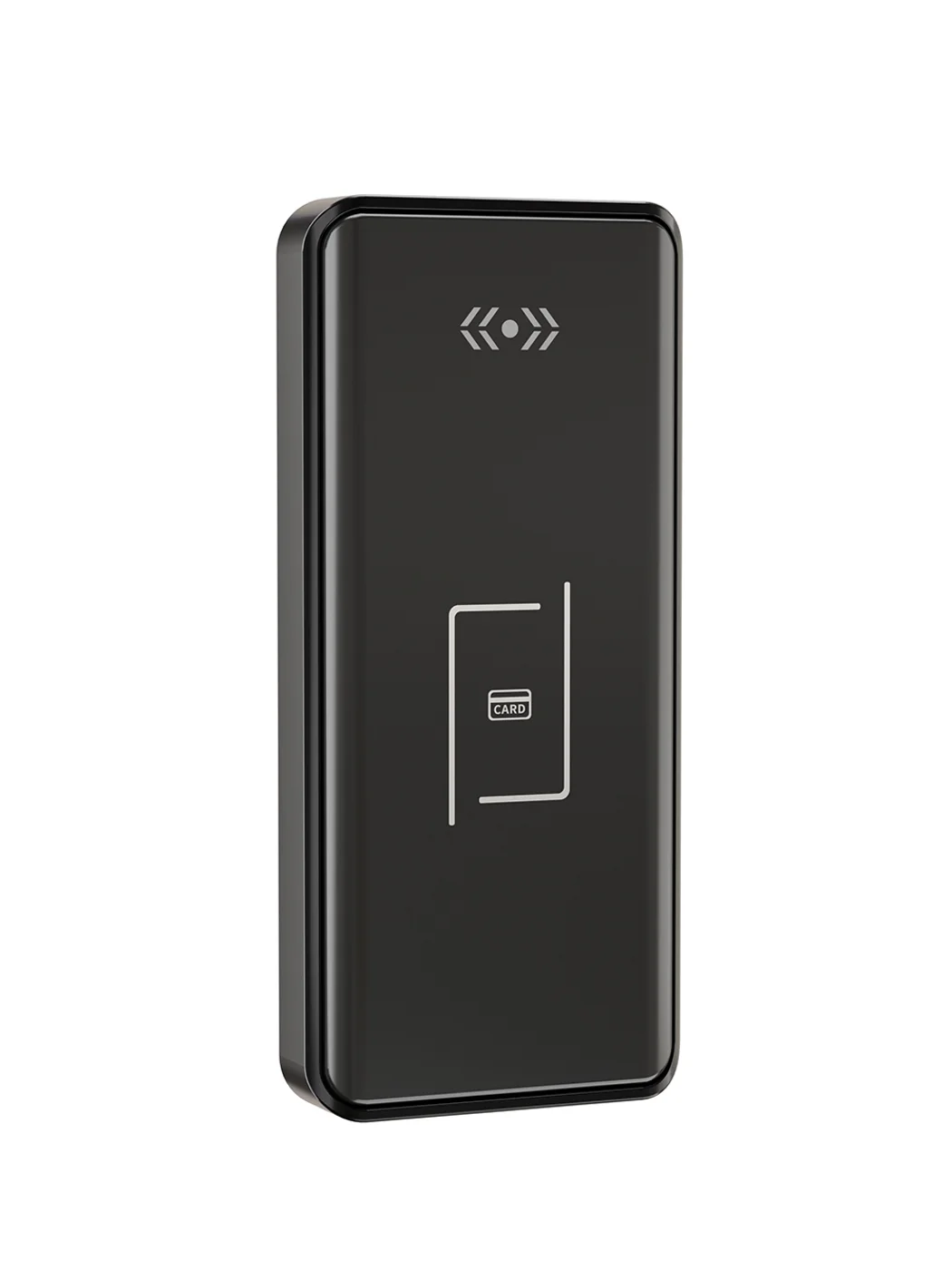
Kunci Loker Gym — Kartu Offline, Tanpa WiFi
Kunci loker gym kartu offline untuk loker fitness dan kolam. Kartu MIFARE, baterai, retrofit 5 menit, tanpa WiFi atau server. Zinc alloy, CE/FCC/RoHS.
Halaman ini sudah menunjuk ke halaman tersebut sebagai referensi yang direkomendasikan berikutnya.
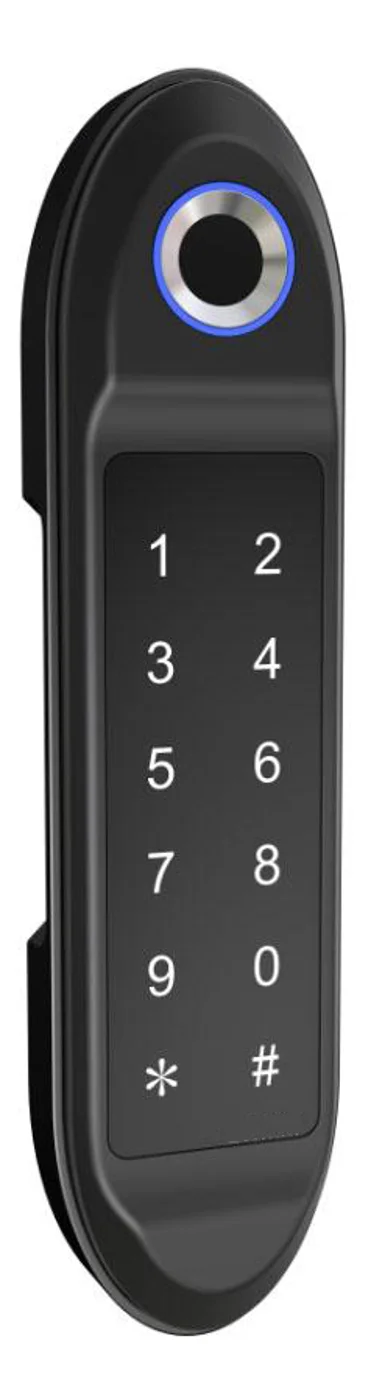
Kunci Lemari Elektronik Kode PIN — Mandiri, Tanpa WiFi
Kunci lemari keypad offline untuk loker gym, kantor, dan paket. Bertenaga baterai, retrofit 5 menit, pemasangan sederhana. PIN + kartu MIFARE, DC 6V, 4×AA.
Halaman ini sudah menunjuk ke halaman tersebut sebagai referensi yang direkomendasikan berikutnya.
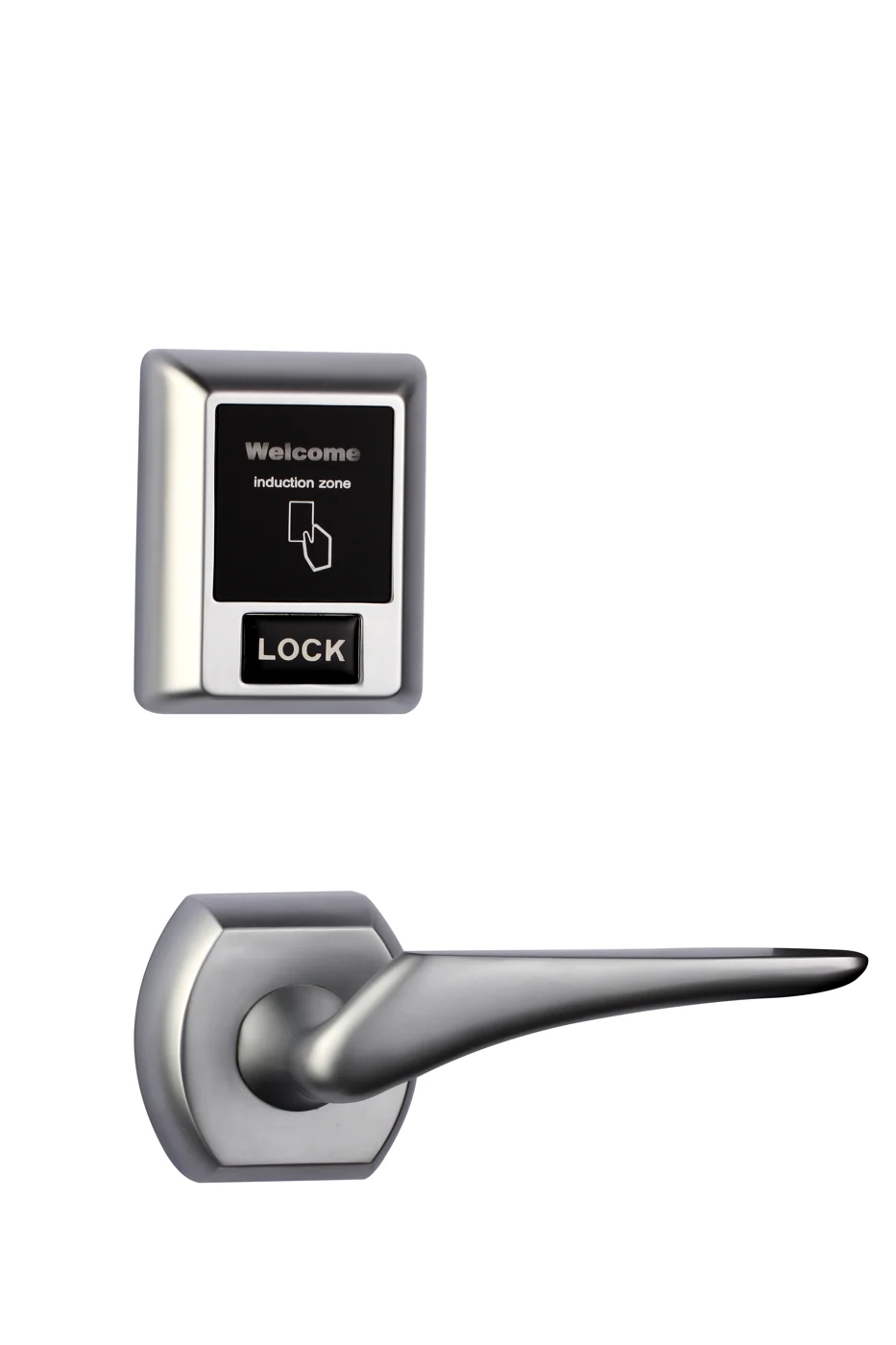
Kunci Lemari Bluetooth — App + PIN + Kartu, Armada Terkelola
Kunci lemari BLE offline untuk loker paket, kantor, dan armada terkelola. App + PIN + kartu MIFARE, atur kredensial jarak jauh, tanpa server, retrofit baterai.
Halaman ini sudah menunjuk ke halaman tersebut sebagai referensi yang direkomendasikan berikutnya.
Artikel blog terkait
3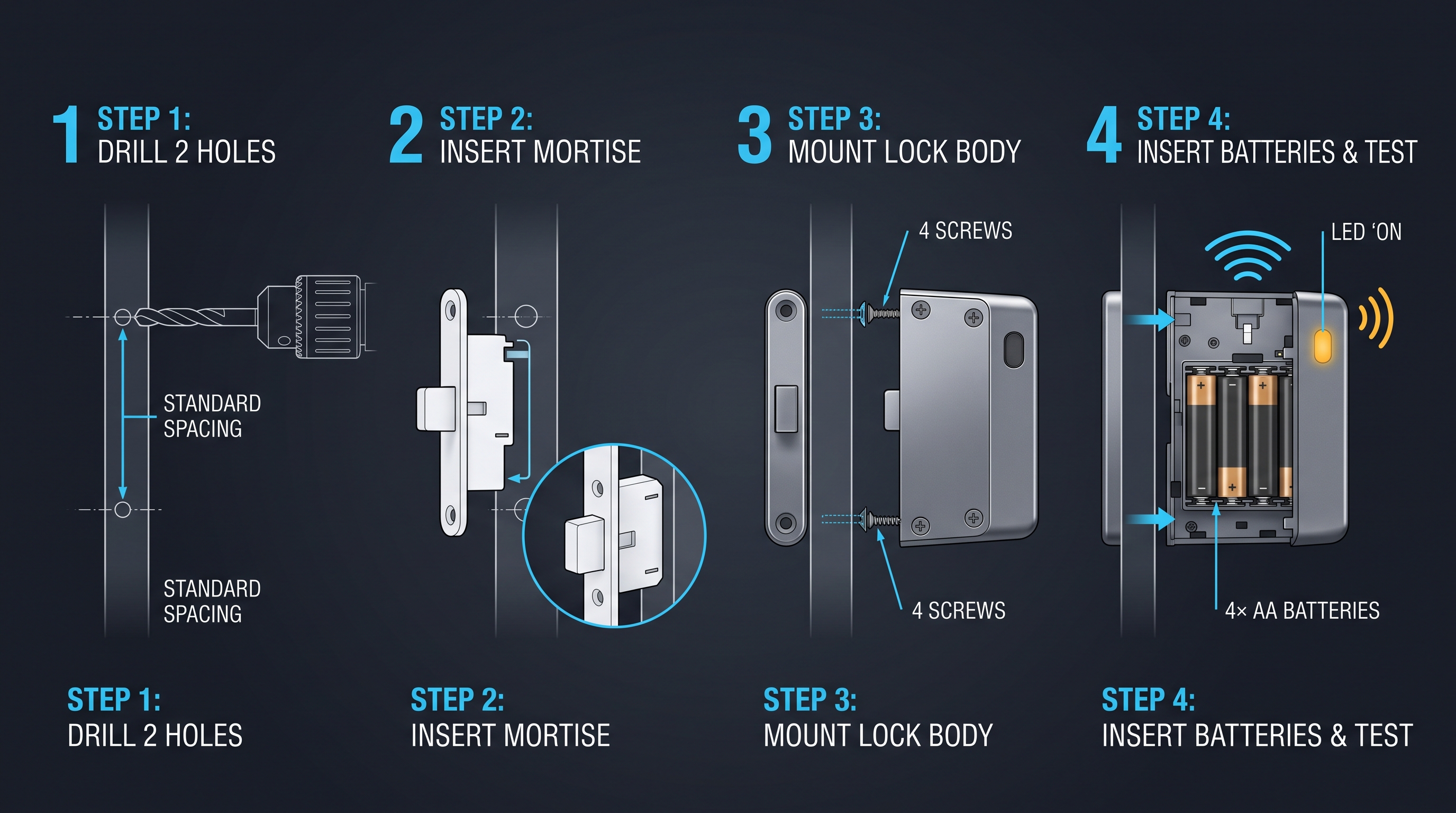
Kunci Kabinet Perhiasan: Panduan Lengkap Mengamankan Perhiasan Bernilai Tinggi di Kabinet dan Etalase
Pelajari cara kunci kabinet perhiasan mengamankan perhiasan bernilai tinggi di kabinet etalase dan brankas. Bandingkan sistem kunci kabinet perhiasan elektromagnetik, RFID, biometrik, dan kunci.
Halaman tersebut mendukung konteks produk yang sama: Kunci Loker Gym — Kartu Offline, Tanpa WiFi.
Kunci Lemari IoT: Panduan Lengkap Keamanan Lemari Pintar dan Terhubung
Pelajari cara kerja kunci lemari IoT dengan Wi-Fi, BLE, Zigbee, MQTT, dan dasbor cloud: telemetri, manajemen armada, OTA, edge vs cloud, dan keamanan.
Halaman tersebut mendukung konteks produk yang sama: Kunci Loker Gym — Kartu Offline, Tanpa WiFi.
Kunci Kabinet Invisible: Panduan Lengkap 2026 untuk Keamanan Perabot dan Kabinet Tersembunyi yang Tak Terdeteksi
Panduan lengkap sistem kunci kabinet invisible: kunci tersembunyi magnetik sentuh, RFID, elektromagnetik, dan Bluetooth untuk perabot mewah, lemari medis, etalase ritel, serta penyimpanan kantor dengan kriteria instalasi, daya, dan seleksi.
Halaman tersebut mendukung konteks produk yang sama: Kunci Lemari Elektronik Kode PIN — Mandiri, Tanpa WiFi.
Rinci proyek hotel Anda bersama insinyur kami
Kirimkan jumlah kamar, jenis plafon, dan preferensi protokol Anda. Kami akan mengirimkan rencana sampel dan penawaran dalam 24 jam kerja.
- Beralih dari panduan umum ke diskusi produk atau aplikasi.
- Gunakan RFQ saat harga, gambar teknis, MOQ, atau jadwal peluncuran membutuhkan struktur.
- Jaga jalur kontak langsung tetap terlihat untuk klarifikasi cepat dan serah terima.