The Complete Guide to Electronic Drawer Lock Technology, Installation, and Deployment
Learn everything about electronic drawer lock technology: solenoid mechanisms, RFID/PIN/biometric credentials, fail-safe vs fail-secure, battery vs hardwired, audit, retrofitting, and office/healthcare/retail deployment.
What Is an Electronic Drawer Lock?
An electronic drawer lock is a motorized or solenoid-driven locking mechanism that secures a drawer, cabinet, file cabinet, or safe using an electronically actuated bolt rather than a mechanical key. Unlike a traditional cam lock or pin-tumbler lock, the electronic drawer lock eliminates physical key exchange by relying on electrical signals to extend or retract a locking bolt. The core components of a typical electronic drawer lock include an actuator (solenoid or DC motor), a bolt with a throw of 10 to 25 mm (typically 15 mm for standard office furniture), a return spring rated at 3 to 8 N, a credential reader or input interface, a control PCB with a microcontroller, and a power source (batteries or low-voltage DC supply at 12 V DC or 24 V DC drawing 300 to 1,200 mA during actuation). Cycle life for commercial-grade electronic drawer locks ranges from 200,000 to 500,000 cycles per ANSI/BHMA A156.11 Grade 1 standards, with UL 1037 burglary-resistant listing available on hardened models. Pricing for a single electronic drawer lock unit varies from $40 for basic solenoid models to $250 for networked biometric versions. An electronic drawer lock can operate as a standalone unit with on-board credential verification or as part of a networked access control system communicating via Wiegand, OSDP, RS-485, or wireless protocols.
How an Electronic Drawer Lock Works: Bolt Throw and Actuation Mechanics
The fundamental operating principle of an electronic drawer lock centers on the controlled movement of a locking bolt between extended (locked) and retracted (unlocked) positions. When the lock receives a valid credential or unlock signal, the actuator applies force to overcome the return spring and retract the bolt, allowing the drawer to be pulled open. Upon releasing the signal or when the drawer closes, the spring pushes the bolt back into the locked position. The bolt throw — the linear distance the bolt travels — is one of the most critical specifications. Office-grade electronic drawer locks typically offer a bolt throw of 12 to 15 mm, while high-security models for safes and narcotics cabinets may extend to 20 to 25 mm. The bolt itself is usually made of hardened steel (HRC 45-55) with a diameter of 6 to 10 mm to resist manual prying. Solenoid-based locks use a wire coil wrapped around a ferromagnetic plunger; when energized, the magnetic field pulls the plunger (and attached bolt) inward with a force of 5 to 15 N. Motor-based locks use a small DC gear motor (typically 6 to 24 V, 100 to 500 mA) to rotate a cam or rack-and-pinion that translates rotary motion into linear bolt movement. Motor-driven electronic drawer locks consume less peak current than solenoids but operate more slowly (200 to 500 ms versus 50 to 150 ms for a solenoid). Duty cycle is a key constraint: continuous-duty solenoids can remain energized indefinitely, while intermittent-duty solenoids (typically rated at 25% duty cycle maximum) require a rest period to avoid overheating. Many modern electronic drawer locks incorporate a sensing microswitch to detect bolt position (fully extended or fully retracted), which enables the control system to report door status and detect forced-entry attempts.
Credential Types for an Electronic Drawer Lock: RFID, PIN, App, and Biometric
The credential interface defines how a user authenticates to an electronic drawer lock, and the choice of credential type directly affects security level, convenience, cost, and deployment scale. RFID-based electronic drawer locks are the most common in commercial settings, using 125 kHz proximity cards (EM4100, HID Prox) or 13.56 MHz smart cards (MIFARE Classic, DESFire, iCLASS) with read ranges of 10 to 50 mm. A basic RFID electronic drawer lock reads the card UID and compares it against an on-board whitelist of 100 to 2,000 credentials; networked versions forward the card data to a central controller for real-time validation against a database of thousands of users. PIN-code electronic drawer locks use a membrane keypad or capacitive touchpad with 4 to 12 digit codes; typical PIN locks store 10 to 100 unique codes and support temporary or one-time codes for visitors. Bluetooth Low Energy (BLE) app-based electronic drawer locks allow users to unlock via a smartphone application using AES-128 or AES-256 encrypted authentication, with features such as time-scheduled access, remote unlock, and credential sharing. Biometric electronic drawer locks typically integrate a capacitive fingerprint sensor (e.g., FPC or Synaptics sensor with 508 dpi resolution) capable of storing 20 to 200 fingerprint templates; false acceptance rates (FAR) of 0.001% and false rejection rates (FRR) of 1-3% are standard for commercial-grade units. Multi-factor electronic drawer locks combine two credential types, such as RFID card plus PIN, for higher-security environments like pharmaceutical cabinets or cash drawers. The credential reader on an electronic drawer lock may be integrated into the lock body (surface-mounted on the drawer front) or remotely mounted on a desk surface or wall plate and connected via a 4- to 6-conductor cable. Wiegand and OSDP protocols are the standard interfaces for connecting credential readers to access control panels, with OSDP offering encrypted communication and bi-directional messaging.
Fail-Safe versus Fail-Secure Electronic Drawer Lock Configurations
The fail-safe versus fail-secure distinction describes how an electronic drawer lock behaves when power is removed, and this choice has profound implications for security, safety, and code compliance. A fail-safe electronic drawer lock automatically unlocks when power is interrupted, meaning the bolt retracts and the drawer can be opened freely during a power outage or fire alarm condition. This configuration is mandated by many building codes for egress paths and is typically required for locks on exit doors, though for drawer applications it is less common. A fail-secure electronic drawer lock remains locked when power is removed; the bolt stays extended and the drawer cannot be opened without a valid credential, a mechanical key override, or a backup power source. Fail-secure is the dominant configuration for security-focused drawer applications including cash drawers, confidential file cabinets, narcotics storage, and weapon safes, because a power failure does not compromise security. Power-off state is determined by the lock's mechanical design: fail-safe locks use a spring that retracts the bolt when the solenoid de-energizes, while fail-secure locks use a spring that extends the bolt when de-energized. Some electronic drawer lock models offer field-selectable fail mode via a mechanical jumper or DIP switch that reverses the bolt's spring bias. UL 1037 and UL 294 listings for electronic drawer locks specify testing for both fail-safe and fail-secure modes, including 100,000-cycle endurance testing at rated load. In healthcare environments, NFPA 101 Life Safety Code and local fire marshals often require fail-safe operation on any lock that could impede egress, but drawers are generally exempt because they are not egress pathways. Nevertheless, a best practice for any electronic drawer lock deployment is to document the fail-mode selection and ensure it aligns with the facility's emergency action plan and insurance requirements.
Battery-Powered versus Hardwired Electronic Drawer Lock Systems
The power source for an electronic drawer lock is a fundamental architectural decision that affects installation complexity, maintenance cost, reliability, and system integration. Battery-powered electronic drawer locks are completely self-contained, requiring no wiring to the lock itself, which makes them ideal for retrofitting existing furniture where running cables is impractical. Typical battery configurations include 4 x AA alkaline cells (6 V nominal, 2,000 to 3,000 mAh) for low-power Bluetooth locks lasting 6 to 12 months, or 4 to 8 x AA lithium cells for higher-power RFID/PIN locks lasting 3 to 6 months depending on actuation frequency. Some electronic drawer locks use a sealed rechargeable lithium-ion battery pack (3.7 V, 1,800 to 4,400 mAh) charged via USB-C or a docking contact, with a cycle life of 300 to 500 charge cycles. Battery-powered electronic drawer locks use ultra-low-power microcontrollers (sub-1 microamp sleep current) to extend battery life; a typical lock drawing 5 to ���15 mA during actuation but only 2 to 10 microamps in standby can achieve 8,000 to 15,000 actuations per battery set. Hardwired electronic drawer locks connect to a centralized power supply or access control panel via 2- to 4-conductor low-voltage cable (18 to 22 AWG), drawing power continuously from a 12 V DC or 24 V DC source. The advantage of hardwiring is unlimited actuation cycles, no battery replacement labor, and the ability to power network radios and illuminated readers continuously. Power over Ethernet (PoE) electronic drawer locks combine data and power over a single Cat5e/Cat6 cable using IEEE 802.3af (15.4 W) or 802.3at (30 W) standards, enabling direct connection to a network switch without a separate power supply. Hybrid electronic drawer locks offer battery backup for hardwired units, automatically switching to internal batteries during mains power loss to maintain security and audit continuity. When planning a deployment, the total cost of ownership (TCO) calculation for battery versus hardwired electronic drawer lock must include battery replacement labor ($2 to $5 per battery change per lock), wiring and installation labor ($50 to $150 per lock for hardwired), and the cost of unplanned lockouts if batteries fail unexpectedly.
Audit Trail Capabilities in an Electronic Drawer Lock
Audit trail logging transforms an electronic drawer lock from a simple access barrier into a forensic security tool by recording every access event with timestamp, user identity, and action details. A basic electronic drawer lock with audit capability stores the last 1,000 to 5,000 events in non-volatile memory (EEPROM or flash) with entries including: date/time (RTC-backed), credential ID or user name, action type (unlock, lock, forced entry, tamper, low battery), and event source (keypad, card, app, remote). Data retrieval methods vary by lock model: the simplest method is on-board retrieval via USB download to a laptop using proprietary software, while networked electronic drawer locks push events in real time to a central access control server via TCP/IP, RS-485, or wireless mesh. Audit logs must be tamper-evident: commercial electronic drawer locks store events with a monotonically incrementing sequence number and an HMAC or CRC checksum to detect deletion or modification of log entries. For regulated industries, audit capability is not optional. HIPAA requires covered entities to implement policies and procedures to record and examine access and other activity in information systems containing ePHI, which extends to physical access controls for medical records and pharmaceutical drawers. Similarly, SOX (Sarbanes-Oxley Act), PCI DSS, and GDPR all have requirements that translate to physical access auditing for document storage and cash handling. The granularity of audit data matters: the best electronic drawer lock systems log not only successful unlocks but also failed attempts (with the credential presented), door-forced events (bolt overriden), and extended open time (drawer left ajar beyond a configurable threshold, typically 30 to 120 seconds). Cloud-connected electronic drawer locks take audit a step further by providing dashboard views of access patterns, real-time alerts for security events via email or SMS, and the ability to generate compliance reports on demand. When evaluating an electronic drawer lock for audit capability, verify that the clock is RTC-backed with a replaceable coin cell (CR2032, typical life 3-5 years) and that log export supports CSV or JSON formats for integration with SIEM systems.
Retrofitting an Electronic Drawer Lock into Existing Furniture
Retrofitting an electronic drawer lock into existing desks, cabinets, and file cabinets is one of the most common deployment scenarios because it upgrades security without replacing expensive casegoods. The retrofittability of an electronic drawer lock depends on three physical factors: available space behind the drawer front, drawer material thickness, and bolt alignment with the cabinet frame. Most office furniture uses drawer fronts with 16 to 19 mm (5/8 to 3/4 inch) particle board or MDF, while metal file cabinets use 1.0 to 1.5 mm sheet steel. A surface-mount electronic drawer lock attaches directly to the inside face of the drawer front with two to four M4 or #8 screws, requiring only a 10 to 20 mm clearance gap between the drawer front and the cabinet frame. The bolt extends from the lock body into a strike plate or bolt catch mounted on the cabinet frame or the drawer slide. For furniture with limited clearance, a low-profile electronic drawer lock with a body depth of only 18 to 25 mm is available. For metal cabinets, a concealed electronic drawer lock can be mounted inside the cabinet with a short bolt throw (10 to 12 mm) engaging a strike on the drawer side. The strike plate must be precisely aligned: misalignment of more than 2 mm can cause the bolt to bind, increasing actuation current by 30-50% and potentially causing premature solenoid failure. For retrofitting a cam-lock drawer to electronic operation, some electronic drawer locks are designed as direct replacements for standard 16 mm, 19 mm, or 22 mm cam locks, using the same mounting hole pattern (typically a 19 mm or 22 mm diameter hole with a D-shaped or double-D cross-section). Wireless battery-powered electronic drawer locks are the easiest to retrofit because no wiring is required: the installer drills or punches the mounting holes, attaches the lock body with screws, installs the strike, inserts batteries, and pairs the lock with the management software via Bluetooth or NFC — a process that takes 15 to 30 minutes per drawer for a skilled technician. Hardwired retrofits require running cable through cable management channels, under desks, or inside cabinet raceways, adding 30 to 60 minutes per lock. Pre-wired modular furniture systems (e.g., Herman Miller, Steelcase, Haworth) may have dedicated raceways that simplify routing. Regardless of the approach, every retrofitted electronic drawer lock should be tested through at least 20 open-close cycles before being put into service to verify alignment, actuation, and credential recognition.
Deploying an Electronic Drawer Lock in Office Environments
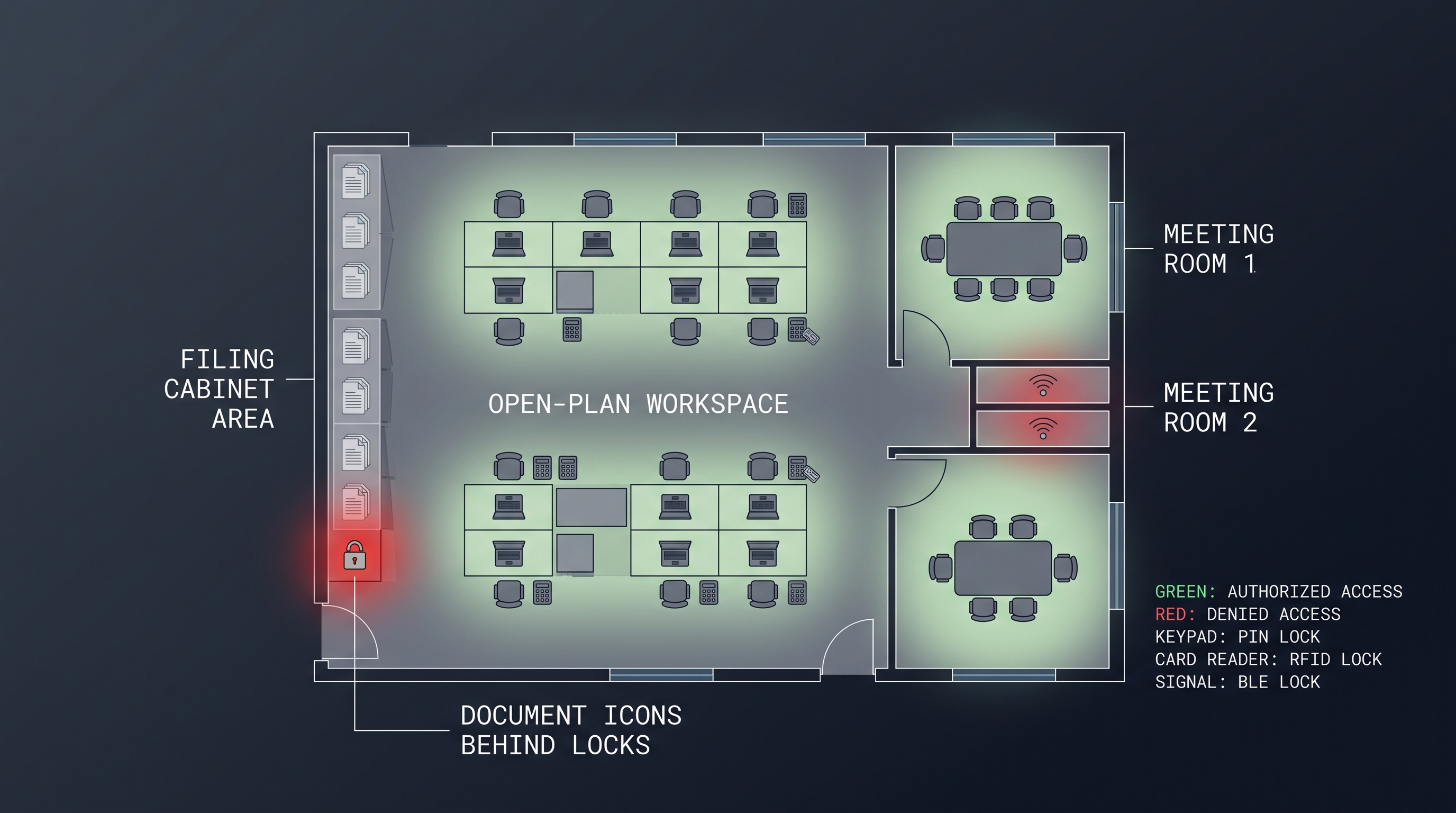
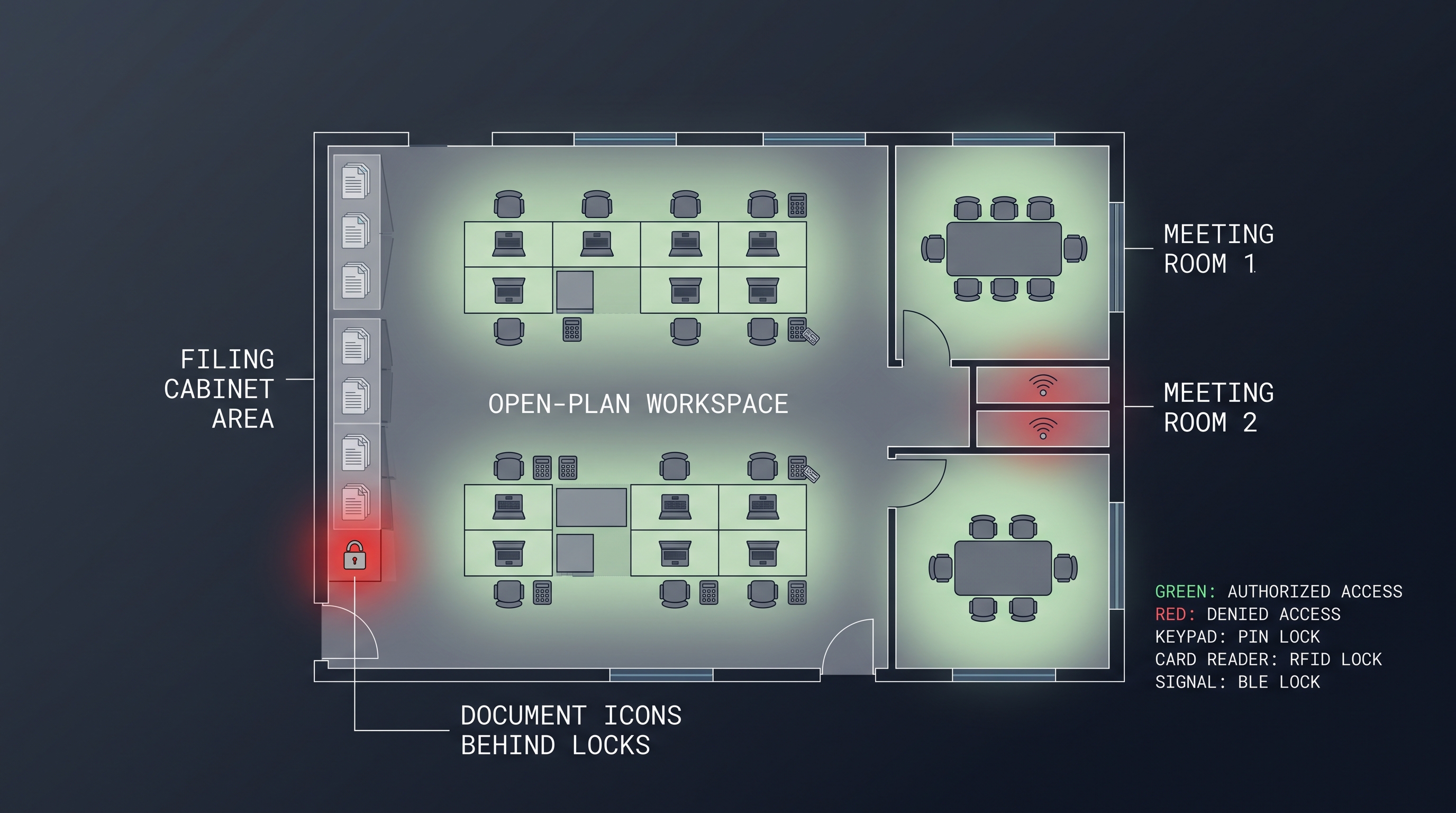
Office environments represent the largest market for electronic drawer locks, driven by the need to secure sensitive documents, personal belongings, IT equipment, and office supplies without the friction of key management. A typical corporate office deployment might involve 50 to 500 electronic drawer locks on desk pedestals, lateral files, overhead cabinets, and lockers. The primary benefits in this setting include eliminating key duplication and lost-key replacement costs (which average $75 to $150 per incident), enabling instant credential revocation when an employee leaves (versus weeks to recollect physical keys), and providing an audit trail for compliance with internal data protection policies. For open-plan offices, an electronic drawer lock on each desk's pedestal drawer allows employees to store laptops and personal items securely while away from their desks. The most cost-effective configuration for office deployments is a standalone RFID electronic drawer lock with 125 kHz proximity card reading, storing 100 to500 credentials on-board and using the existing employee ID badge as the credential — no new card issuance needed. For organizations with an existing access control system (e.g., Lenel, Honeywell, Software House, Paxton), a networked electronic drawer lock that connects to the same Wiegand bus or OSDP channel allows the facility team to manage door and drawer access from a single software platform. Open-time monitoring is particularly valuable in office settings: an electronic drawer lock that alerts when a drawer remains open for more than 5 minutes helps prevent inventory shrinkage and reduces visual clutter. Space planning must account for the electronic drawer lock's form factor: on a standard 15-inch-wide pedestal drawer, the lock mounts on the left or right side, with the reader either integrated into the drawer face or mounted on the desk modesty panel. ADA accessibility must be considered when deploying PIN-pad electronic drawer locks: the keypad should be mounted between 15 and48 inches above the floor, operable with one hand, and require less than5 lbf to activate. For executive offices and HR departments handling confidential personnel files, a biometric electronic drawer lock or a multi-factor RFID-plus-PIN electronic drawer lock provides an additional layer of security appropriate for sensitive records.
Deploying an Electronic Drawer Lock in Healthcare Environments
Healthcare facilities — hospitals, clinics, pharmacies, and long-term care centers — deploy electronic drawer locks to meet stringent regulatory requirements for controlled substance storage, patient record confidentiality, and equipment security. The Joint Commission, HIPAA, and the Drug Enforcement Administration (DEA) all impose requirements that an electronic drawer lock can help satisfy. In medication carts and automated dispensing cabinets (ADCs), an electronic drawer lock controls access to individual patient drawers or medication bins, with audit logs recording exactly which nurse accessed which drug at what time. DEA regulations for Schedule II-V controlled substances require that the pharmacy maintain a complete and accurate record of the receipt and distribution of all controlled substances, and an electronic drawer lock with audit trail directly supports this requirement by providing indisputable access records. The typical healthcare-grade electronic drawer lock for medication carts must withstand frequent sanitization wipes (isopropyl alcohol, bleach solution, quaternary ammonium compounds) and therefore requires an IP54 or IP65-rated sealed housing and a chemical-resistant polycarbonate or stainless steel faceplate. Battery life is critical in healthcare because medication carts are often moved between patient rooms and cannot remain tethered to a power source; a high-capacity lithium-ion battery pack powering an electronic drawer lock for 3,000 to5,000 actuations between charges is standard. For narcotics storage, a biometric electronic drawer lock with dual-authentication (fingerprint plus PIn) provides the highest level of accountability, logging the exact identity of the person accessing each drawer. In medical records departments, an electronic drawer lock on lateral file cabinets storing paper patient charts ensures that only authorized personnel can access files, with audit records available for HIPAA compliance audits. For crash carts and emergency equipment carts, an electronic drawer lock can be configured with a break-glass override: a sensor detects when the glass is broken or the manual release is activated, logging the emergency access and optionally triggering an alert to security or nursing supervisors. When deploying electronic drawer locks in healthcare, integration with the existing nurse call system or hospital access control network is important; many healthcare facilities use HL7 or API-based integration to synchronize user databases between the electronic drawer lock system and the HR/payroll system so that credential access is automatically revoked upon termination or department transfer.
Deploying an Electronic Drawer Lock in Retail Cash Drawers
Retail environments place unique demands on an electronic drawer lock because cash drawers must be opened hundreds of times per shift while maintaining strict accountability for every transaction. A typical point-of-sale (POS) electronic drawer lock is an electric strike or solenoid mechanism integrated into the cash drawer itself, triggered by the POS terminal after a sale is completed. The electronic drawer lock for a cash drawer must be rated for high-frequency operation: a busy retail register may open 200 to 400 times per shift, meaning 100,000 to 200,000 cycles per year. For this reason, the solenoid in a POS-grade electronic drawer lock is typically a continuous-duty type rated for 1,000,000+ cycles, with a hardened steel bolt and a reinforced strike plate. The interface between the POS terminal and the electronic drawer lock is standardized: EIA-232 serial (RS-232) or a simple 12 V DC trigger signal sent from a cash drawer port on the receipt printer or POS terminal. Most cash drawer electronic drawer locks use a 12 V DC solenoid with a current draw of 1.0 to 2.5 A during the 100 to 300 ms actuation pulse, after which a mechanical latch holds the drawer open until it is manually closed. The audit requirement for retail electronic drawer locks is different from office or healthcare: rather than tracking who opened the drawer, the lock integrates with the POS software to log every open event against a transaction number, employee ID, and timestamp. This integration enables exception reporting — for example, flagging any drawer open that occurs without a corresponding sale (a no-sale open) as a potential theft event. In high-loss retail environments, an electronic drawer lock with time-delayed opening (requiring a 2 to 5 second wait after the POS command) can reduce grab-and-run theft by giving staff a moment to verify the customer's payment. For self-checkout lanes, the electronic drawer lock must interface with the self-checkout controller and typically includes a jam sensor that detects if the drawer is being forcibly pried open. The physical security rating of a cash drawer electronic drawer lock matters: UL 1037 listed cash drawers resist forced opening attempts with up to150 lbf of pry force for 5 minutes. For after-hours cash management, a dual-control electronic drawer lock on the safe drop drawer requires two separate credentials (e.g., manager card plus employee PIn) before the drawer opens, ensuring no single individual can access cash without a witness.
Choosing the Right Electronic Drawer Lock: A Decision Framework
Selecting the correct electronic drawer lock for a specific application requires evaluating five dimensions: security level, credential type, power configuration, network connectivity, and physical form factor. The decision framework begins with a risk assessment: what is being protected, what is the value of the contents, and who are the authorized users? For low-security applications such as office supply cabinets, a basic standalone electronic drawer lock with RFID credential storage for 100 users and battery power is appropriate. For medium-security applications such as personnel files or IT equipment, a networked electronic drawer lock with audit trail, PIN or smart card credentials, and hardwired or hybrid power offers a good balance of security and manageability. For high-security applications including narcotics, weapons, cash, and classified documents, a biometric or multi-factor electronic drawer lock with full audit, encrypted communication (OSDP or TLS over IP), fail-secure operation, and UL 1037 listing is recommended. The credential decision depends on the existing infrastructure: if employees already carry HID iCLASS or MIFARE DESFire badges for door access, choose an electronic drawer lock that reads the same credential format to avoid dual-card carry. The physical form factor must be verified against the furniture: measure the drawer front thickness, the clearance between the drawer and frame, the bolt-to-strike alignment axis, and the available space behind the drawer for the lock body. A common mistake is purchasing an electronic drawer lock with a bolt throw that exceeds the available clearance, causing the bolt to strike the frame instead of entering the strike hole. Table 1 summarizes the key specification ranges across electronic drawer lock categories.
Table 1. Electronic Drawer Lock Specification Comparison by Application Category
| Parameter | Office Basic | Office Networked | Healthcare | Retail POS | High-Security |
|---|---|---|---|---|---|
| Typical bolt throw | 12-15 mm | 12-15 mm | 15-20 mm | 10-12 mm | 20-25 mm |
| Bolt material | Hardened steel | Hardened steel | Stainless steel | Hardened steel | Case-hardened alloy |
| Actuator type | Solenoid | Solenoid or motor | Motor | Solenoid | Motor + clutch |
| Credential types | RFID (125 kHz) | RFID + PIN + BLE | Biometric + PIN | POS trigger | Multi-factor |
| On-board users | 100-500 | 1,000-10,000 | 200-2,000 | N/A (POS driven) | 50-200 |
| Audit trail | Optional (1k events) | Yes (10k+ events) | Yes (50k+ events) | Yes (POS integrated) | Yes (50k+ tamper-proof) |
| Power | 4x AA, 6-12 mo | Hardwired or hybrid | Rechargeable Li-ion | 12 V DC from POS | Hardwired with batt backup |
| Typical price per lock | $40-80 | $80-150 | $120-250 | $25-60 (strike only) | $150-400 |
| Cycle life | 200,000 | 300,000 | 500,000 | 1,000,000+ | 500,000 |
| Certifications | CE, FCC | UL 294, FCC | UL 1037, HIPAA | UL 1037 | UL 1037, UL 294, DEA |
Installation Best Practices for an Electronic Drawer Lock
Proper installation of an electronic drawer lock determines its reliability, security, and service life more than any other factor. Before beginning installation, verify that the electronic drawer lock's bolt throw, mounting hole pattern, and voltage rating match the furniture and power source. For hardwired installations, use 18 to 22 AWG stranded wire for runs up to 50 feet (15 m), stepping up to16 AWG for runs up to150 feet (45 m) to compensate for voltage drop. The power supply for a hardwired electronic drawer lock must be a regulated linear or switching supply rated for continuous duty, providing 12 V DC or 24 V DC with less than 5% ripple; using an unregulated supply can cause solenoid chatter, reduced bolt force, and premature failure. When daisy-chaining multiple electronic drawer locks on a single power run, calculate total current draw including inrush: a solenoid lock may draw 1.5 A for150 ms during actuation, so10 locks actuated simultaneously require 15 A peak capacity. Most access control panels provide dedicated lock power outputs with fused or PTC-protected circuits rated at 1 to 3 A per output. For battery-powered electronic drawer locks, insert fresh batteries at installation and record the installation date on the lock body using a permanent marker or label — this simplifies maintenance scheduling. Bolt alignment is critical: the strike plate must be positioned so that the bolt enters the center of the strike hole with less than 1.5 mm of vertical and lateral misalignment. Use a bolt alignment gauge or mark the strike position by extending the bolt manually (with power disconnected) and marking the contact point on the frame. For retrofits on metal cabinets, a center punch and 6 to 8 mm drill bit create the strike opening; for wood furniture, a 10 to12 mm forstner bit or hole saw produces a clean entry. After mounting, test the electronic drawer lock through 20 cycles: check for binding, listen for abnormal solenoid hum (indicating partial voltage or misalignment), measure the actuation current with a multimeter (should match the datasheet spec within 10%), and verify that the bolt fully retracts and extends every time. Document the installation with photographs of the lock placement, wire routing, and strike alignment for future maintenance reference. Finally, program the credentials, set the date and time on RTC-backed units, and perform a credential test with each authorized user's badge or PIN before signing off the installation.
Wireless Connectivity and Software Management for an Electronic Drawer Lock
Network-connected electronic drawer locks have transformed drawer access management from a manual, lock-by-lock configuration task into a centralized, scalable security operation. Wireless electronic drawer locks communicate using one or more protocols: Bluetooth Low Energy (BLE 5.0+) for short-range smartphone control and configuration, Wi-Fi (802.11 b/g/n) for direct IP network connectivity, Zigbee (802.15.4) or Z-Wave for integration with building automation systems, and proprietary 900 MHz or 2.4 GHz mesh networks for large-scale deployments covering hundreds of locks across multiple floors. The management software platform for a fleet of electronic drawer locks typically provides: user and credential management (add, suspend, delete users; assign credentials; set access schedules), lock configuration (auto-lock delay from 0 to 60 seconds, open-time alarm threshold, fail-mode setting), real-time monitoring (lock status, battery level, connection health), audit log access and export, and system alerts (low battery, tamper, forced entry, communication loss). Cloud-based electronic drawer lock management eliminates the need for on-premise servers and allows facility managers to administer locks from any web browser. Security of the wireless link is paramount: all communications between the electronic drawer lock and the management platform should be encrypted with AES-128 or AES-256, with TLS 1.2+ for IP-based connections. BLE electronic drawer locks use Elliptic Curve Diffie-Hellman (ECDH) key exchange to establish a secure session before transmitting credentials or configuration data. For organizations with strict network security policies, an electronic drawer lock that supports 802.1X network access control can authenticate to the Wi-Fi network using digital certificates, ensuring that only authorized devices join the network. Firmware update capability is a critical feature: the ability to push security patches and feature updates over-the-air (OTA) to a deployed fleet of electronic drawer locks ensures that vulnerabilities are addressed without physical access to each lock. When evaluating the software platform, verify that it supports role-based access control (RBAC) so that different facility staff have appropriate permissions — for example, a front desk manager can issue temporary credentials, while only the security director can view audit logs or change fail-mode settings.
Electronic Drawer Lock Cost Analysis and Return on Investment
The financial case for deploying electronic drawer locks rests on quantifiable savings in key management, loss prevention, and compliance efficiency. A mid-sized organization with 200 desks using mechanical cam locks spends approximately $3,000 to $6,000 per year on key-related costs: key duplication ($3-8 per key), lock rekeying when a key is lost ($15-25 per lock), locksmith callouts for emergency lockouts ($150-300 per visit), and administrative time managing a key log. Transitioning to an electronic drawer lock system eliminates these recurring costs. The upfront investment for 200 electronic drawer locks varies by specification: basic standalone RFID models at $50-80 per lock total $10,000 to $16,000 for hardware, plus installation labor at $30-60 per lock ($6,000 to $12,000). Networked electronic drawer locks with audit and centralized management cost $80-150 per lock ($16,000 to $30,000) with similar installation costs. The simple payback period for electronic drawer locks based on key management savings alone is typically 2 to 4 years. When loss prevention savings are included — reduced theft of laptops ($1,200 average replacement cost), office supplies, and confidential information — the payback period shortens to 12 to 24 months. For regulated industries, the ROI calculation must include compliance cost avoidance: a HIPAA violation for improper physical access controls can result in fines from $100 to $50,000 per violation, with annual maximums of $1.5 million. An electronic drawer lock system with audit trail provides documented evidence of compliance that can substantially reduce both the likelihood and the financial impact of a compliance audit finding. For retail cash drawer deployments, an electronic drawer lock integrated with POS exception reporting typically reduces internal theft by 40-70% in the first year, with a single theft incident often exceeding the cost of the entire lock system for that register. Battery-powered electronic drawer locks add an ongoing consumable cost of $2 to $6 per lock per year for battery replacement; hardwired and PoE locks avoid this cost but require backup power infrastructure. When preparing a capital budget request for electronic drawer locks, include: hardware cost per lock, installation labor, management software licensing (typically $2-10 per lock per year for cloud platforms), battery replacement cost (for battery models), and a 10% contingency for furniture modifications or unexpected alignment issues.
Security Vulnerabilities and Mitigation for Electronic Drawer Locks
No electronic drawer lock is impervious to attack, but understanding the threat model allows specifiers to choose appropriate countermeasures. The most common attack vector against an electronic drawer lock is physical bypass: using a thin metal shim (feeler gauge or plastic shim) slid between the drawer face and the cabinet frame to push the bolt back into the lock body. Anti-shim designs counter this with a bolt that incorporates a barbed, hook-shaped, or T-shaped tip that catches on the strike plate if the drawer is pulled while the bolt is extended — the more force applied, the more securely the hook engages. Another physical attack is prying the drawer front away from the slides to increase the gap between the bolt and strike, then disengaging the bolt. A hardened steel strike plate anchored with machine screws into a metal frame or with 1/4-inch toggle bolts into wood furniture resists prying attacks up to 300 lbf. Electromagnetic attacks include using a strong rare-earth magnet (N52 neodymium) placed against the drawer face near the solenoid to physically pull the plunger and retract the bolt. Magnetic shielding inside the electronic drawer lock housing — a mu-metal or steel plate between the solenoid and the exterior face — reduces magnetic coupling by 60-80% and defeats all but the strongest external magnets. Electronic attacks include tapping the Wiegand data lines between the reader and the lock controller to replay credential data. OSDP with Secure Channel (SC) encryption eliminates this vulnerability by encrypting the data stream with AES-128 and requiring mutual authentication. For battery-powered electronic drawer locks, a denial-of-service attack can be as simple as rapidly presenting invalid credentials to drain the battery; rate limiting (e.g., max 5 failed attempts per minute) and low-battery alerts mitigate this. Tamper switches inside the electronic drawer lock body detect if the cover is removed or the mounting screws are loosened, generating an alert event in the audit log. Firmware vulnerabilities in networked electronic drawer locks must be addressed through a vendor's responsible disclosure program and timely OTA updates. When procuring an electronic drawer lock, request the vendor's security white paper and third-party penetration test results — reputable manufacturers conduct annual penetration testing against NIST SP 800-115 methodology.
The Future of Electronic Drawer Lock Technology
The electronic drawer lock market is evolving rapidly, driven by broader trends in IoT, access control convergence, and artificial intelligence. Several emerging technologies will shape the next generation of electronic drawer locks over the next three to five years. Wireless power transfer (resonant inductive charging) will eliminate batteries entirely for retrofit applications: an electronic drawer lock with a receiver coil on the drawer and a transmitter coil on the cabinet frame can transfer 1 to 5 W across a 5 to 15 mm gap, providing continuous power without wires or battery changes. UWB (Ultra-Wideband) precision ranging, as used in Apple AirTag and FiRa Fine Ranging, will enable presence-based electronic drawer lock automation: the lock automatically unlocks when an authorized user approaches within 1 to 3 meters and locks when they walk away, with centimeter-level positioning accuracy that prevents false triggers from adjacent desks. Face recognition on the electronic drawer lock itself — using a low-power AI accelerator (e.g., NXP i.MX RT series, Synaptics Katana) with a 2 MP IR camera — will provide hands-free, touchless unlocking for healthcare and cleanroom environments. ML-based anomaly detection in electronic drawer lock management platforms will analyze access patterns to identify unusual behavior — for example, an employee accessing files at 2 AM when their normal pattern is 9-5 — and automatically flag or block the event. Blockchain-based audit logging for electronic drawer locks in highly regulated environments will provide immutable audit records that satisfy the most stringent compliance requirements without relying on a central database. Standardization efforts through ONVIF (Physical Access Control profile) and the IoT Alliance will improve interoperability between electronic drawer locks and building management systems, reducing integration costs and vendor lock-in. As the cost of microcontroller, radio, and sensor components continues to decline, the price floor for a basic networked electronic drawer lock is expected to drop from $80 in 2026 to approximately $45-50 by 2028, accelerating adoption in small and mid-sized businesses that have historically relied on mechanical locks. The electronic drawer lock is transitioning from a niche security product to a standard component of intelligent furniture, and organizations that invest in understanding the technology today will be well-positioned to deploy it effectively as the market matures.
Electronic Drawer Lock Standards, Certifications, and Compliance
Understanding the certification landscape for electronic drawer locks is essential for specifying products that meet legal, insurance, and security requirements. UL 1037 is the primary safety standard for anti-theft alarmed and locking devices in the United States, testing the lock's resistance to forced entry by applying up to 150 lbf (667 N) of pry force for 5 minutes while monitoring for breach. UL 294 is the standard for access control system units, evaluating performance under voltage variations, standby current, and endurance (1 million cycles for Grade 1). ANSI/BHMA A156.11, American National Standard for Cabinet Locks, grades electronic drawer locks from Grade 1 (heavy duty, 500,000 cycles minimum, 1,500 lbf static force) through Grade 3 (light duty, 200,000 cycles). Electronic drawer locks sold in the European Union must carry CE marking demonstrating compliance with the Low Voltage Directive (2014/35/EU), EMC Directive (2014/30/EU), and RoHS Directive (2011/65/EU). For fire-rated furniture, the electronic drawer lock must not compromise the furniture's fire rating — typically this requires that the lock does not create a through-hole in the fire barrier and uses materials rated for the required fire exposure (usually 30 to 60 minutes). For healthcare, HIPAA compliance is not a certification but a regulatory requirement: the electronic drawer lock must be part of a HIPAA-compliant physical safeguard program, which means documented policies, audit logs, and automatic lock operation. For government and defense applications, electronic drawer locks must comply with FIPS 201 (PIV card authentication) and may require NIAP Common Criteria evaluation for networked models. When evaluating a manufacturer's certifications, verify that the certification documents are current (not expired), apply to the specific model number being purchased, and were issued by an accredited testing laboratory (UL, Intertek, TUV, etc.). Beware of self-declared certifications that are not backed by third-party testing — always request the certificate number and verify it through the certifying body's online directory.
Integration of an Electronic Drawer Lock with Access Control Systems
Integrating an electronic drawer lock with an organization's existing access control system provides unified credential management, centralized audit, and reduced administrative overhead. The integration architecture depends on the access control system's capabilities: most commercial access control panels (Lenel, Honeywell ProWatch, Software House C-CURE 9000, Bosch, Paxton) support Wiegand and OSDP reader interfaces and provide configurable output relays that can control an electronic drawer lock. In a typical integration, the access control panel treats the electronic drawer lock as an additional door in the system: a card read connects to the panel's reader input, the panel validates the credential and checks the access schedule, and if authorized, it energizes its lock relay to send power to the electronic drawer lock's solenoid. This approach allows the electronic drawer lock to use the same credential database, access schedules, holiday rules, and anti-passback settings as the building's main doors. For organizations without a traditional access control system, a purpose-built electronic drawer lock management appliance or cloud gateway provides similar functionality. This appliance connects to up to 4, 8, or 16 electronic drawer locks via RS-485 or Wi-Fi, manages credentials locally with a cache of up to 50,000 users, and synchronizes with a cloud management platform over the internet. API integration between the electronic drawer lock platform and the organization's HR system (Workday, BambooHR, ADP) automates credential provisioning: when a new employee is onboarded, their badge is automatically authorized for their assigned drawer; when they depart, access is revoked without human intervention. For multi-site organizations, cloud-managed electronic drawer locks enable facility managers to monitor and configure locks across all locations from a single dashboard. Physical Access Control as a Service (PACaaS) models are emerging, where the organization pays a monthly fee per electronic drawer lock ($3-8 per lock per month) that includes hardware, cloud management, audit storage, and support — converting capital expenditure to operating expenditure. When planning an integration, confirm that the electronic drawer lock's voltage, current, and wiring match the access control panel's lock output specifications. Most access control panel lock outputs provide 12 V DC at 1-2 A, which is sufficient for one to two electronic drawer locks per output. For larger clusters, an external power supply with a lock relay board is required. Always include a flyback diode across the solenoid terminals to suppress the voltage spike (typically 100-200 V) generated when the solenoid de-energizes, which can damage the access control panel's relay contacts.
Environmental and Durability Considerations for an Electronic Drawer Lock
The operating environment dramatically affects the performance and lifespan of an electronic drawer lock. Temperature extremes cause expansion and contraction of materials, change lubricant viscosity, and alter battery chemistry discharge rates. A commercial-grade electronic drawer lock should be rated for operation from -10 degrees C to +50 degrees C (14 F to 122 F), with storage from -20 C to +60 C. For outdoor or unconditioned warehouse applications, a weather-resistant electronic drawer lock with an IP65 rating and an internal heater (5-10 W) to prevent condensation is required. Humidity above 85% RH can cause corrosion of the solenoid core, bolt, and return spring if not plated or made of stainless steel. In coastal environments, specify an electronic drawer lock with a 316 stainless steel bolt and housing to resist saltwater corrosion. Dust and particulate matter are the enemy of solenoid mechanisms: a build-up of paper dust, toner, or wood particles in the bolt channel increases friction and can cause the bolt to stick in the extended or retracted position. An electronic drawer lock for industrial or warehouse use should have a wiper seal or rubber gasket around the bolt exit to exclude contaminants. Vibration is a concern for electronic drawer locks on mobile carts, vehicles, or marine applications: the lock should be tested to MIL-STD-810G for vibration and shock, and should use locking fasteners (Loctite, nylon-insert lock nuts) to prevent screws from loosening. Cycle life testing under load — the electronic drawer lock should be tested by the manufacturer at rated voltage and temperature with the bolt engaging a strike plate — provides the most realistic durability estimate. Request the manufacturer's cycle life test report showing the number of cycles completed, the failure mode (if any), and the condition of the bolt and solenoid at test completion. For high-vibration environments, a motor-based electronic drawer lock is generally more reliable than a solenoid-based lock because the motor's gear train provides mechanical damping and the motor itself is less susceptible to resonant vibration. In cleanroom and healthcare environments, the electronic drawer lock's outgassing profile and cleanability matter: the housing should be made of materials that do not outgas VOCs (polycarbonate, ABS, or stainless steel) and have a smooth, non-porous surface that can be wiped with disinfectants without degradation.
Electronic Drawer Lock Maintenance and Troubleshooting
Regular maintenance extends the service life of an electronic drawer lock and prevents unexpected failures that could lock users out of their belongings. For battery-powered electronic drawer locks, establish a scheduled battery replacement program: replace alkaline batteries every 6 months and lithium batteries every 12 months, regardless of the reported battery level indicator, because battery chemistry can fail suddenly at low temperatures. When the electronic drawer lock reports low battery (typically at 20-25% remaining capacity), users have approximately 50 to 200 additional actuations before the lock fails to operate. For hardwired electronic drawer locks, annual inspection should include: measuring the supply voltage at the lock terminals (should be within 5% of rated voltage under load), checking wire connections for corrosion or looseness, cleaning the bolt and strike plate with a dry lubricant (PTFE spray, not oil-based), and verifying the RTC battery (if applicable). Common electronic drawer lock failures and their causes include: bolt fails to extend (mechanical obstruction in the bolt channel, broken return spring, or voltage too low), bolt fails to retract (solenoid coil open circuit, driver transistor failed, or mechanical binding from misalignment), intermittent operation (loose wire connection, failing battery contact, or corroded connector), and credential not read (debris on the reader face, damaged credential, or reader cable fault). Most electronic drawer lock manufacturers provide diagnostic LEDs on the control board: a flashing green LED typically indicates normal operation, solid red indicates a fault condition, and specific flash patterns correspond to error codes documented in the service manual. For networked electronic drawer locks, the management software usually provides remote diagnostics including last event log, communication signal strength, battery voltage, and internal temperature. Before replacing an electronic drawer lock that appears to have failed, perform a power cycle (remove and reapply power), then test with a known-good credential, then measure the supply voltage at the lock, and finally check for mechanical binding by manually cycling the bolt with a tool (following the manufacturer's procedure — never force the bolt). Document all maintenance actions in a log for each electronic drawer lock, including date, technician name, action taken, and any replaced parts, to build a reliability history that informs future procurement and preventive maintenance schedules.
Legal and Privacy Implications of Electronic Drawer Lock Deployment
Deploying electronic drawer locks introduces legal and privacy considerations that organizations must address before installation. The primary privacy concern is data collection: an electronic drawer lock audit log records who accessed which drawer at what time, which constitutes personally identifiable information (PII) under GDPR and similar privacy regulations. Organizations must have a lawful basis for processing this data (typically legitimate interest or consent) and must provide a privacy notice to employees and visitors whose access is logged. Data retention periods for electronic drawer lock audit logs should be defined in policy: a common retention period is 12 to 24 months for general office use, 3 to 7 years for regulated industries (HIPAA, SOX), and indefinite for security incident investigation records. Employees have a reasonable expectation of privacy in their assigned desk drawer in many jurisdictions, and an electronic drawer lock that logs every access must be implemented with transparency — a written policy should disclose that drawer access is monitored and logged. In unionized environments, the deployment of electronic drawer locks with audit capability may be a mandatory subject of bargaining under the National Labor Relations Act (NLRA), because it constitutes a change in working conditions and employee surveillance. Legal counsel should review the electronic drawer lock deployment plan before implementation in union settings. For electronic drawer locks that use biometric credentials (fingerprint, facial recognition), additional legal requirements apply: Illinois Biometric Information Privacy Act (BIPA), Texas Capture or Use of Biometric Identifier Act, Washington biometric law, and similar statutes in other states require written consent before collecting biometric data, mandate data retention and destruction schedules, and create a private right of action with damages of $1,000 to $5,000 per violation. Organizations should conduct a Data Protection Impact Assessment (DPIA) before deploying electronic drawer locks with biometric readers. For organizations that store client or patient data in secured drawers, the electronic drawer lock audit log may be subject to discovery in litigation — ensure that audit records are preserved when a legal hold is issued. Finally, the electronic drawer lock system's terms of service and data processing agreement (DPA) with the vendor should be reviewed to ensure that the vendor does not claim ownership of audit data and that data is stored in the appropriate jurisdiction.
Case Studies: Electronic Drawer Lock Deployments Across Industries
Real-world deployments illustrate how electronic drawer locks solve specific security and operational challenges. In a 500-employee financial services firm in New York, deploying networked RFID electronic drawer locks on all desk pedestals eliminated a $12,000 annual key management cost and reduced laptop theft from 8 incidents per year to zero over 18 months, with an ROI realized in 14 months. The system used the employees' existing HID iCLASS badges, and the audit trail provided critical evidence in two internal investigations of unauthorized file access. In a 300-bed hospital in Ohio, biometric electronic drawer locks on medication carts reduced controlled substance discrepancies by 76% in the first quarter after deployment, because the audit trail identified the specific nurse for every dose removed. The hospital selected a motor-based electronic drawer lock with rechargeable lithium battery packs, achieving 2,500 actuations per charge and a 96-hour battery life with continuous use. In a150-store retail chain, replacing manual cash drawer keys with POS-integrated electronic drawer locks and exception reporting reduced internal theft by 53% and eliminated $45,000 per year in key replacement and rekeying costs across the chain. The deployment used a standard 12 V DC solenoid electronic drawer lock with an integrated jam sensor and a 1,000,000-cycle life rating. In a government classified document facility, a dual-authentication electronic drawer lock with fingerprint plus smart card and full OSDP-encrypted communication was deployed on 40 secure file cabinets, passing a NISPOM compliance audit with zero findings. The locks used a hardened steel 20 mm bolt throw with anti-shim design and UL 1037 burglary-resistant rating. In a co-working space operator with 12 locations, cloud-managed BLE electronic drawer locks on 1,200 desks allowed members to unlock their assigned drawer via the co-working app, with instant credential provisioning when a new member checks in and automatic revocation at membership end. The operator reported a 90% reduction in front-desk lockout requests and a member satisfaction score increase of 12 points attributed to the frictionless access experience. Each of these case studies underscores a common theme: the electronic drawer lock, when correctly specified and deployed, delivers measurable security improvement, operational efficiency, and cost reduction that far exceeds the initial investment.
Not sure which sensor fits your project?
Talk to our mmWave application engineers for a free consultation.
Find the right presence sensor for your hotel project
Compare the 3 protocols, check hotel-specific case studies, and download the installation guide
Related products
3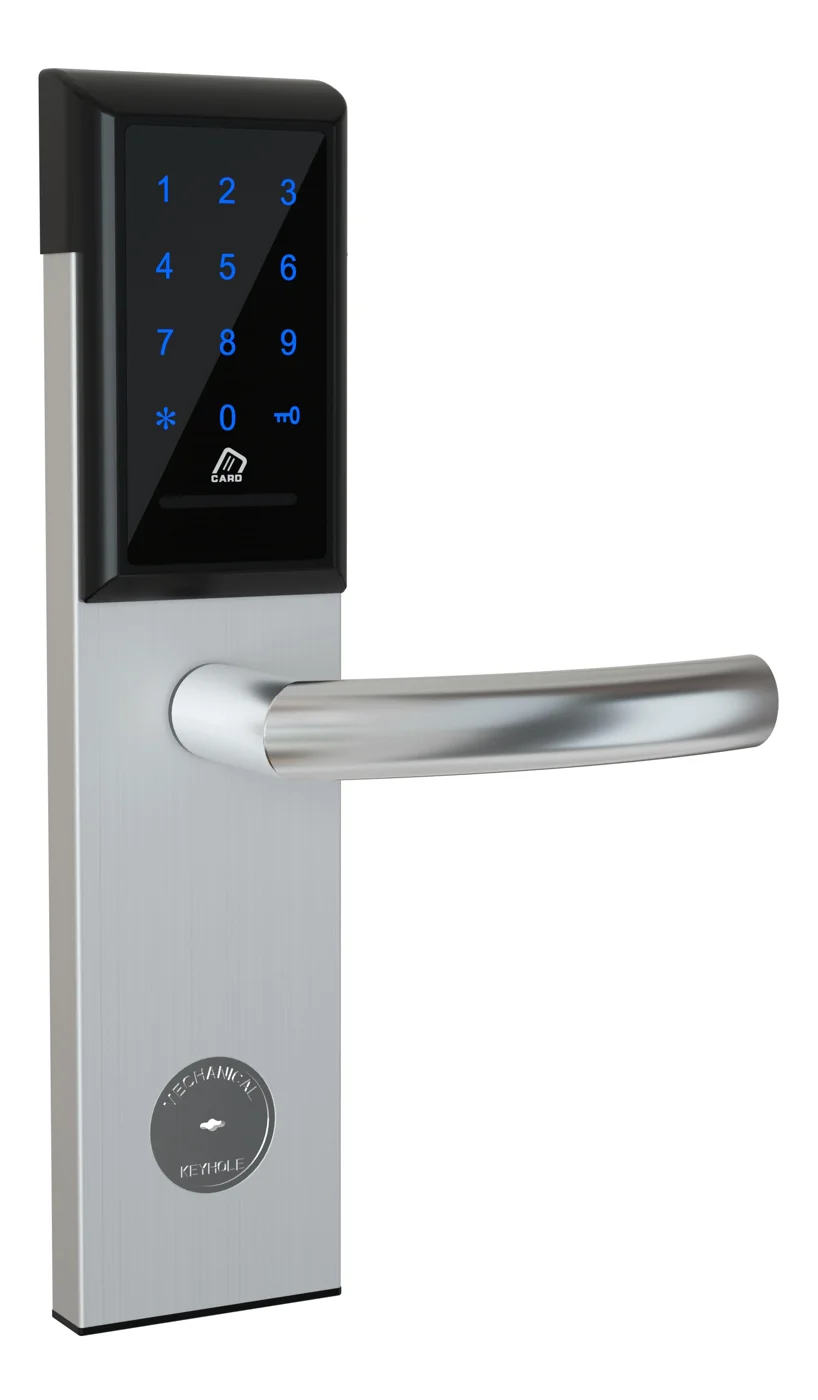
Office Cabinet Lock — PIN + Card for Filing & Pedestals
Offline PIN + card office cabinet lock for filing cabinets, pedestals, and drawers. Battery-powered 5-minute retrofit, no WiFi, no key management. CE/FCC/RoHS.
This page already points to it as the next recommended reference.
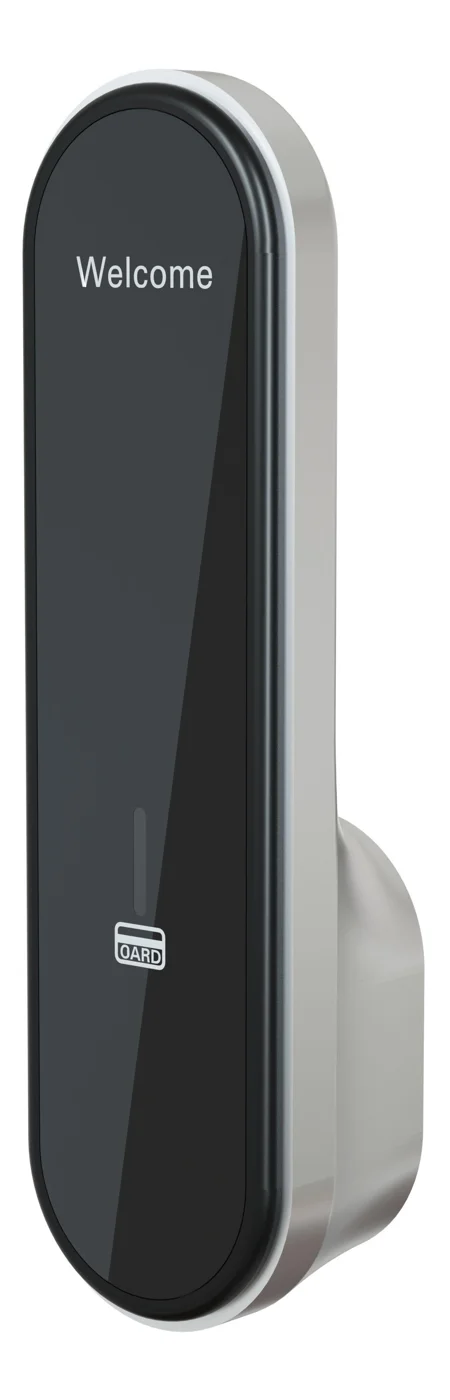
RFID Cabinet Lock — MIFARE Card, Offline Authentication
Offline MIFARE RFID cabinet lock for gym, spa, and office lockers. Tap-to-unlock 13.56 MHz, no WiFi needed, 5-minute retrofit. Zinc alloy body, battery-powered.
This page already points to it as the next recommended reference.
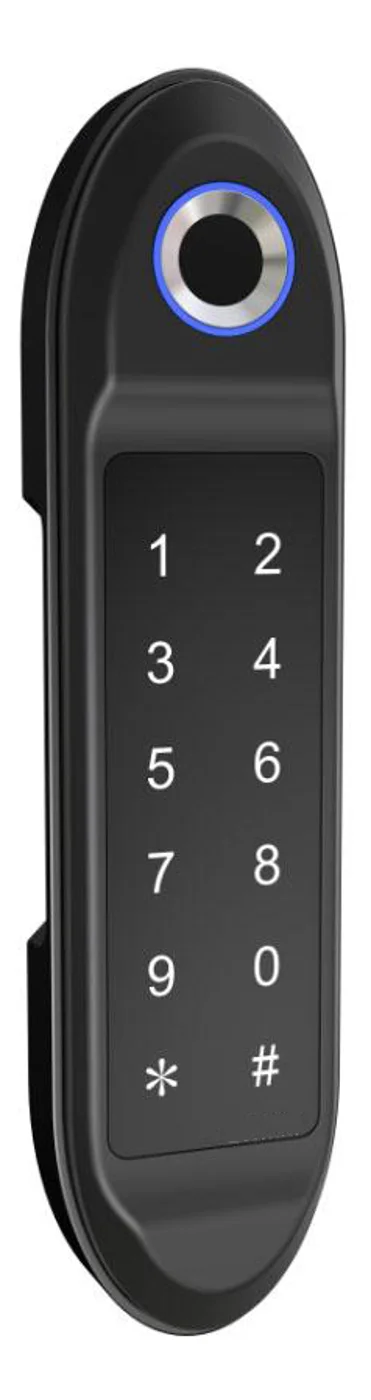
PIN Code Electronic Cabinet Lock — Stand-Alone, No WiFi
Offline keypad cabinet lock for gym, office and parcel lockers. Battery-powered, 5-minute retrofit, audit-free simple deployment. PIN + MIFARE card, DC 6V, 4×AA.
This page already points to it as the next recommended reference.
Related blog posts
3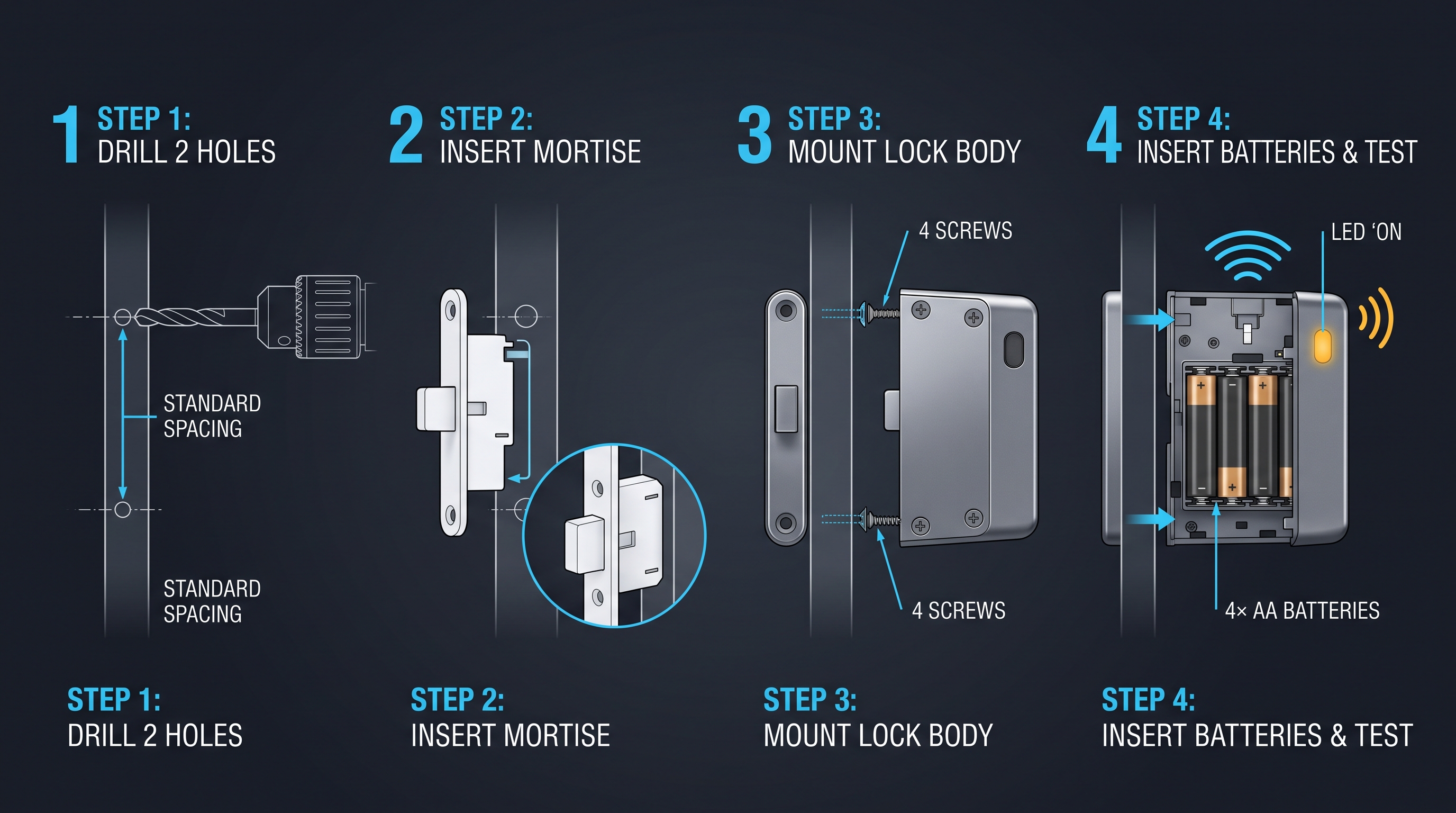
Electronic Locker Lock Price: Complete Guide to Cost Factors, Tiers, and Vendor Negotiation
Understand what drives an electronic locker lock price — from credential types and materials to volume discounts, NRE tooling, shipping, and 5-year TCO. Full pricing guide with tables.
It supports the same product context: Office Cabinet Lock — PIN + Card for Filing & Pedestals.
Electronic Locker Lock: The Complete 2026 Guide to Keyless Locker Security
Discover how an electronic locker lock works, from RFID to biometric models, with buying tips, specs, and comparisons for gyms, offices, and schools.
It supports the same product context: PIN Code Electronic Cabinet Lock — Stand-Alone, No WiFi.
Electronic Furniture Lock: The Complete Guide to Powered Cabinet Security
Electronic furniture lock secures cabinets, drawers, and casegoods with RFID, BLE, PIN, or biometric credentials, replacing keys with auditable, managed access. Full guide.
It supports the same product context: Office Cabinet Lock — PIN + Card for Filing & Pedestals, RFID Cabinet Lock — MIFARE Card, Offline Authentication, PIN Code Electronic Cabinet Lock — Stand-Alone, No WiFi.
Specify your hotel project with our engineers
Send your room count, ceiling type, and protocol preference. We will return a sample plan and quote within 24 business hours.
- Move from general guidance into a product or application discussion.
- Use RFQ when pricing, drawings, MOQ, or launch timing needs structure.
- Keep a direct contact path visible for fast clarifications and handoff.