The Best Digital Cabinet Lock Buying Guide for 2026: Types, Features, and Top Picks
Comprehensive buying guide covering the best digital cabinet lock options: RFID, NFC, Bluetooth, fingerprint, and keypad technologies with installation tips and pricing insights.
With security breaches in workplace and residential storage rising 23% year-over-year according to 2025 facility management surveys, selecting the best digital cabinet lock has become a priority for IT administrators, facility managers, and security-conscious homeowners alike. Digital cabinet locks eliminate the vulnerabilities of traditional keyed systems — key duplication, lost keys, and unauthorized access — by introducing electronic authentication methods that provide audit trails, time-based access, and remote management capabilities. The best digital cabinet lock for any given application balances access technology, build quality, battery life, and integration compatibility while meeting the specific security grade required by the environment. This guide examines over 15 digital cabinet lock models across five access technology categories, providing the detailed comparison data, installation guidance, and pricing benchmarks necessary to make an informed purchasing decision in 2026. Whether you are securing a single filing cabinet, outfitting an entire office floor, or implementing compliant storage for healthcare or retail, understanding the technology landscape is the first step toward selecting the best digital cabinet lock.
What Makes the Best Digital Cabinet Lock in 2026
A digital cabinet lock is an electronically controlled locking mechanism designed for drawers, cabinets, lockers, and storage compartments that replaces traditional mechanical keys with digital authentication — typically RFID/NFC cards (13.56 MHz MIFARE Classic or DESFire EV2/EV3), Bluetooth Low Energy (BLE 5.0+), capacitive fingerprint sensors (508 DPI resolution, FAR below 0.001%), or PIN keypads (4-12 digit codes) — and operates on battery power (commonly 4x AA alkaline or 2x CR123A lithium, providing 8,000–30,000 unlock cycles or 12–36 months of service). Unlike mechanical cam locks, which are susceptible to picking, bumping, and unauthorized key duplication, the best digital cabinet lock options integrate real-time audit logging (storing 1,000–100,000 events locally), time-restricted access scheduling, and remote administration via WiFi or Bluetooth gateways. The best digital cabinet lock for 2026 must carry CE and FCC certifications, offer IP54 or higher ingress protection for semi-outdoor or humid environments, and provide a mechanical emergency override for battery failure scenarios. When evaluating the best digital cabinet lock, facility managers should assess access frequency (daily vs occasional), user count (single-user vs 50+ users), environmental exposure, integration with existing access control systems (HID, Wiegand, OSDP), and total cost of ownership including battery replacement cycles and software subscription fees.
The digital cabinet lock market has evolved rapidly from early 125 kHz low-frequency RFID-only locks with basic solenoid actuation to today's multi-protocol platforms that support mobile credentials, biometric verification, and cloud-based management. This evolution mirrors the broader access control industry's shift toward converged physical-digital security. The best digital cabinet lock solutions now offer features that were once exclusive to enterprise-grade door access systems, including API integrations for building management systems, time-and-attendance correlation, and integration with video surveillance platforms. Understanding which features matter for your specific application — and which are unnecessary cost drivers — is the central purpose of this comprehensive guide.
| Evaluation Factor | What to Look For | Why It Matters |
|---|---|---|
| Access Technology | RFID/NFC, Bluetooth, Fingerprint, Keypad | Determines user convenience and security level |
| Battery Life | 12-36 months, low-battery warning | Prevents lockout and maintenance overhead |
| Construction Material | Zinc alloy, stainless steel, reinforced polymer | Impacts tamper resistance and durability |
| IP Rating | IP54 minimum, IP65 for humid environments | Ensures reliability in varied conditions |
| Audit Trail | 1,000-100,000 event local storage | Critical for compliance and incident investigation |
| Emergency Override | Mechanical key, external battery contacts | Prevents permanent lockout scenarios |
| Certifications | CE, FCC, RoHS, UL (where applicable) | Validates safety and quality standards |
| Software/API | Mobile app, cloud dashboard, REST API | Enables remote management and integration |
Best Digital Cabinet Lock: Technology Types Compared
A best digital cabinet lock evaluation begins with understanding the five principal access technology categories: RFID card-based locks operating at 125 kHz (EM, HID Prox, Indala) or 13.56 MHz (MIFARE Classic 1K, MIFARE DESFire EV2/EV3 with AES-128 encryption, ISO/IEC 14443 Type A/B, ISO 15693), which are the most widely deployed in office and institutional settings due to low credential cost ($0.50-$3.00 per card) and compatibility with existing employee ID badges. Bluetooth Low Energy smartphone locks using BLE 5.0/5.2 (2.4 GHz ISM band, 128-bit AES-CCM encryption) offer app-based access, eliminating physical credentials entirely while enabling remote unlock and time-bound digital key sharing with a battery consumption of approximately 0.5-2.0 mAh per unlock event. Fingerprint biometric digital cabinet locks deploy optical sensors (500 DPI typical, priced $25-$60 at module cost) or capacitive sensors (508 DPI, live-finger detection, FAR less than 0.0001%, FRR below 1%, module cost $12-$35) for single-user to 100-user enrollment. PIN keypad digital cabinet locks offer the simplest deployment with 4-12 digit code capacity, 20-200 user code slots, and tamper-timeout after 3-5 incorrect attempts. The best digital cabinet lock selection hinges on matching the access technology to user behavior patterns — facilities with turnover benefit from card-based systems, while fixed-team environments may prefer biometric or Bluetooth options for convenience.
Each access technology brings distinct trade-offs in security, convenience, cost, and management overhead. The following comparison table provides a quantitative overview of how the five technology categories perform across key evaluation dimensions.
| Technology | Frequency/Standard | User Capacity | Battery Life | Tamper Resistance | Unit Cost (Lock + Reader) | Best For |
|---|---|---|---|---|---|---|
| RFID Card (125 kHz) | EM4100, HID Prox | Unlimited (card-based) | 18-36 months | Medium | $25-$60 | Offices, schools, gyms |
| RFID/NFC (13.56 MHz) | MIFARE, DESFire, ISO 14443 | Unlimited (card-based) | 18-36 months | High (encrypted) | $30-$80 | Corporate, healthcare, government |
| Bluetooth (BLE) | BLE 5.0/5.2, 2.4 GHz | 50-500 users (app) | 8-18 months | Medium-High | $40-$120 | Co-working, tech offices, smart homes |
| Fingerprint (Capacitive) | 508 DPI, FAR <0.0001% | 20-100 fingerprints | 12-24 months | High (biometric) | $35-$90 | Executive offices, medical cabinets |
| PIN Keypad | 4-12 digits, tamper lockout | 20-200 codes | 24-36 months | Low-Medium | $15-$45 | Low-security cabinets, retail displays |
RFID-based digital cabinet locks dominate the office and institutional markets because credentials are inexpensive, durable, and integrate seamlessly with existing access control infrastructure. An employee's existing HID or MIFARE badge — already used for building entry, parking, and cafeteria payment — becomes the cabinet access credential, eliminating the need for separate key management. The best digital cabinet lock solutions in this category support multiple RFID standards simultaneously, including 125 kHz EM/HID for backward compatibility and 13.56 MHz DESFire for high-security applications, effectively future-proofing the investment as organizations migrate to more secure credential standards.
Bluetooth-based digital cabinet locks represent the fastest-growing segment, driven by the ubiquity of smartphones and the expectation of app-based control. The best digital cabinet lock implementations in BLE use AES-128-CCM encryption for the wireless link, support time-limited digital key sharing (e.g., granting a contractor access to a specific cabinet for a defined time window), and integrate with major access control platforms via REST APIs. Battery consumption is higher than RFID — typically requiring replacement every 8-18 months in daily-use scenarios — but the elimination of physical credential procurement and distribution costs often provides net savings for organizations with more than 30 users.
Fingerprint biometric digital cabinet locks offer the highest convenience factor for fixed-user environments. The best digital cabinet lock implementations use capacitive sensors rather than optical sensors because capacitive sensors detect live finger tissue (rejecting silicone replicas and latent prints) and operate reliably with dry, wet, or slightly dirty fingers — all common conditions in workshop, laboratory, and medical environments. Enrollment typically takes 4-6 finger presses per user, and authentication completes in under 0.5 seconds. The primary limitation of fingerprint systems is user capacity (typically 20-100 stored fingerprints), which makes them less suitable for high-turnover shared cabinet scenarios.
Best Digital Cabinet Lock: Key Features to Evaluate
A best digital cabinet lock evaluation must assess the key features that differentiate entry-level models from professional-grade solutions: audit trail capacity (ranging from 1,000 events on basic models to 100,000+ events on enterprise locks, stored in non-volatile flash memory with timestamp resolution of 1 second), access scheduling (time-zone programming allowing specific users or credential types access only during defined hours — critical for cleaning staff and contractors), remote management (WiFi bridge or BLE-to-WiFi gateway enabling real-time unlock, status monitoring, and configuration changes from cloud dashboards accessible via web browser or mobile app), auto-relock timing (programmable delay from 1-30 seconds after unlocking, preventing doors from being left unsecured while also allowing sufficient time for access), and multi-factor authentication capability (combining PIN + card or PIN + fingerprint to meet higher security requirements for pharmaceutical, cash-handling, and data center cabinets). The best digital cabinet lock solutions provide configurable event-triggered alerts — battery low warning, tamper attempt detected, door held open longer than N seconds — delivered via app push notification, email, or webhook integration to security incident management platforms. Mechanical construction quality is equally critical: the lock body should be die-cast zinc alloy (Zamak 3/5, tensile strength 280 MPa) or 304 stainless steel, the cam mechanism should withstand 80,000+ cycles, and the external housing should achieve IP54 or higher ingress protection.
The importance of audit trail capability cannot be overstated in regulated environments. Healthcare facilities governed by HIPAA, financial institutions subject to SOX compliance, and research laboratories following GLP standards all require verifiable records of who accessed which cabinet and when. The best digital cabinet lock for these applications stores access events with user ID, timestamp, cabinet identifier, and authentication method, and exports logs in CSV or JSON format via USB or wireless connection for integration with Security Information and Event Management (SIEM) platforms.
| Feature | Entry-Level | Mid-Range | Professional/Enterprise |
|---|---|---|---|
| Audit Trail Capacity | 1,000-3,000 events | 10,000-30,000 events | 50,000-100,000+ events |
| Access Scheduling | Not supported | Time-zone based, 5-20 zones | Calendar-based, unlimited zones |
| Remote Management | Not supported | BLE-to-phone (local only) | Cloud dashboard, multi-site |
| Auto-Relock | Fixed 3-5 seconds | Programmable 1-30 seconds | Programmable with door sensor |
| Multi-Factor Auth | Not supported | PIN + Card | PIN + Card / PIN + Fingerprint |
| Tamper Alert | None | Local buzzer | Push notification + email |
| Construction Material | ABS polymer / zinc alloy | Zinc alloy + steel cam | Stainless steel, IP65 rated |
| Software API | Not available | Basic mobile app SDK | REST/GraphQL, MQTT support |
Construction quality directly determines the security posture of any digital cabinet lock. The lock body material, cam mechanism durability, and tamper resistance features collectively define whether an attacker can bypass the lock through physical means rather than electronic exploitation. The best digital cabinet lock designs use hardened steel cams with a minimum Rockwell hardness of HRC 52, anti-drill plates protecting the lock cylinder or electronic module, and concealed mounting screws that are accessible only when the cabinet is open. For outdoor or semi-outdoor applications such as poolside lockers or exterior equipment cabinets, an IP65 rating is essential — the "6" indicates complete dust-tight construction, while the "5" signifies protection against water jets from any direction. In coastal environments, 316 stainless steel construction is preferred over 304 for its superior corrosion resistance against salt spray.
Battery technology choices significantly impact total cost of ownership. The best digital cabinet lock designs use widely available battery formats (AA, AAA, CR123A) rather than proprietary or rare battery types. Alkaline AA batteries (4x, providing 6V nominal) are the most common configuration, delivering 12-24 months of service in typical office use. Lithium batteries (CR123A, 3V, 2x providing 6V) offer extended temperature range (-30 C to +60 C vs -18 C to +55 C for alkaline) and up to 36 months of service, making them the better choice for outdoor installations or cold storage cabinets. A critical feature is multi-stage low-battery warning: an audible beep or LED flash at 20% remaining capacity, followed by more frequent warnings at 10% and 5%, with the lock entering a fail-open or fail-secure state (configurable) when power is critically depleted.
Best Digital Cabinet Lock: Installation and Compatibility
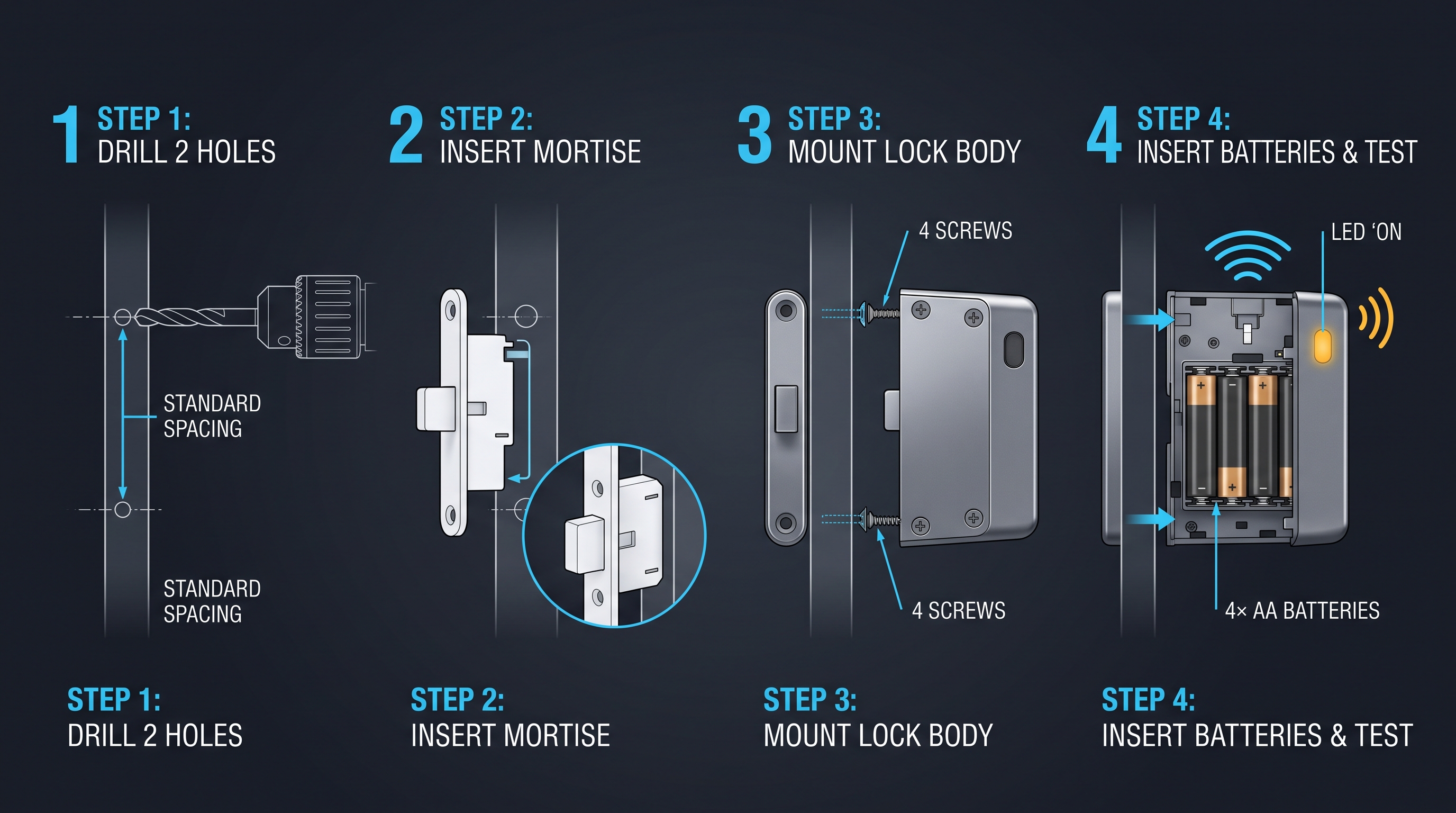
Installation compatibility is a deciding factor when choosing the best digital cabinet lock for retrofit applications: the lock must match the existing cabinet preparation — most commonly a 19 mm or 21 mm mounting hole for standard cam lock cutouts, with lock body dimensions typically 50-70 mm in length, 25-35 mm in width, and 15-25 mm in thickness — and the cam must align with the cabinet's locking bar or latch mechanism with adjustability of at least 5 mm in both vertical and horizontal planes through slotted mounting plates or multi-position cam attachment. The best digital cabinet lock models support both right-hand and left-hand door swing configurations through reversible cam installation and offer adjustable cam rotation angles (90 or 180-degree default, configurable via software or DIP switch). Cabinet material compatibility spans wood (12-22 mm thickness typical), metal (0.8-2.0 mm steel), glass (requires specialized adhesive or clamp mounting), and laminate/MDF — each requiring specific mounting hardware included with premium models: wood screws (3.5 x 16 mm), machine screws with nuts (M4 x 20 mm) for metal, and adhesive mounting plates for glass. The installation process for the best digital cabinet lock should require only a Phillips screwdriver, a drill with 19 mm or 21 mm hole saw, and a tape measure — achievable by facility maintenance staff in under 15 minutes per cabinet without specialized locksmith tools or training.
Cabinet preparation measurements deserve careful attention because mismatches between lock body dimensions and existing cutouts can derail a retrofit project. The vast majority of cabinets worldwide use either a 19 mm (3/4 inch) or 21 mm (13/16 inch) circular cutout, based on decades of cam lock standardization. The best digital cabinet lock manufacturers provide detailed dimensional drawings with tolerances, and many offer adapter plates or escutcheons that cover oversized or irregular cutouts up to 25 mm in diameter. Before ordering, facility managers should measure the existing cutout diameter, cabinet material thickness at the mounting point, clearance depth behind the lock mounting surface (accounting for drawer slides, cabinet frame members, and adjacent hardware), and the cam-to-locking-bar alignment distance.
| Compatibility Factor | Standard Range | Measurement Method |
|---|---|---|
| Mounting Hole Diameter | 19 mm or 21 mm | Caliper or gauge on existing hole |
| Cabinet Material Thickness | 12-22 mm (wood), 0.8-2.0 mm (metal) | Caliper or thickness gauge |
| Lock Body Clearance Depth | 30-50 mm behind mounting surface | Measure from inside cabinet face |
| Cam Reach/Projection | 8-25 mm from lock center | Measure to locking bar contact point |
| Door Swing Direction | Left-hand or right-hand | Face cabinet, note hinge side |
| Cam Rotation Angle | 90 or 180 default | Verify lock bar travel requirements |
Wiring considerations apply to certain best digital cabinet lock models — primarily those with external battery packs, remote unlock buttons, or integration with building access control panels via Wiegand or OSDP interfaces. These wired connections typically use 22-26 AWG stranded wire with JST or Molex connectors, running through existing cable management channels or surface-mounted raceways. For cabinets that are frequently moved, such as mobile medical carts or retail display fixtures, wireless-only digital cabinet locks eliminate the reliability concern of repeated flexing and connector fatigue. Cabinet-mounted solar panels or energy-harvesting NFC readers are emerging technologies that may eliminate battery replacement entirely, though these remain niche solutions with 2-3x cost premiums as of 2026.
The retrofit installation workflow deserves a structured approach: (1) remove the existing mechanical lock by unscrewing the retaining nut (typically 19 mm hex or spanner nut) and extracting the lock body; (2) clean the mounting surface and verify the cutout is free of burrs or deformation; (3) install the lock body from the exterior side, ensuring proper orientation of the cam relative to the locking bar; (4) tighten the retaining nut to 2.5-3.0 Nm torque — excessive torque can deform the lock body or crack plastic escutcheons; (5) mount the cam in the correct position using the set screw, testing the lock/unlock throw distance; (6) install batteries, perform the initialization sequence (typically pressing a reset button or presenting the first administrator card), and test lock/unlock operation 3-5 times; (7) enroll users and configure access parameters using the programming card, keypad, or mobile app as appropriate.
Best Digital Cabinet Lock: Security Standards and Certifications
A best digital cabinet lock must meet recognized security standards and carry verifiable certifications: CE marking (European Conformity, mandatory for sale in EU/EEA, covering electromagnetic compatibility per EN 55032/55035, radio equipment compliance per RED 2014/53/EU for wireless models, and safety per EN 62368-1), FCC certification (47 CFR Part 15 for intentional and unintentional radio frequency emissions in the US market, with specific absorption rate limits for body-worn devices), RoHS compliance (Directive 2011/65/EU restricting lead, mercury, cadmium, hexavalent chromium, PBBs, and PBDEs, plus the four phthalates added under Directive 2015/863), and UL certification where applicable (UL 294 for access control system units at Attack, Endurance, Line Security, and Standby Power levels I-IV, with Level IV representing the highest destruction attack resistance). The best digital cabinet lock for healthcare applications must additionally comply with HIPAA security rule requirements for access control (45 CFR 164.312(a)(1)), specifically the implementation specification for unique user identification and automatic logoff, which an audit-trail-capable digital cabinet lock addresses directly. For government and defense applications, locks should meet FIPS 201-3 for PIV credential compatibility or achieve NIAP Common Criteria evaluation for the authentication mechanism. Physical security standards such as EN 1143-1 (secure storage units) and EN 1300 (high-security locks) provide independent verification of attack resistance, though most commercial digital cabinet locks target EN 1300 Class B or the equivalent, representing 10,000-30,000 effective key differs and resistance to 5 minutes of skilled manipulation.
Security certification is not merely a compliance checkbox — it directly correlates with the lock's resistance to real-world attack methods. The best digital cabinet lock providers submit their products for independent testing by accredited laboratories such as TUV Rheinland, SGS, UL, or Intertek, and publish the certification certificates for verification. Counterfeit or uncertified digital cabinet locks flooding online marketplaces at improbably low prices ($8-$15) typically lack any meaningful security testing, use unencrypted RFID protocols vulnerable to cloning attacks, and fail within months of installation.
| Certification | Scope | Relevance to Digital Cabinet Locks |
|---|---|---|
| CE Marking | EU safety, EMC, radio compliance | Mandatory for EU market; validates basic safety |
| FCC Part 15 | US radio frequency emissions | Required for wireless locks sold in US |
| RoHS | Hazardous substance restriction | Environmental compliance for global markets |
| UL 294 | Access control system units | Physical and electrical security validation |
| EN 1300 Class B | High-security lock cylinders | Attack resistance and key differs |
| IP54 / IP65 | Ingress protection rating | Dust and water resistance verification |
| FIPS 201-3 | PIV credential compatibility | US government deployment eligibility |
Encryption standards distinguish the best digital cabinet lock from commodity alternatives. RFID locks using MIFARE DESFire EV2 or EV3 implement AES-128 encryption with mutual three-pass authentication, effectively preventing credential cloning and replay attacks that plague unencrypted 125 kHz EM/HID systems. BLE locks should implement LE Secure Connections with Elliptic Curve Diffie-Hellman (ECDH) key exchange using the P-256 curve, providing approximately 128-bit equivalent security against passive eavesdropping and man-in-the-middle attacks. The best digital cabinet lock firmware implements secure boot (verifying firmware signature against a hardware-rooted public key before execution), encrypted firmware update delivery (AES-256-GCM or equivalent), and tamper-evident logging that cannot be modified or deleted without administrator authorization. Penetration testing reports — ideally from an accredited CREST or ISO 17025 laboratory — provide additional confidence beyond paper certifications.
Data privacy is an increasingly important security dimension for the best digital cabinet lock. GDPR (General Data Protection Regulation) compliance for locks deployed in the EU requires that personal data — including biometric templates, access logs, and user identifiers — be stored with appropriate technical safeguards. The best digital cabinet lock implementations store biometric data as irreversible templates (hashed feature vectors, not raw fingerprint images), encrypt access logs at rest, and provide a mechanism for complete data erasure upon decommissioning or user deletion. California's CCPA and Brazil's LGPD impose similar requirements and penalties, making data privacy considerations globally relevant for multinational deployments.
Best Digital Cabinet Lock: Price and Value Analysis
The price of the best digital cabinet lock spans a wide range — from approximately $15 for basic PIN keypad locks to over $250 for enterprise-grade multi-protocol wireless locks with cloud management — and value assessment must consider not just the hardware acquisition cost but the complete total cost of ownership (TCO) over a 5-year lifecycle including battery replacement ($0.50-$2.00 per lock per year), software subscription fees ($0-$5 per lock per month for cloud management platforms), credential issuance costs ($0.50-$3.00 per user for cards/fobs, zero for PIN or Bluetooth), installation labor (15-30 minutes per lock for retrofit, $15-$50 at contract facility maintenance rates), and ongoing administrative overhead (user enrollment, deactivation, access schedule updates estimated at 5-15 minutes per user per year). The best digital cabinet lock ROI analysis shows that while mechanical key systems have lower upfront hardware cost ($5-$15 per lock), they incur annual key management costs of $15-$40 per lock including rekeying after staff turnover, lost key replacement, and administrative time — making digital locks cost-effective within 12-24 months for any environment with more than 20 users or annual turnover exceeding 15%. Organizations with 50+ locks and a cloud management platform achieve the fastest payback due to centralized administration eliminating the labor of physically visiting each cabinet for access changes.
The market segments into four price tiers with distinct feature profiles. Understanding these tiers helps procurement teams avoid both over-specification (paying for features that will never be used) and under-specification (selecting a lock that fails to meet security or audit requirements, requiring premature replacement).
| Price Tier | Hardware Cost per Lock | Key Features | Typical Applications | 5-Year TCO (50 Locks) |
|---|---|---|---|---|
| Budget ($15-$35) | $15-$35 | PIN keypad or 125 kHz RFID, plastic body, 1,000 event log, no remote management | Low-security retail displays, residential | $1,500-$3,000 |
| Standard ($35-$80) | $35-$80 | 13.56 MHz RFID/NFC or BLE, zinc alloy body, 10,000 event log, basic app | Offices, gyms, schools | $3,500-$7,000 |
| Professional ($80-$150) | $80-$150 | Multi-protocol (RFID + BLE), fingerprint option, 50,000 event log, cloud dashboard | Corporate, healthcare, co-working | $7,000-$14,000 |
| Enterprise ($150-$250+) | $150-$250+ | All protocols, biometric, REST API, MQTT, SIEM integration, 100,000+ event log, IP65 | Government, pharma, data centers, airports | $14,000-$30,000+ |
The subscription cost component warrants careful scrutiny. Some best digital cabinet lock providers bundle hardware and software into an all-inclusive price, while others separate hardware (one-time purchase) from software (recurring subscription). Common subscription models include per-lock monthly fees ($0.50-$5.00 per lock/month), tiered platform fees ($29-$199/month for unlimited locks within a tier), and perpetual license options ($1,500-$10,000 one-time for on-premises server software). Organizations with stable, long-term lock deployments often prefer perpetual licenses to avoid ongoing operational expenses, while those with growing or fluctuating lock counts may favor per-lock subscriptions for flexibility. Before committing to a best digital cabinet lock platform, procurement should verify whether the subscription fee includes firmware updates, technical support (response SLA, support hours, channel availability), and feature upgrades or whether these are charged separately.
Credential lifecycle costs vary significantly by technology. RFID cards (MIFARE Classic, $0.50-$1.00 each in quantity) offer the lowest per-user credential cost and last 5-10 years under normal handling. BLE smartphone access eliminates credential manufacturing costs entirely but requires user onboarding (app installation, account creation, Bluetooth pairing) estimated at 5-10 minutes per user and ongoing IT support for app compatibility issues across iOS and Android versions. Fingerprint enrollment is a one-time cost of 1-2 minutes per user with no consumable credential cost, making it the lowest long-term TCO for stable user populations. The best digital cabinet lock allows mixing of authentication methods within a single deployment — for example, RFID cards for the general workforce and fingerprint for high-security cabinets accessed by a limited group.
Best Digital Cabinet Lock: Use Case Scenarios
Office environments represent the largest market for the best digital cabinet lock, with typical deployments ranging from 20-200 locks across filing cabinets, supply closets, IT equipment racks, and personal storage pedestals: in a 100-person office, the best digital cabinet lock deployment using RFID cards (integrated with existing employee access badges at 13.56 MHz MIFARE DESFire) achieves a reduction in key management overhead of approximately 80% — from 3-5 hours per week of supervisor time managing physical keys to under 30 minutes per week for digital administration — with an additional benefit of complete audit visibility enabling investigation of missing items within minutes rather than conducting facility-wide key holder interviews. Medical and healthcare facilities deploy the best digital cabinet lock on pharmaceutical storage cabinets, patient record cabinets, and controlled substance inventory lockers, where HIPAA compliance and DEA controlled substance security requirements mandate user-specific access logging, dual-authentication for Schedule II-IV substances (requiring two authorized staff members to simultaneously authenticate), and automatic relock with tamper alarm — features that are standard on professional-tier digital cabinet locks but impossible with mechanical keys. Retail environments use the best digital cabinet lock for high-value merchandise display cases, cash drawer security, and back-room inventory storage, with time-restricted access ensuring that only shift supervisors can unlock during specific hours and that all access events are timestamped for loss prevention analysis.
Each use case presents a unique combination of requirements that narrows the field of suitable digital cabinet lock options. The following table maps common application scenarios to their key requirements and recommended lock types.
| Application Scenario | Key Requirements | Recommended Lock Type | Typical Deployment Size |
|---|---|---|---|
| Corporate Office | RFID badge integration, audit trail, centralized management | 13.56 MHz RFID/NFC, cloud-managed | 20-200 locks |
| Healthcare/Pharmacy | Dual-authentication, HIPAA audit log, auto-relock | Multi-protocol with PIN + card, enterprise tier | 10-100 locks |
| Retail/Loss Prevention | Time-restricted access, tamper alerts, simple operation | Keypad + RFID hybrid, professional tier | 5-50 locks |
| Education/Schools | Simple user management, vandal resistance, bulk pricing | RFID card, standard tier | 50-500 locks |
| Residential/Home Office | Easy installation, smartphone access, aesthetic design | Bluetooth BLE, mid-to-professional tier | 1-10 locks |
| Co-working Spaces | Mobile app access, time-based booking, remote management | Bluetooth BLE with cloud platform | 50-300 locks |
Healthcare deployments of the best digital cabinet lock merit particular attention due to the regulatory environment and the consequences of security failure. Controlled substance diversion — the theft of medications by healthcare workers — is estimated to affect 10-15% of healthcare professionals at some point in their careers according to industry studies. The best digital cabinet lock for pharmaceutical storage implements dual-custody authentication (requiring two separately authenticated users within 30 seconds of each other to unlock), automatic relock within 15 seconds of opening, and audit trail export compatible with automated diversion monitoring software such as Invistics or Kit Check. Additionally, the lock housing must withstand hospital-grade disinfectants (quaternary ammonium compounds, hydrogen peroxide vapor, bleach solutions) without degradation of the keypad membrane or card reader surface.
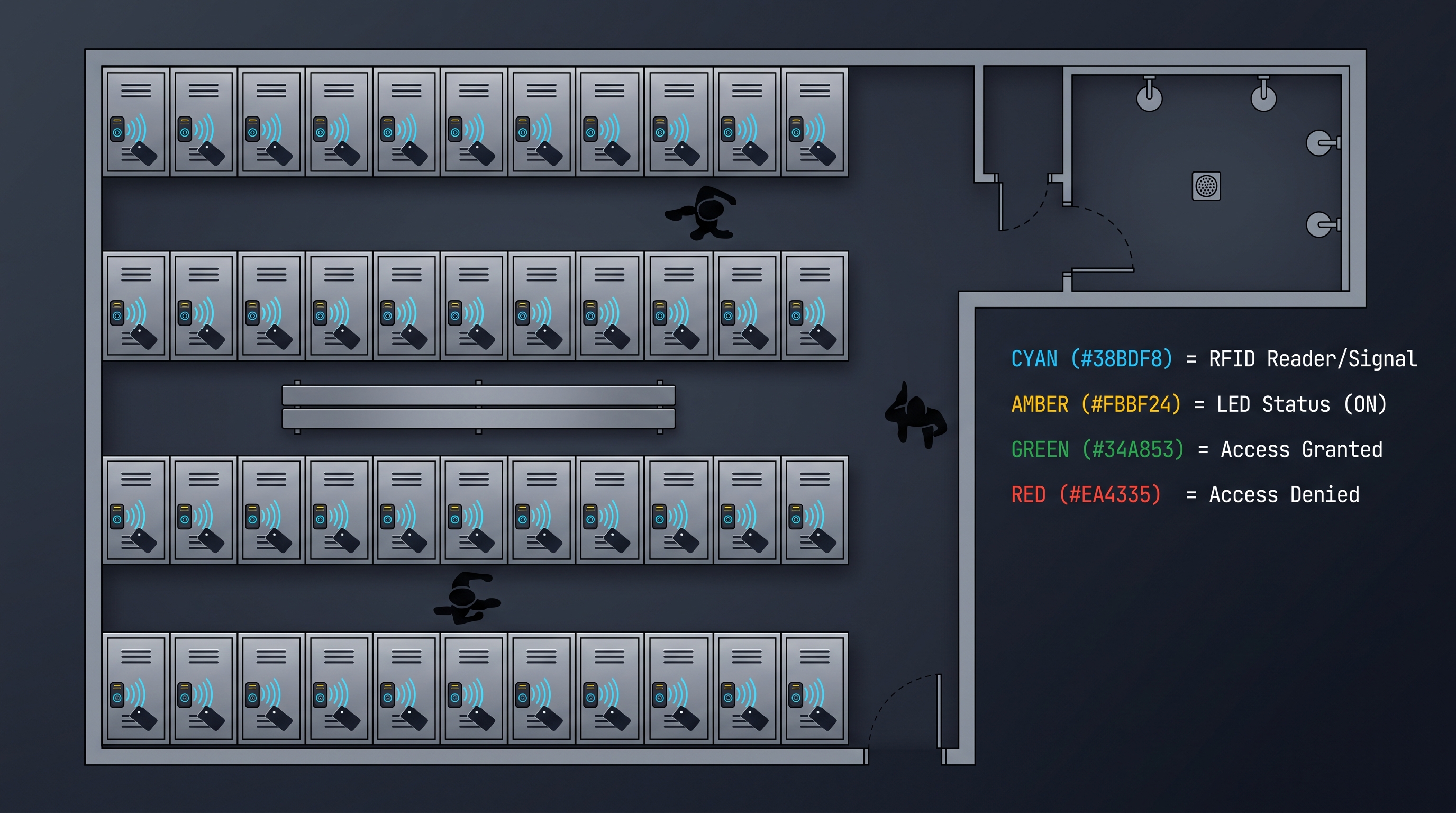
Educational deployments face a different set of challenges. School locker digital cabinet locks must withstand heavy daily use (10-30 unlock cycles per day per lock during passing periods), resist vandalism from frustrated students, and operate reliably despite exposure to graphite, adhesives, and other contaminants that students may introduce. The best digital cabinet lock for school applications uses a fully sealed keypad membrane or RFID reader faceplate with no exposed fasteners, an internal buzzer volume of at least 85 dB at 10 cm for audible feedback in noisy corridors, and a master key emergency override accessible only by authorized staff. Pricing sensitivity in education markets favors standard-tier RFID models with bulk purchasing discounts typically reaching 20-35% for orders of 100+ units.
Residential and home office applications prioritize a different feature set than commercial deployments. The best digital cabinet lock for home use emphasizes aesthetic integration with furniture (available in matte black, brushed nickel, and white finishes), silent or quiet operation (below 45 dB at 1 meter), and simple smartphone-only management without requiring IT infrastructure. Fingerprint models are particularly popular for home offices because they provide instant access without carrying a card or remembering a code, and multiple family members can be enrolled for shared cabinets.
Best Digital Cabinet Lock: Maintenance and Troubleshooting
Maintaining the best digital cabinet lock ensures reliable operation and maximizes the return on investment: proactive maintenance tasks include battery replacement on a calendar schedule (every 12 months for AA alkaline, 24 months for lithium CR123A) rather than waiting for low-battery warnings, which can occur at inconvenient times — the best digital cabinet lock models preserve all user data and configuration settings in non-volatile flash memory during battery changes, allowing battery swaps without reprogramming and with a battery-change timeout window of 30-60 seconds during which a supercapacitor or backup capacitor maintains the real-time clock and volatile memory state. Regular cleaning of the RFID reader surface or keypad membrane with a microfiber cloth dampened with isopropyl alcohol (70% solution, avoiding abrasive cleaners that can micro-scratch and fog the reader window) maintains reliable credential reading, while quarterly testing of the mechanical emergency override key confirms that the physical backup access method remains functional — a task that reveals frozen or seized override cylinders in approximately 3-5% of locks not tested for 12+ months according to facility management surveys. The best digital cabinet lock firmware should be updated every 6-12 months or whenever a security vulnerability is published by the manufacturer, with the update process being executable wirelessly (for BLE/WiFi models) or via micro-USB connection to a laptop running the manufacturer's configuration utility, and the update itself must be cryptographically signed to prevent firmware tampering.
Common troubleshooting scenarios and their resolutions are well-documented for the best digital cabinet lock brands. The following table summarizes the most frequent issues encountered during deployment and the standard resolution steps.
| Symptom | Probable Cause | Resolution | Prevention |
|---|---|---|---|
| Lock fails to respond to card | RFID antenna misalignment, damaged card | Re-present card flat against reader; test with known-good card | Replace visibly warped or cracked cards |
| Intermittent Bluetooth connection | BLE range (>10m), interference from WiFi 2.4 GHz | Move phone within 2m range; avoid Bluetooth-WiFi co-channel | Position lock away from WiFi APs; use BLE 5.0+ |
| Battery drains in under 3 months | Excessive unlock cycles, counterfeit batteries | Count daily cycles; install brand-name alkaline/lithium | Track cycle count; replace batteries on calendar schedule |
| Keypad unresponsive | Moisture ingress, worn membrane | Dry with desiccant; replace keypad assembly | Choose IP54+ rated lock for humid locations |
| Audit log export fails | Storage full, file system corruption | Clear old logs after backup; perform factory reset | Export and clear logs quarterly |
| Mechanical override frozen | Corrosion, lack of lubrication | Apply graphite powder to cylinder; exercise key gently | Operate override key quarterly; apply dry lubricant annually |
| Incorrect time/date stamps | RTC drift, dead backup capacitor | Re-sync time via programming card or app; replace lock if RTC fails | Verify time accuracy monthly; replace batteries before depletion |
Battery management is the most common maintenance concern for any best digital cabinet lock deployment. A disciplined approach to battery procurement — purchasing from authorized distributors rather than online marketplace sellers where counterfeit alkaline and lithium batteries are prevalent — ensures rated capacity and prevents premature failure. Battery brands with documented quality consistency (Energizer Industrial, Duracell Procell, Panasonic, Varta) should be specified in maintenance procedures. For large deployments (100+ locks), battery replacement can be scheduled in quarterly rotation with 25% of locks serviced each quarter, spreading the labor and material cost evenly across the fiscal year rather than incurring a single annual spike.
Firmware version tracking becomes critical as deployments scale. The best digital cabinet lock management platforms include a firmware version dashboard showing the version running on each lock in the fleet, with the ability to push updates to selected locks or globally. Security researchers periodically discover vulnerabilities in RFID protocols, BLE implementations, and cryptographic libraries — the 2023-2025 period saw CVEs published for MIFARE Classic key recovery attacks (improved nested attack reducing required authentications), BLE link-layer relay vulnerabilities, and side-channel attacks on AES implementations in microcontrollers. A best digital cabinet lock provider with a demonstrated track record of issuing firmware patches within 30-90 days of vulnerability disclosure protects the organization from these evolving threats.
Best Digital Cabinet Lock: Industry Trends and Future Outlook
The best digital cabinet lock market is being shaped by several transformative trends: the convergence of UWB (Ultra-Wideband, IEEE 802.15.4z, 3.1-10.6 GHz, 30 cm positioning accuracy) with digital locking platforms enabling hands-free unlock as an authorized user approaches the cabinet — a significant convenience upgrade over present-touch RFID or app-launch Bluetooth workflows that adds approximately $8-$15 to the lock bill of materials at current chipset pricing, with volume-driven cost reduction expected to bring UWB into the professional-tier best digital cabinet lock segment by 2028. Matter protocol adoption (Matter 1.3 and later, operating over Thread at 2.4 GHz 802.15.4 with IPv6 mesh networking) is extending smart home ecosystem compatibility to cabinet locks, allowing a best digital cabinet lock to appear as a lock accessory in Apple Home, Google Home, Amazon Alexa, and Samsung SmartThings simultaneously without requiring proprietary bridges or hubs — though cabinet lock profiles in Matter are still evolving and widespread adoption is projected for the 2027-2028 timeframe. AI-driven predictive maintenance, analyzing battery discharge curves and unlock cycle patterns across a fleet of locks to predict individual lock battery failure 30-60 days in advance with 90%+ accuracy, is being incorporated into enterprise cloud management platforms from leading best digital cabinet lock providers, reducing unplanned lockout events by an estimated 70% based on early adopter data. Edge computing architectures, where a local gateway (Raspberry Pi CM4 or equivalent, running Linux with containerized lock management software) handles authentication decisions and log aggregation locally with sub-100 ms latency while syncing to cloud for reporting and remote access, addresses both latency sensitivity (users expect sub-second unlock response) and data sovereignty requirements (some jurisdictions and organizations require access log data to remain on-premises).
Wireless power transfer and energy harvesting represent the most disruptive technology on the horizon for the best digital cabinet lock category. NFC energy harvesting — where the lock draws power from the NFC field of the user's smartphone during the credential presentation — could eliminate batteries entirely for scenarios where users authenticate with their phone. Current implementations can harvest 50-100 mW from standard NFC readers, sufficient to power a low-energy solenoid or motorized latch for the 200-500 ms required to retract the locking bolt. The best digital cabinet lock manufacturers are also exploring photovoltaic energy harvesting using indoor-optimized amorphous silicon or perovskite solar cells integrated into the lock faceplate, generating 100-500 microwatts from typical office lighting (300-500 lux) — not sufficient to power the lock directly, but capable of trickle-charging a supercapacitor or thin-film battery that provides burst power for unlock actuation.
| Trend | Technology | Maturity Timeline | Impact on Best Digital Cabinet Lock |
|---|---|---|---|
| UWB Hands-Free Unlock | IEEE 802.15.4z, 3.1-10.6 GHz | 2026-2028 | Eliminates physical credential interaction |
| Matter Protocol Support | Matter 1.3+, Thread mesh | 2027-2028 | Multi-ecosystem smart home integration |
| AI Predictive Maintenance | ML battery analytics, cloud | 2025-2027 | 70% reduction in unplanned battery failures |
| Edge-First Architecture | Local gateway, containerized SW | 2026-2028 | Sub-100ms latency, data sovereignty |
| NFC Energy Harvesting | ISO 14443 field power | 2026-2029 | Battery-free NFC phone-unlock locks |
| Post-Quantum Cryptography | NIST PQC standards (CRYSTALS-Kyber) | 2028-2032 | Future-proofing against quantum attacks |
Post-quantum cryptography is a longer-term consideration for the best digital cabinet lock ecosystem. While quantum computers capable of breaking ECC (Elliptic Curve Cryptography) and RSA at commercially relevant speeds remain 5-10+ years away, digital cabinet locks deployed in 2026 may still be in service when quantum threats materialize — particularly in government, defense, and critical infrastructure applications with 10-15 year deployment lifecycles. NIST's 2024 standardization of CRYSTALS-Kyber (FIPS 203, Module-Lattice-Based Key-Encapsulation Mechanism) provides a migration path to quantum-resistant key exchange, though the computational and memory requirements (Kyber-768 public key size: 1,184 bytes vs 32 bytes for ECDH P-256) present implementation challenges for the constrained microcontrollers (ARM Cortex-M0/M3/M4, 64-256 KB flash, 8-32 KB RAM) typically used in digital cabinet locks. The best digital cabinet lock manufacturers are monitoring PQC standardization and planning hardware refreshes with more capable microcontrollers (Cortex-M33 with TrustZone, 512 KB+ flash) that can accommodate hybrid classical+PQC protocols when deployment timelines require it.
Best Digital Cabinet Lock: Final Recommendations
Selecting the best digital cabinet lock requires methodically matching lock capabilities to specific operational requirements rather than defaulting to the most feature-rich or the least expensive option: organizations should start by documenting their access frequency (daily vs occasional), user population size and stability (10 users with 5% annual turnover vs 200 users with 30% turnover), environmental conditions (climate-controlled office vs humid pool locker vs outdoor equipment cabinet), integration requirements (standalone vs integration with building access control system via Wiegand/OSDP vs cloud API integration with custom applications), compliance obligations (HIPAA, SOX, GLP, GDPR), and budget constraints (both upfront hardware and ongoing subscription/support costs) — this structured requirements document then maps directly to the technology and price tier recommendations in this guide. For the most common deployment scenario — a 50-100 person office with filing cabinets and supply storage in a climate-controlled environment — the best digital cabinet lock recommendation is a 13.56 MHz RFID/NFC model with MIFARE DESFire EV2 support in the standard or professional tier ($50-$100 per lock), integrated with existing employee access badges to eliminate credential issuance costs, with cloud management for centralized administration and audit log access. For healthcare environments, the recommendation shifts to enterprise-tier multi-protocol locks supporting dual authentication with 100,000+ event logging and dedicated pharmaceutical compliance features. For high-turnover environments such as gyms and schools, RFID-based systems with simple administration interfaces minimize staff training burden while providing the access accountability that mechanical keys cannot offer.
Vendor selection criteria for the best digital cabinet lock should weigh factors beyond the technical specifications listed in this guide. Evaluate the manufacturer's market presence and financial stability — a lock platform is a 5-10 year commitment, and a vendor that exits the market leaves customers with unsupported hardware and no path to security updates. Assess the quality of technical documentation, API documentation (OpenAPI/Swagger specification availability), and community forums or developer resources. Request references from deployments of similar scale and industry, and verify them. Test the mobile app or cloud dashboard with a trial account before committing — usability issues that seem minor in a 5-minute demo become significant frustrations when managing 200 locks daily. Verify warranty terms (standard is 1-2 years, with some best digital cabinet lock manufacturers offering 3-5 year warranties on professional and enterprise tiers) and the process for warranty replacement — cross-shipping with prepaid return labels is the gold standard.
The best digital cabinet lock is not a single product but the optimal match between your requirements and the available technology tiers. By following the evaluation framework presented in this guide — defining requirements, matching technology types and feature sets, comparing total cost of ownership, and verifying certifications and vendor reliability — you will arrive at a best digital cabinet lock selection that delivers security, convenience, and return on investment throughout its operational life.
| Decision Factor | Recommendation | Priority Level |
|---|---|---|
| Access Technology | Match to user behavior: RFID for turnover, BLE for smartphone users, fingerprint for fixed small teams | Critical |
| Audit Trail | Minimum 10,000 events for regulated environments; 50,000+ for healthcare/pharma | Critical |
| Cloud Management | Essential for 20+ locks; optional for 1-5 locks | High |
| Emergency Override | Mechanical key override mandatory for all deployments | Mandatory |
| IP Rating | IP54 minimum for indoor; IP65 for outdoor/humid | High |
| Encryption | AES-128 minimum; DESFire EV2/EV3 for sensitive applications | High |
| Battery Type | AA or CR123A (widely available); avoid proprietary batteries | Medium |
| Vendor Stability | 5+ years in market, active firmware updates, responsive support | High |
Not sure which sensor fits your project?
Talk to our mmWave application engineers for a free consultation.
Find the right presence sensor for your hotel project
Compare the 3 protocols, check hotel-specific case studies, and download the installation guide
Related products
3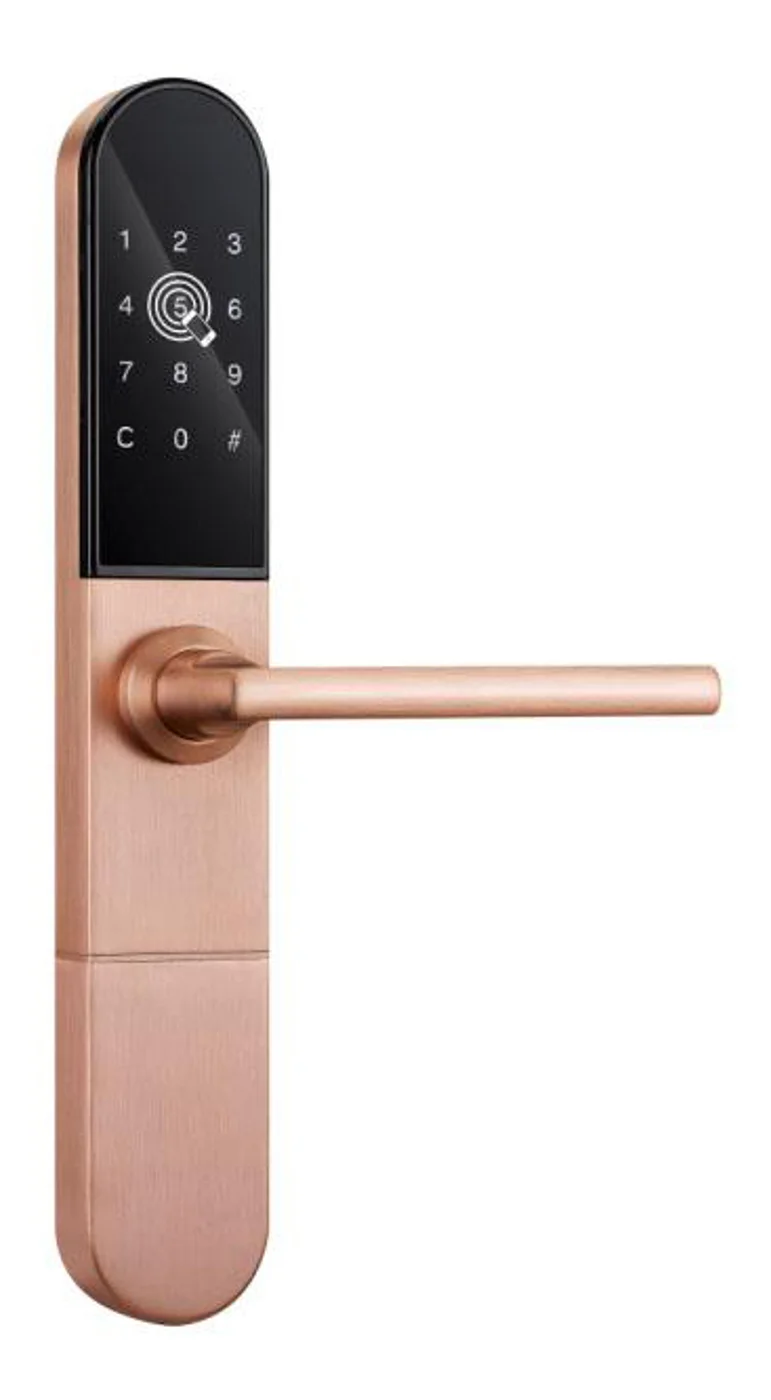
Smart Cabinet Lock — App-Managed, Multi-Site Dashboard
App-managed smart cabinet lock for office, parcel, and multi-site fleets. BLE app dashboard, audit trail, remote unlock, no per-lock server. Higher-tier chassis.
This page already points to it as the next recommended reference.
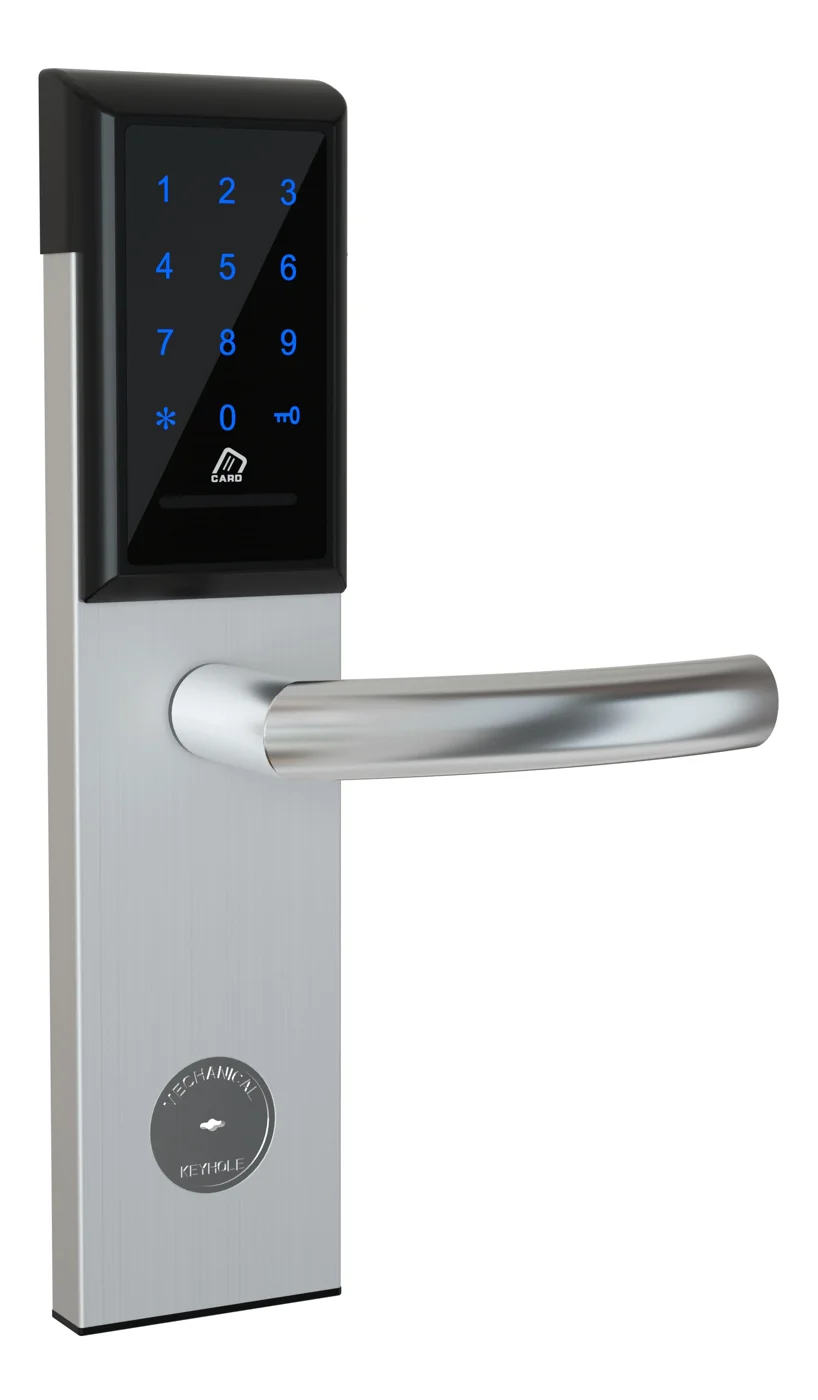
Office Cabinet Lock — PIN + Card for Filing & Pedestals
Offline PIN + card office cabinet lock for filing cabinets, pedestals, and drawers. Battery-powered 5-minute retrofit, no WiFi, no key management. CE/FCC/RoHS.
This page already points to it as the next recommended reference.
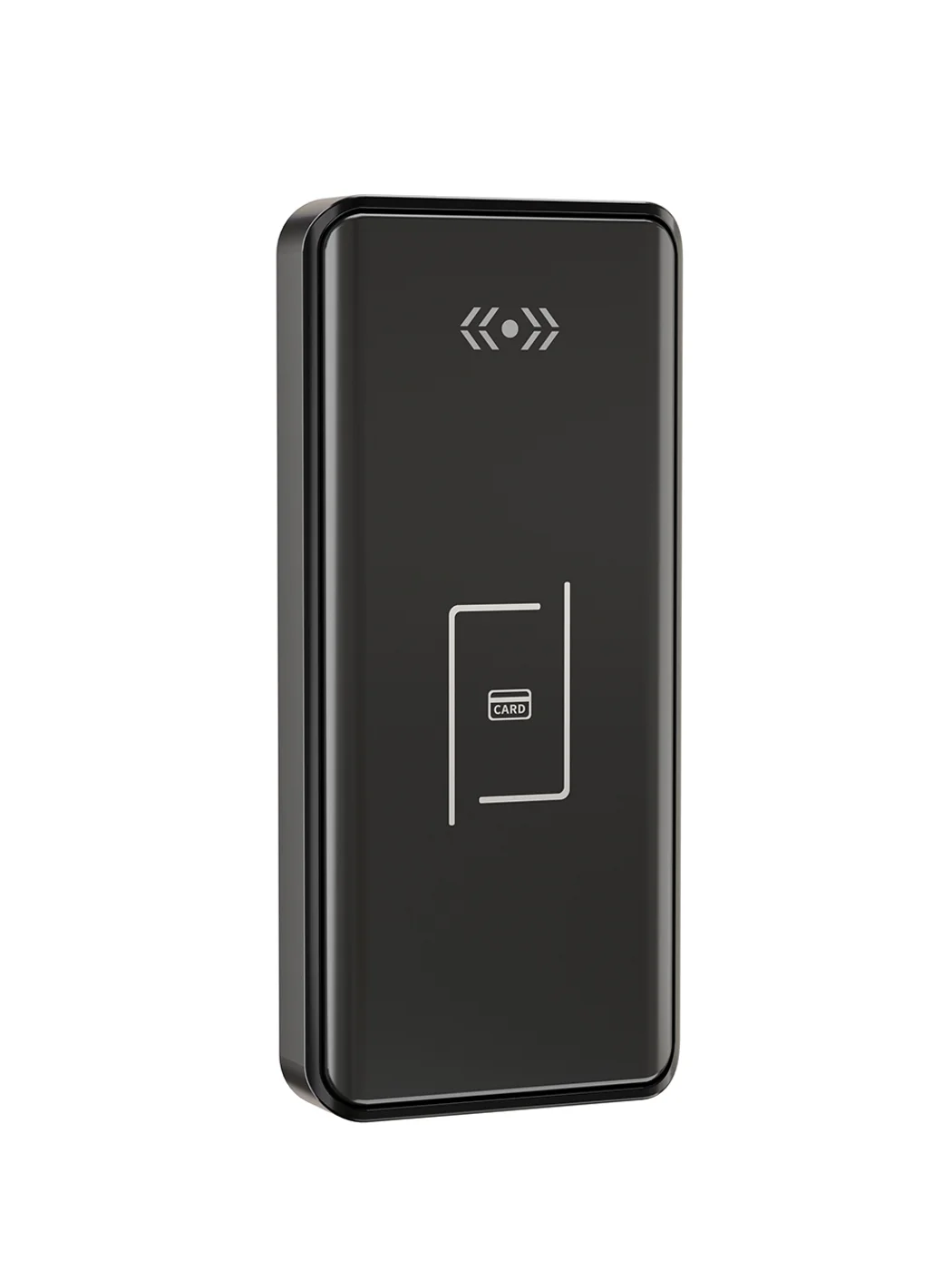
Gym Locker Lock — Offline Card, No WiFi Required
Offline card gym locker lock for fitness and pool lockers. MIFARE card, battery-powered 5-minute retrofit, no WiFi or server. Zinc alloy body, CE/FCC/RoHS.
This page already points to it as the next recommended reference.
Related blog posts
3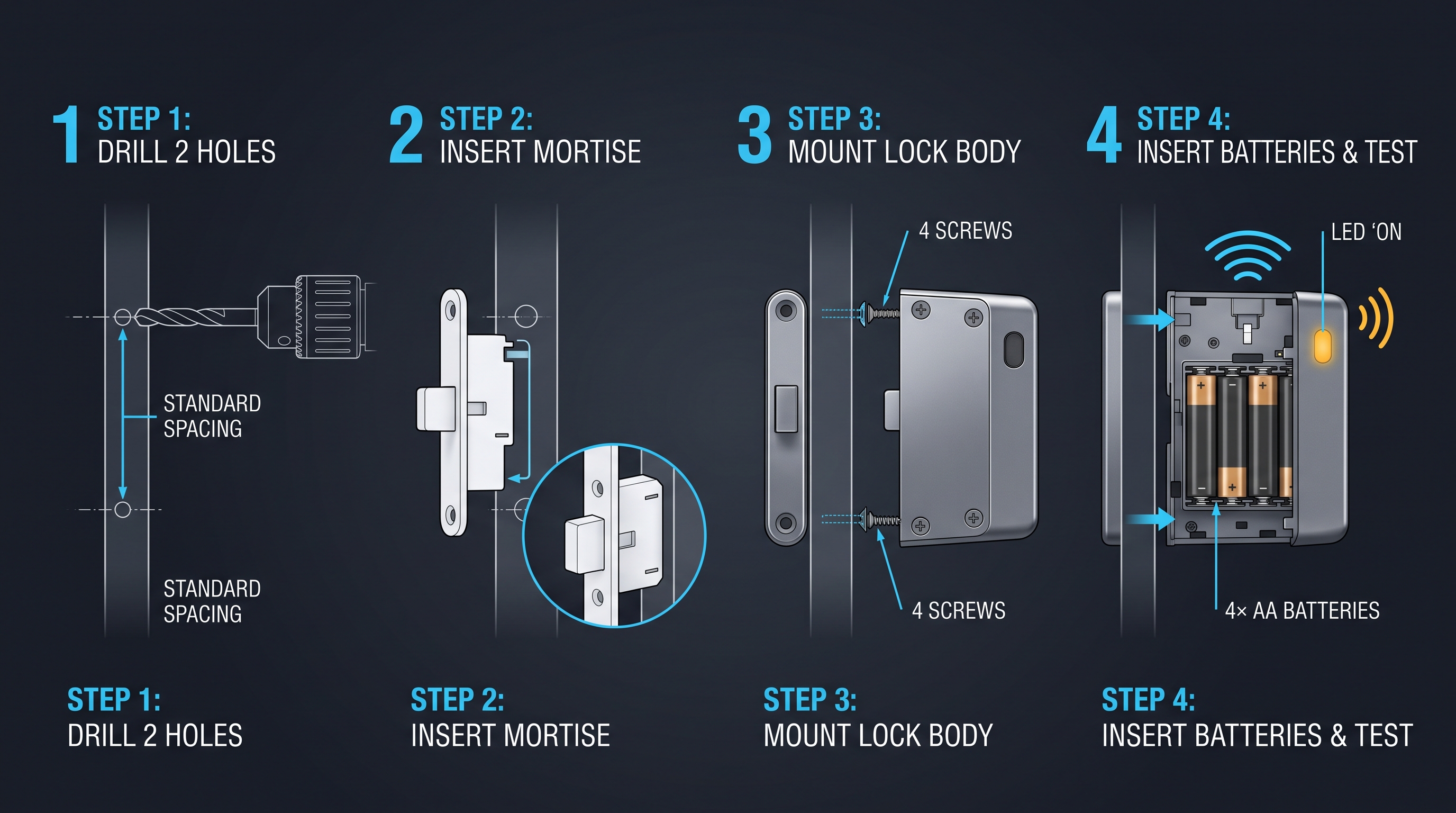
EMS Cabinet Lock: DEA-Compliant Drug Security for Paramedic Vehicles
EMS cabinet lock guide covering DEA Schedule II compliance, dual-authentication, tamper-evidence, audit trail, vehicle power, and ePCR integration for ambulance fleets.
It supports the same product context: Smart Cabinet Lock — App-Managed, Multi-Site Dashboard, Office Cabinet Lock — PIN + Card for Filing & Pedestals, Gym Locker Lock — Offline Card, No WiFi Required.
The Complete Guide to Emergency Cabinet Locks for AEDs, First Aid, Fire Extinguishers, and Trauma Kits
Learn everything about emergency cabinet locks: break-glass vs solenoid vs motorized latches, tamper alarms, remote alerts, ADA compliance, battery life, and deployment across schools, offices, gyms, transit, and aircraft.
It supports the same product context: Gym Locker Lock — Offline Card, No WiFi Required.
Employee Locker Lock Systems: The Definitive Guide for Workplace Security and Efficiency
A definitive guide to employee locker lock systems covering selection, installation, security, management software, compliance, and best practices for workplace locker security.
It supports the same product context: Smart Cabinet Lock — App-Managed, Multi-Site Dashboard, Office Cabinet Lock — PIN + Card for Filing & Pedestals, Gym Locker Lock — Offline Card, No WiFi Required.
Specify your hotel project with our engineers
Send your room count, ceiling type, and protocol preference. We will return a sample plan and quote within 24 business hours.
- Move from general guidance into a product or application discussion.
- Use RFQ when pricing, drawings, MOQ, or launch timing needs structure.
- Keep a direct contact path visible for fast clarifications and handoff.